
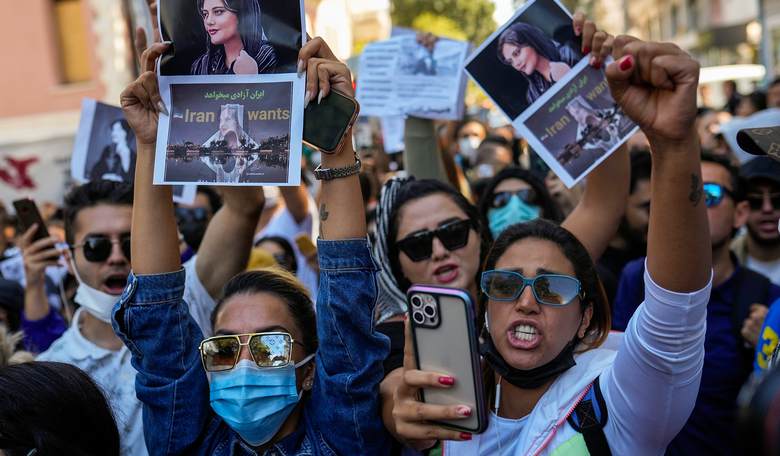
On Sept. 16, 2022, a young Kurdish woman, Mahsa Amini, was visiting Tehran with her parents. She was walking down the street when members of the hated religious police (Basij) jumped out of a car and shoved Mahsa into the passenger seat. They took her to the police station, where she was interrogated and beaten into a coma.
Mahsa Amini, 22, is in a coma after being tortured by Iranian authorities.
— Leah Remini (@LeahRemini) September 15, 2022
This would be unacceptable no matter what, but the fact that she was arrested for improper wearing of the hijab makes it even more horrifying.
Please join me in sharing her name and story.#مهسا_امینی pic.twitter.com/FEB6BYfIZO
Her crime was wearing her hijab incorrectly, at least in the Basij's view. She died a few days later. Her death set off the most serious challenge yet to the moral certitude of the Iranian authorities. Hundreds of thousands of women took off their head coverings and threw them away or burned them.
The outburst of emotion is reminiscent of the outrage that suffused the country in 2009 when a young woman, Neda Soltan, was gunned down by a sniper. The killing occurred amid protests against the regime during the “Green Revolution,” after authorities clearly stole the 2009 presidential election for Mahmoud Ahmadinejad.
Now, on the fourth anniversary of the death of Mahsa Amini, authorities are taking no chances.
After the regime slaughtered 35,000 Iranians in the streets last January, the response to any new uprising will be “far more decisive than all previous periods,” judiciary chief Gholam-Hossein Mohsen Ejei wrote on X.
“If they once again make the mistake of thinking they can create unrest and riots, they can be certain that they will face a very strong and firm response from the police, security, and intelligence forces, as well as the judiciary,” Mr. Ejei added.
The protests in 2022 gave birth to the slogan “Jin, Jiyan, Azadi,” or “women, life, freedom.”
Armed Islamic Revolutionary Guard Corps, Basij, and police units are now mobilizing across the country. Motorcycle-mounted enforcers are reportedly positioning themselves on roofs and streets, ready to suppress any sign of unrest. While would-be protesters in the big cities fear a return of the killing, far away protests are brewing.
Three members of the Islamic Revolutionary Guard Corps were killed during a seven-hour clash with protesters at the southeastern city of Saravan, the regime-controlled Tasnim news agency reported earlier this week.
Members of a Baloch minority group, the People’s Fighters Front, confronted regime enforcers who arrived at 5 am in large numbers to raid a local home. One Baloch fighter was killed in the firefight.
“There are massive IRGC trucks everywhere you go,” a reporter at the anti-regime channel Iran International, Negar Mojtahedi, tells The New York Sun. “They’re blocking roads. They’re everywhere in anticipation of more than just something, more than usual.”
Ms. Mojtahedi also told the Sun that it was unlikely people would take to the streets to protest. “People are finding other ways to protest, because they know they’ll get killed.”
“Iranians know there’s no way out of the mess that the regime created,” Mojtahedi said. “Eventually people are going to do something. It doesn’t mean it’s necessarily going to happen because of the Mahsa Amini anniversary. But at one point something’s got to give.”
As with most revolutions, the catalyst will likely be hunger and an inability for Iranians to feed their families rather than ideological motivations.
“I bought six eggs and a can of tuna for 500,000 toman,” one man says while dancing in a viral video. “I’m not upset at all. I’m actually very happy. Because if I’m not happy they’ll call me a Mossad agent.”
Inflation is near 85% year over year; there are massive gasoline shortages in a nation sitting on an ocean of oil. "Under American pressure, banks in the United Arab Emirates, Egypt, and other countries closed down regime accounts," writes the Sun's Benny Avni.
“We are not managing the Iranian threat; we are ending it,” Treasury Secretary Scott Bessent told Congress Tuesday.
Iran has been on the brink before. In 2015, Barack Obama rescued them after sanctions imposed by the Bush administration brought Tehran to its knees. Will the Democrats, once again, throw Tehran a life preserver by forcing Trump to let up on the pressure?
Related: At 9:11 PM on Friday, 9/11, a Man Ran Onto the Field at Yankee Stadium Waving a Palestinian Flag