
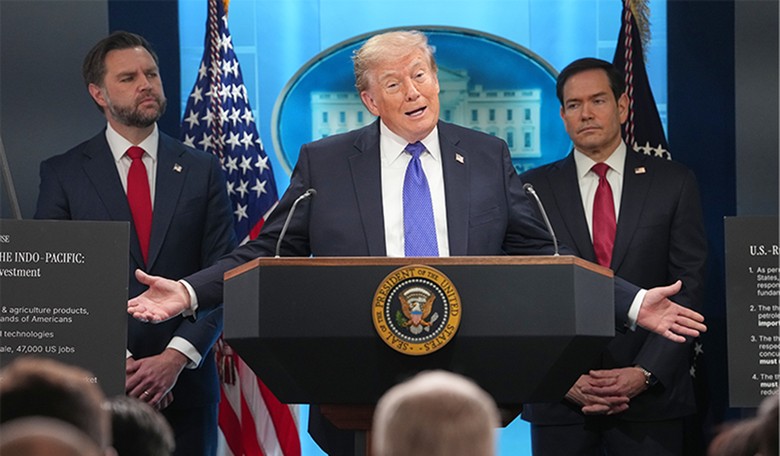
CNN commentator Scott Jennings suggested Sunday that Vice President JD Vance and Secretary of State Marco Rubio should consider leaving the Trump administration if either one plans to run for president in 2028. It's an interesting theory, and there are arguments for and against it.
Jennings offered the advice on CNN's State of the Union after host Jake Tapper asked whether disappointment over the Iran war, which kept some Republicans home or pushed them to vote for Democrats in the midterms, might stick to Rubio in a way it wouldn't stick to Vance.
Jennings spent most of his answer praising Rubio
"He's extremely coherent about the world view,” Jennings said. "And I think, if you look at the whole Cabinet, nobody, nobody has outkicked their coverage more than Marco Rubio in terms of his political stock rising with all corners of the party."
Tapper noted that separating from the administration would be a challenge for Rubio but that Jennings seemed to think he was up to it. Jennings agreed, then widened his advice.
"But I will say this. If I were in the administration and I were going to run in '28, I would probably resign," he said. "I mean, it's hard to run a presidential campaign out of it. And it's hard for a sitting vice president to become president."
Jennings added that a sitting vice president has won the presidency only four times, and it would be extremely hard for Vance to separate himself from Trump. "Like, we have been dominated by one person for a decade," he continued. "I think the American people are going to want some separation."
Scott Jennings: Rubio And Vance Should Resign If They Intend To Run In 2028https://t.co/95LpmXoehr
— RealClearPolitics (@RCPolitics) November 29, 2026
"If I were in the administration and I were going to run in '28, I would probably resign... I think the American people are going to want some separation." https://t.co/qJ2zhfqlnF
To a degree, he has a point. Hillary Clinton left the Obama administration after one term, with the obvious intent to plot a presidential run. While that didn't stop her from being linked to some disastrous policy decisions, like the Libya debacle and Benghazi, putting some distance between yourself and a sitting administration is generally considered helpful. A candidate who resigns gets to talk about his own vision without having to defend every move the White House makes in real time, and he no longer has to clear his public statements with the president's team.
The trouble with Jennings's theory is that the 2028 election will decide who carries the MAGA torch. Resigning could easily look like jumping ship, and Democrats for sure would happily frame it that way, too.
ICYMI: Democrats Have a New Strategy to Steal Our Elections. Here It Is.
For what it’s worth, Rubio is better positioned to make such a move, and the math on the vice presidency explains why. Vice presidents don't resign to run for president, so Vance, if he runs, will have to run as sitting vice president. Rubio, meanwhile, has a record that stands on its own, built during his years in the Senate and his tenure as one of the most effective secretaries of state in modern history. Vance's record in the administration is mixed, and he brings less of a résumé from his short time as a senator from Ohio, so there’s little opportunity to distance himself from the administration even if he wanted to.
There's also a case to be made that any Republican will be tied to Trump in 2028, whether or not that person ever served in his administration. Consider the late Sen. John McCain (R-Ariz.), who was constantly linked to President George W. Bush during that campaign. If Gov. Ron DeSantis (R-Fla.) runs, he’ll be treated as no less MAGA than Vance or Rubio.
Staying on or resigning carries its own risks, and neither Vance nor Rubio has much time to figure out which set of risks he prefers. One thing is clear, though: Republicans need to start thinking about what the party looks like without Trump on the ticket.