
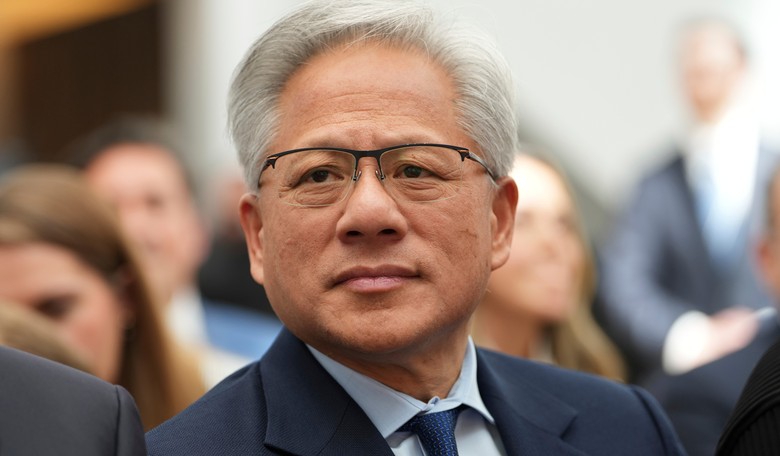
Nvidia CEO Jensen Huang is out. The leader of one of the largest tech companies in America stepped down last week after he was accused of having an affair with a Chinese spy.
Sound familiar?
Back in 2020, Rep. Eric Swalwell (D-Calif.) was exposed (no pun intended) by the FBI for sleeping with an alleged Chinese agent known as Fang Fang. Swalwell, arguably the most annoying member of Congress until he resigned earlier this year, represented the San Francisco Bay Area where big tech is concentrated.
We’ve known for years that China is aggressively targeting American tech, using any means necessary to compromise Silicon Valley and steal its IP. The Nvidia and Swalwell honey traps are further proof that China will do whatever it takes to achieve this goal.
There’s an old saying: America innovates, China duplicates. That’s on full display here.
Yet part of the problem is that American tech is bringing this on itself. It’s not just Huang’s indiscretions; other companies have gone too far in courting Chinese business and exposing themselves to Chinese influence.
The worst offender is Qualcomm, the longtime Silicon Valley stalwart and chipmaker. Qualcomm is ostensibly American, but it’s long looked to Beijing for much of its sales strategy. About half of its revenue comes from China.
Qualcomm’s list of contracts with Chinese companies is long, including partnerships on smartphones, consumer electronics, and artificial intelligence. This poses a problem given that the Trump administration views the United States as locked in an AI race against China.
Incredibly, Qualcomm even has strategic agreements in place with Huawei, the Chinese conglomerate widely regarded as a threat to America’s national security and even its nuclear arsenal. Huawei is currently on trial in New York on racketeering and IP theft charges, yet a major American tech company continues to work with it on 5G and AI.
Qualcomm has even boasted about building an AI chip specifically designed to work around American export controls. Those restrictions were put in place by the Trump administration so Chinese AI, often used as a tool of repression and to hack U.S. targets, can’t benefit from American components. Qualcomm seems determined to violate the spirit, if not the letter, of them.
Other tech companies are integrated into the Chinese economy too. Apple’s manufacturing contractors famously make iPhones in China. Microsoft provides the Chinese with cloud computing services through a local partner company.
Increasingly, what once looked like a new market is becoming a security risk. When Donald Trump came to power, he sounded the alarm about China luring away American manufacturing. Now, China is benefiting from American tech innovation and commerce while leveraging it to ruthlessly undermine the United States.
Economic entanglements with China can and do have national security implications. In 2016, the SEC settled with Qualcomm for $7.5 million because it had showered Chinese Communist Party officials with gifts and jobs for relatives in exchange for lucrative contracts. It was hard to imagine how a company could compromise itself more to the Chinese — at least until Huang came along.
All this raises a question: why China? U.S. companies can sell to wealthy consumer bases in Japan, the UK, and across Europe. America’s allies have their own cutting-edge tech companies that can partner with U.S. counterparts without any risk of espionage.
No American tech CEO has ever woken up in the bed of a British spy. The UK alone has an enormous tech presence, including powerhouses like Arm Holdings and the Sage Group.
The problem isn’t just Nvidia. Silicon Valley on the whole is too exposed to China. That’s how you end up with Jensen Huang pulling a Swalwell. And you don’t ever pull a Swalwell.