





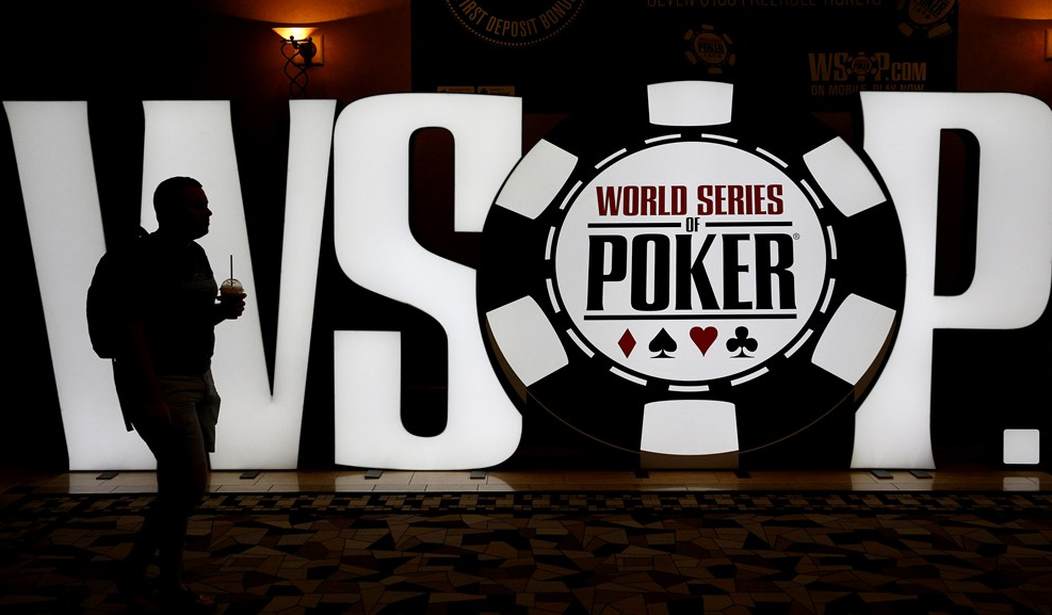
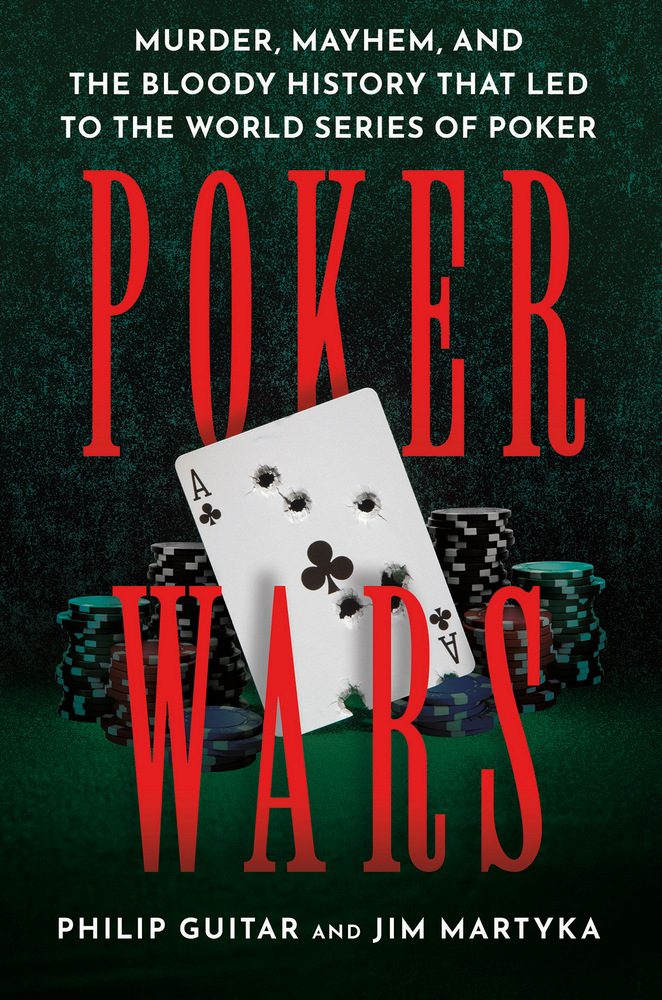
In their new book Poker Wars: Murder, Mayhem, and the Bloody History That Led to the World Series of Poker, Philip Guitar and Jim Martyka write:
$438 Million.
That’s how much the World Series of Poker paid out in prize money in 2024. And that’s nothing compared to what it brought in.
The World Series of Poker ranks alongside Coca-Cola, McDonald’s, and Apple as one of the most iconic and lucrative brands in the world. Comparatively, it’s also the most thrilling.
Even the casual observer who doesn’t play poker is mesmerized by the theatrics of the televised face-offs, the antics of the sometimes charismatic, sometimes polarizing players, their unique sponsor-adorned wardrobes with dark sunglasses hiding any tells, and the gargantuan multicolored chip stacks that change hands with deadly quickness. All backdropped by stacks of cash that could feed a third-world country.
The World Series of Poker (WSOP) holds the renowned distinction as one of the only sports where literally anyone off the street can become a legend overnight. A tournament with a complex past, a series of events involving intense eclectic characters interwoven with bombastic criminals that needed to fall in place, in the exact order, for it to grow into what it is today. Unlike other major sports, there isn’t one person or one moment to point back to or to celebrate as the birthplace of this one. Reflective of the game itself, the backstory of poker and the meteoric rise in popularity of its signature tournament is rich in true-crime history.
But there is a timeline, a thrilling and chaotic sequence of events involving these major players who all came together at the right time and place (mainly Dallas) and loved, fought, killed, and mostly gambled as they all looked to make their name and their money … their destiny. Without these men and women, the events they triggered, and the shitstorms that followed, there would be no WSOP.
Gambling, and even card playing, has a long history, dating back well before it found its way to Big D, the heart of North Texas. A little context would do us well as we venture forth into that storm, showing how the groundwork was laid long ago, waiting for these heavy hitters to make their bets …
And that's the subject of my recent interview with Guitar. (Full disclosure: The audio was transcribed by Plaud, and the transcript was lightly polished by ChatGPT to enhance readability.)
MR. DRISCOLL: Hi, this is Ed Driscoll for PJMedia.com, and we're coming to you from the swank Fort Worth Club, where we're speaking with Philip Guitar, the co-author, along with Jim Martyka, of the new book Poker Wars: Murder, Mayhem, and the Bloody History That Led to the World Series of Poker. It's published by Crooked Lane Books and available in both hardcover and softcover, and for the Kindle. Philip, thanks for stopping by.
MR. GUITAR: Ed, thanks for having me.
MR. DRISCOLL: Today, high-stakes poker tournaments are frequently seen on cable TV. But Phil, as your book explores, professional poker tournaments had quite a rough-and-tumble beginning. How did you research the history of the rather colorful characters who inhabit your book?
MR. GUITAR: Well, that's a great question. I took an in-depth dive. I had always been fascinated by these characters, so I took them one at a time, and one kind of built on another. I'd start researching a character, going through books and interviews, and even talking to former poker players I knew. That person would lead me to another individual, and then I would start researching that person. It went like a stairstep from one to another.
MR. DRISCOLL: As someone who doesn't play poker, I'm glad you included a quick history of the game and its basic rules, and kept the focus on the men who dominated the game, first in Texas and then later in Las Vegas. But we should probably explain the very basics of Texas Hold'em poker early on, and what made it such a popular variation of the game.
MR. GUITAR: Sure. Well, Texas Hold'em is basically played with two hole cards. You're sitting at a table with maybe six or eight other players, and the dealer deals every player two cards face down. Then there's a round of betting, and the dealer deals three cards face up in the middle. That's called the flop. Then there's a round of betting, and you have a fourth card that's called the river. It's laid out there, followed by a round of betting, and then there's the fifth card, called the river, and another round of betting. You play your two cards with three cards out in the middle, and you try to make the best five-card poker hand. That's the essence of it. But your question is what made this particular game so exciting. It was the quick pace compared to other games, like draw games and stud games.
This Hold'em game was fast. It had a lot of action, so it was really easy for people to catch on and play in a hurry.
MR. DRISCOLL: Once Texas Hold'em poker became so popular, cable TV seemed to pick up on how television-friendly the game is.
MR. GUITAR: Right, exactly. I think what really kicked it off for TV was when ESPN started showing the hole cards. Before that, you couldn't see the hole cards. You could follow along, but not nearly like you could when you knew the players' hole cards before the action started.
MR. DRISCOLL: Right. But it seems to me Poker Wars is as much a story about Texas crime history as it is about poker itself.
MR. GUITAR: Absolutely. We're not trying to give anybody tips on how to play Texas Hold'em or strategies for it. That's not what this book's about. It's a true crime story. It involves Texas, it involves Las Vegas, and it involves poker as a whole. But you're right, Ed. It's a true crime story originating in Texas.
MR. DRISCOLL: What role did your co-author, Jim Martyka, play in the writing? How did you divvy up the work?
MR. GUITAR: Well, I got introduced to Jim through a screenwriting friend of mine here in Fort Worth. I write screenplays. I'm a scriptwriter, and I had been approached by The Fort Worth Business Press about writing these articles. They knew that I had them, and they thought, “Hey, this would be great for our magazine.” They asked me if I would do it, and I said, “Yeah, I'd be happy to.”
My screenwriter friend connected me with Jim, who's an editor for books and magazines. He does a lot of different editing work. Through that connection, I started working with Jim. I said, “Hey, Jim, I've got these magazine articles. Will you come in as an editor and work with me on them?” He plays poker himself, on a smaller scale, and he said, “Yeah, I love it.” That's how we originally got started, with those magazine articles.
MR. DRISCOLL: Let's talk about one of the most colorful characters in the book. Benny Binion made the remarkable transition from the Dallas underworld to becoming a respected Las Vegas casino owner. How did he manage to reinvent himself so successfully?
MR. GUITAR: Well, Benny has a remarkable, wild history, and he was able to reinvent himself. I would say one of the biggest things about him was that Benny was a promoter at heart. He got his start in the gambling business promoting poker. He started out as a horse trader, promoting it out on the dusty trails when they were trading horses and stuff. That's where he got his start. To become that casino operator, he reinvented himself by going to prison. When he came out of prison, he had learned what he had to do in order to gain that license.
MR. DRISCOLL: Another gambler in the book has a name that sounds almost like it could be a comic book character: Titanic Thompson. What is Titanic's story?
MR. GUITAR: Oh, Titanic! Titanic was an early mentor to a lot of these guys, including Benny. Titanic is larger than life. He's a swashbuckling character. There are so many outstanding stories about Titanic Thompson, and he was a big proposition man. He made a lot of proposition bets. I'll give you an example: Titanic would bet you that he could take a lemon and throw it over a five-story building.
He would say, “Hey, let's just walk over here to this fruit cart.” Now, we're talking about the early 1900s. “Let's walk over to that fruit cart and pick out a lemon. I'll bet you I can throw that lemon over a five-story building.” You'd be like, “Oh, sure. There's no way that man can do that.” So you'd bet him, and he'd pick up the lemon from the fruit cart owner, rear back, and throw it. That lemon would go sailing over the five-story building. You'd walk away shaking your head, like, “How in the world does this man do it?” But what you didn't know was that Titanic had met with that shop owner the day before and planted that lemon. He had put lead weights inside that particular lemon, so he had that prop bet all lined up. There are hundreds of stories like that. But the thing was that Titanic was a really good card player, and a lot of these guys who grew up in poverty just idolized him.
They wanted to get out of poverty, so they looked up to him. He was like a poker god, a mentor to a lot of these guys.
MR. DRISCOLL: Well, speaking of which, was there a moment during your research when you came up with a detail of a person's history and thought, “There's no way this can possibly be true,” and then discovered it actually was?
MR. GUITAR: Yeah, there were a lot of these guys. I would say a lot of it has to do with Titanic, because of all these adventures he went through in his life. He was involved in what the book talks about as "the murder of the century." I won't really go into it here; it's in the book. But you could also look at a guy like Herbert “the Cat” Noble: the number of times they tried to kill him, and the number of times he was in the hospital from all these gunshot wounds. I thought it was impossible that he had survived and lived as long as he did.
MR. DRISCOLL: Several well-known gangsters make appearances in Poker Wars. What role did organized crime play in transforming poker from a sort of underground game into something much more mainstream?
MR. GUITAR: Well, for example, Dallas was kind of a freestanding area, but the lieutenants of the Carlos Marcello family in New Orleans pretty much controlled parts of it. That was the organized crime influence when you speak of Cosa Nostra. As things moved on, the Mafia saw what an influence this game could have, and they did want to get involved in it.
These mobsters had hidden interests in the casinos in Las Vegas. I'm talking about the Chicago Outfit and, at the time, the Genovese family, the Gambino family, and some people like that. One of the biggest things they wanted to do was stop this gang war that was going on in Texas. They sent a representative down here to do some talking about it because they thought this was bad for business in Nevada. Those were some of the roles they had in this whole story.
MR. DRISCOLL: You wrote about the changing attitude of Texas law enforcement when it comes to the game. You wrote, “By the 1940s, the Dallas Sheriff's Department was severely cash-strapped. There was a short supply of able deputies with the war raging in Europe. Plus, the laissez-faire fascist attitude that the city took to policing didn't help matters.” That phrase really jumped out at me. I think I know what you mean here, but since “libertarian Nazis” seems like a rather sharp contradiction in terms, could you explain what it means in this context?
MR. GUITAR: Yeah, sure. They were cash-strapped, like a lot of cities and bureaucratic organizations during that time in history. So they figured, “Look, we're going to let this gambling run free in this town. But about once a month or so, we're going to come in and do some raids. You're going to pay for this, depending on how many people we have, and then your people are going to get free.” Everybody was in on it: the gambling operators, the police. It was a way to inject some cash into the police, the city council, and Dallas in general. It was a way to let it go while making it look like they were policing it. But at the same time, they were able to get that much-needed cash infusion.
MR. DRISCOLL: I think you wrote that the Texas police eventually went from looking the other way at card houses to starting to seriously crack down on gambling after World War II.
MR. GUITAR: They sure did. It actually started around 1936, when they had what they called the Texas Centennial Celebration. During that celebration, they said, “We're going to have so many people coming to Texas for this party, this celebration. We're going to let gambling kind of run wild.” Like you said, they let it go. But then they didn't just stop. They said, “Hey, this is so great for the economy, we're going to let it go,” and that continued into the '40s.
But after World War II, there was so much carnage taking place, with this savagery between these gambling operators, that they decided, “Hey, we've got to crack down. It's for the public well-being.” You're right. After World War II, that's when they started cracking down.
MR. DRISCOLL: There's the famous quote from The Man Who Shot Liberty Valance: “This is the west, sir. When the legend becomes the fact, print the legend.” How do you separate fact from legend when you're writing about people who have been mythologized for decades?
MR. GUITAR: I think you take all this and consider it the best you can. There is a lot of mythology, but there are a lot of facts, too. I think Texas is kind of a mythological place in itself, especially its history. There's a delicate balance there, and I think you have to try to find your way in the middle.
MR. DRISCOLL: Speaking of that, at least in the Kindle edition, when you get to the copyright page at the end, it says, “This is a work of fiction. All the names, characters, organizations, places, and events portrayed in this novel are either products of the author's imagination or used fictitiously. Any resemblance to real or actual events, locales, or persons, living or dead, is entirely coincidental.” I sort of felt like I was watching a documentary, and then you get to the standard boilerplate that Hollywood puts on [the closing credits of] fictional movies. How did that happen?
MR. GUITAR: Yeah, that was something that was just placed on there. But we didn't just dream this story up. There are a lot of facts in there. We connected the dots. You just hit it: it's a standard boilerplate that has to be put in there.
MR. DRISCOLL: Yeah, a lot of these characters have Wikipedia pages. These are real guys.
MR. GUITAR: Right. These are real guys. These are real stories. These are real events. We didn't just dream these things up. But with laws nowadays, publishers have to do this to protect themselves. You nailed it on the head. It is like you're watching a Hollywood documentary based on actual stories and true events.
MR. DRISCOLL: Was there a particular tipping point when poker stopped being regarded primarily as a backroom gambling game and became legitimate entertainment, and eventually something you could watch on ESPN?
MR. GUITAR: It did, and that's where it grew from this small group of renegade operators and gamblers to the mainstream. That is all chronicled. I would say it was around the mid-'70s when it became that way. It pretty much stayed that way, but I think probably the biggest turning point was what we talked about with the hole cards, when ESPN started to show them.
And there was the fact that any man or woman could go down there, enter the World Series of Poker, and play. This is aboveground. We're not shielding this as something underground. I think that's what made it take off.
MR. DRISCOLL: I think you described Doyle Brunson as a sort of transitional figure, from poker being the stuff of backroom betting to creating an almost scientific method of playing it. How did he shape the game?
MR. GUITAR: Oh, Doyle Brunson is known as the godfather of poker. He had more to do with poker, the way it's played, and the way people idolized the strategy of the game than anybody. In fact, Doyle wrote a couple of books called Super/System that he actually wished he hadn't written, because he tells people exactly his philosophy on how to play poker.
When he was riding around with his group of guys, making the Texas circuit, they got to a point where, on these long road trips together, they would go over and write down a lot of statistics. They'd say, “I saw this many hands, and this came up on this many hands.” They started trying to calculate statistics before anybody really got into that.
Doyle was great at reading personalities and reading people across the table from him. But he was also one of the first people to really calculate the statistics and what they call EV, expected value, your positive potential. Like, “If I'm sitting in this position, how many times might this card come up, or that card? What are the stats that this might happen? What are some really good starting hands?” This was all math. This was all from Doyle, and he was one of the first people to come up with this theory.
MR. DRISCOLL: You've been a professional poker player yourself. How did that experience affect the way you approached this history? Did it give you any insights an outside historian might not have had?
MR. GUITAR: Yeah, it did. I understand what it takes to make a living. Being around card players, I understand how they think, and how a man or woman trying to make a living at poker compares with someone playing it recreationally. It made me understand the grind. It's a grinding, day-in, day-out process. It's not one of these deals where you're like, “Hey, I'm going to sit down here and make a million dollars in five hours, or something.”
No, I'm going to sit at this table for eight hours, and maybe I'll come away with a win today, and maybe I won't. It's kind of like being a plumber or an electrician: you have to put the time in. Or being a writer or publisher. It doesn't just happen. You've got to sit at the table and put these hours in. I think learning this mindset, whether you're grinding it out just making a living or playing for the highest stakes possible, it gives you a good foundation for understanding what everybody else is thinking.
MR. DRISCOLL: Conversely, did your own experience in poker create any assumptions or blind spots you had to guard against while researching the book?
MR. GUITAR: Well, I wanted to portray people and events as accurately as possible. I didn't want to put anything or get anything out of bounds that wasn't right. But I can't really think of a particular blind spot. I could understand what these men were going through, and women, too, as they were traveling around, trying to survive and make a living out of this game. I'm not saying I went through those same hardships, but I could put myself in their mindset.
MR. DRISCOLL: Of all the characters you encountered while researching Poker Wars, who surprised you the most?
MR. GUITAR: I think Johnny Moss was a guy who really surprised me. He was a West Texas guy. He was another mentor to Doyle Brunson. They weren't close personal buddies hanging out, but I think Doyle respected the way he played and his mastery of the game. It surprised me to learn that Johnny, like a lot of these characters, went through a lot of hardship when he first came over here. Just his journey and voyage, and everything he had to go through growing up.
He started off here in Fort Worth and eventually moved out to the Odessa and Midland area. I knew about him later on, when he was an older man, but I didn't know his story as a child. That really amazed me.
MR. DRISCOLL: How many of these guys did you interview personally?
MR. GUITAR: Well, I didn't interview a lot. A lot of these guys are not with us anymore. But I was able to connect with some of the younger generation, some of the guys who were connected with Doyle earlier on, and some who were connected with Johnny. I'd say there were about five or six I was able to connect with.
MR. DRISCOLL: Can you talk about how the World Series of Poker came to be in the late '60s and early '70s?
MR. GUITAR: Sure, I'll tell you a little bit. They were having a game out in Reno called the Texas Gamblers' Reunion. It was organized by a San Antonio gambler and poker player who had gone out there and bought a casino. He just wanted to get his friends together from Texas and play poker. At the same time, you had a group of Texas poker players at the Dunes introducing Texas Hold'em to some Las Vegas poker professionals.
They were saying, “Here's this new game, Texas Hold'em,” and it was really starting to catch on. So you had this combination: a group in Reno having this big reunion, and another group of Texas gamblers introducing the game to the Las Vegas pros and starting to spread it around. It just escalated. Benny ended up going over to this Texas Gamblers' Reunion in Reno, and it kind of morphed from that incarnation.
MR. DRISCOLL: Looking at poker today, how much of the culture you wrote about in Poker Wars still survives?
MR. GUITAR: Well, there are people out here every day playing professional poker, and there's everyday recreational poker. People aren't having to hide their money as much anymore. They don't have the same fear of being hijacked or robbed. Does that kind of stuff happen? Yeah, it does. Guys who win a big tournament occasionally get robbed. But for the most part, poker's safe. You can go play poker now. There are a lot of rooms here in Texas that are what they call aboveground games.
You can go play poker in Nevada, and it's a safe environment. The biggest thing now is the number of people playing, both recreationally and professionally. People love this game around the world. It doesn't matter where we're talking about, or whether they're playing at the kitchen table. It continues to grow in popularity every day.
MR. DRISCOLL: If Poker Wars were turned into a movie or TV series, which characters would you build the story around, and who would you cast to play them?
MR. GUITAR: Oh my gosh, that's such a great question. I'd have to say one of our main protagonists would have to be Benny Binion, for sure. I just got through working with Dennis Quaid on a project, so I would love for him to be involved. Maybe he would play a younger Benny coming up, or an older one. I'd love to be involved with Dennis Quaid. I could see Tommy Lee Jones playing an older character, maybe Johnny Moss or Titanic Thompson, someone of that nature. There are so many great people I'm leaving out, but those are two of the guys who come to mind.
MR. DRISCOLL: You mentioned Dennis Quaid and the documentary you did with him. It's called Water Wars, and it's available on Amazon Video. What does the title refer to?
MR. GUITAR: The title refers to a water war, a dispute out in West Texas between a group of farmers and ranchers and a group of hidden interests, some shadowy billionaires who came in from out of state. They were trying to rewrite some rules out there, and people were losing their water rights.
It refers to a water war that originated in West Texas but had implications statewide, and then actually affected water legislation in a lot of other states, on a national level.
MR. DRISCOLL: How did Dennis Quaid come on board? What was he like to work with?
MR. GUITAR: Oh, he was so amazing to work with, and I'm just so grateful we had the opportunity to get him to come on board. I was working with some producers who had worked with him on another project and knew his management team. They loved the film and the project, so we pitched it through them. It's a group called a Group of Ferrets, and a guy named Michael Dwyer. Michael and the others said, “We think Dennis would love this.”
I said, “Well, I would love that. I think he would be a great, authentic voice for this.” We pitched it to him, and he loved it. He wanted to join right off the bat, so it wasn't a hard sell at all. He was the perfect man, the Texas voice for a Texas story that had nationwide implications.
MR. DRISCOLL: How complete was the documentary when he first saw it?
MR. GUITAR: I'd say we had it about 90 percent complete. We went back and reshot a couple of scenes. We were doing some staged scenes with actors and background actors, but pretty much all of our primary interviews, our talking-head interviews, were done, and we had shot all of our B-roll. So we had it 90 percent complete.
MR. DRISCOLL: Having worked in both print and film, how do the two media compare, and which is your favorite to work with?
MR. GUITAR: I love seeing something come to life on screen. I love them both for different reasons. With print, I love having that freedom to throw the horse's reins and let him run wild, to let my creative muse run, whether it's nonfiction or fiction, and really dive in and do research. Film is more of a condensed form. If I had to choose one, I'd say I love print. But, like I said, there's nothing like seeing something you've worked on come to life on screen. It really touches the heart.
MR. DRISCOLL: We've been talking with Philip Guitar, the co-author of Poker Wars and the co-producer of Water Wars, now available on Amazon Video. Phil, thanks for stopping by today.
MR. GUITAR: Hey, thanks for having me, Ed. I sure appreciate it. Thank you.

Join the Conversation
VIP members get the ability to comment on articles.