





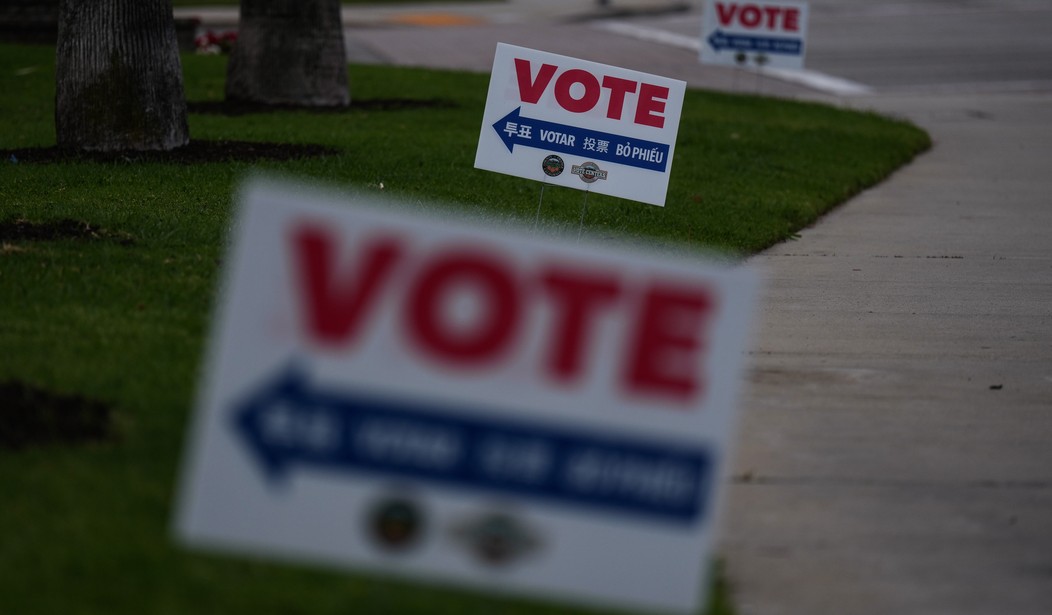
"To ID, or not to ID—that is the question."
William Shakespeare never penned those exact words. Hamlet's immortal soliloquy wrestled with existence itself, whether to endure “the slings and arrows of outrageous fortune” or to oppose them. Four centuries later, America has produced its own existential drama, though one decidedly less poetic. Our national dilemma is no longer whether to be, but whether to present an ID.
In modern political culture, the answer appears astonishingly simple, until one asks what the identification is for.
If you wish to board an airplane, present identification.
If you wish to enter many government buildings, present identification.
If you wish to purchase certain medications, cash a check, obtain a driver's license, or access countless public services, present identification.
Increasingly, if you wish to receive taxpayer-subsidized benefits, identification is viewed as nothing more than common sense.
Yet if one suggests that citizens verify their identity before casting a ballot, many of the very same political leaders suddenly discover that identification has become a constitutional crisis.
Consistency, it seems, has become the rarest commodity in American politics.
New York City's Mayor Zohran Mamdani has championed a ludicrous plan to establish city-owned grocery stores, arguing that government can provide affordable food more effectively than the private market.
I pause here to decide whether to erase the last paragraph, because a rational person would not believe me. So let’s turn to a reliable source.
The Guardian reports that participants would be required to verify eligibility through identification to ensure the subsidized program serves its intended beneficiaries. The rationale is straightforward: public resources should not be abused, and accountability matters.
On that point, few reasonable people would object.
Government has both the authority and the responsibility to ensure that taxpayer-funded programs are administered honestly. Fraud undermines public confidence. Verification protects scarce resources. So identification becomes a practical instrument of stewardship.
Quite right.
But then comes the Shakespearean twist.
Many of the same political leaders, including our Mayor Mamdani and numerous progressive governors, members of Congress, senators, and mayors across the country, have opposed voter identification requirements or criticized legislation such as the Save America Act, arguing that such measures risk disenfranchising eligible voters or create unnecessary barriers to participation.
It raises an unavoidable philosophical question: If identification protects the integrity of government programs, why is identification portrayed so differently when protecting elections?
Hamlet himself might have found this difficult to follow.
Imagine him standing atop the battlements of Elsinore, peering into twenty-first-century America:
"To ID, or not to ID? That depends entirely upon which government office one happens to be entering today."
The absurdity practically stages itself.
The issue is not whether reasonable people may disagree over voter identification laws. Intelligent arguments exist on both sides. One side emphasizes election integrity; the other emphasizes voter access. Democracies have long debated how best to balance these legitimate concerns.
The deeper issue is philosophical consistency… and the obvious issue is that Democrats are treating voters like oversensitive 12-year-olds scared to identify themselves.
If identification is an ordinary safeguard against misuse of taxpayer resources, why should elections be uniquely exempt from similar concerns?
If identity verification demonstrates responsible administration in one setting, why does it become an intolerable burden in another? If fraud prevention is prudent at the grocery counter, why is it portrayed as suspect at the ballot box?
These are not merely political questions.
They are cultural questions.
Western culture increasingly evaluates principles not by their intrinsic merit, but by their immediate political usefulness. We have drifted from asking, “Is this principle true?” to asking, “Does this principle advance my preferred outcome?” It’s nothing short of truth in the age of applause.
Once that transformation occurs, consistency becomes optional.
George Orwell warned that political language could make lies sound truthful and murder respectable. Today it often performs a subtler task: making contradictions appear perfectly reasonable.
Identity becomes both oppressive and essential.
Borders become both obsolete and indispensable.
Government becomes both hopelessly incompetent and uniquely qualified to manage ever-larger portions of economic life.
Language bends.
Logic follows.
Public trust evaporates.
History repeatedly reminds us that republics do not collapse merely because citizens disagree. They weaken when shared standards disappear altogether. Aristotle argued that justice required treating like cases alike. Cicero insisted that the law should reflect reason rather than passion. Even the English common-law tradition rests upon the assumption that principles must apply consistently if they are to command respect.
Selective application is not justice.
It is preference dressed in judicial robes.
This is why the current debate reaches beyond voter ID or grocery stores. It exposes something deeper within our civic imagination.
Americans once admired coherence.
Today we reward contradiction provided it serves our tribe.
The result is a political culture where identical policies are alternately celebrated or condemned depending entirely upon who proposes them.
The same citizens who distrust government to count calories suddenly trust it to operate supermarkets.
The same politicians who insist identification is necessary to protect subsidized groceries may oppose identification in elections because they believe the contexts differ in important ways. Those distinctions deserve discussion. Yet they also invite scrutiny. A healthy republic requires more than good intentions; it requires coherent reasoning that citizens across the political spectrum can understand, evaluate, and challenge.
Shakespeare understood that appearances eventually yield to reality. Masks fall. Contradictions accumulate. Sooner or later, every audience notices when the script no longer makes sense.
Perhaps that is the lesson for our own age.
The real question is no longer whether identification is good or bad but whether principles still matter more than politics.
If they do, then we owe one another arguments that are consistent even when inconvenient.
If they do not, then we have exchanged philosophy for partisanship and statesmanship for theatre.
Hamlet sought truth amid deception.
Our generation should aspire to no less.
The moment a principle changes with the politics, it ceases to be a principle; it becomes a prop. And a republic built on props eventually watches the curtain fall.
Editor’s Note: Help us continue to report the truth about corrupt politicians.
Join PJ Media VIP and use promo code FIGHT to receive 60% off your membership.


Join the Conversation
VIP members get the ability to comment on articles.