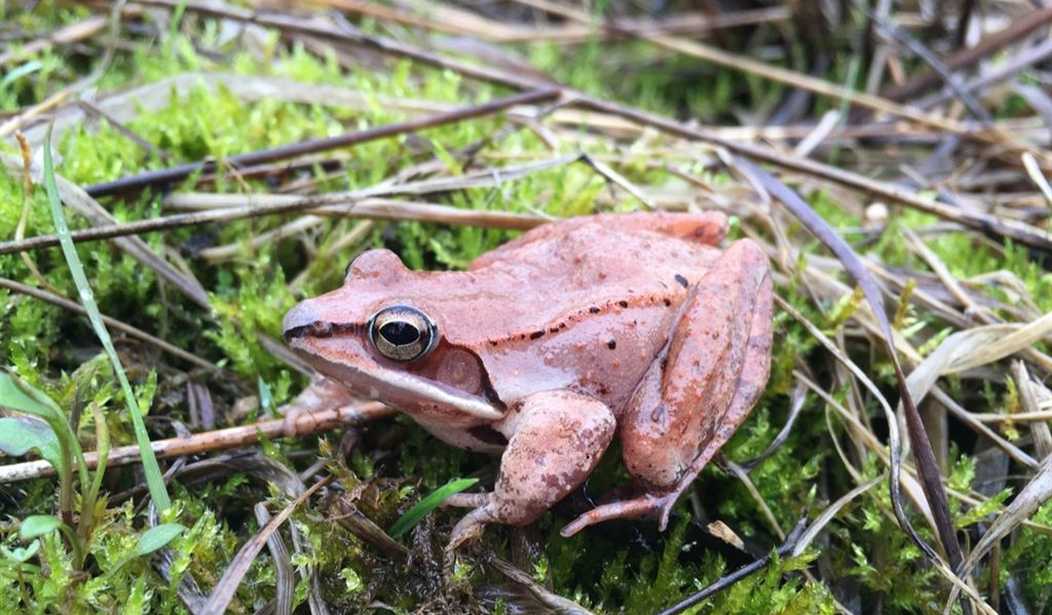

Somewhere beneath the fallen leaves of a Wisconsin forest, a little creature prepares to do something that would send a human straight to the morgue. Its heart will stop, its breathing will cease, and much of its body will freeze, and it will remain motionless through winter’s bitterest days.
Then, when spring arrives, it’ll wake up and hop away.
Meet the wood frog, a remarkable little amphibian that apparently missed the memo explaining that freezing to death is supposed to be permanent.
The wood frog, Lithobates sylvaticus, doesn’t look especially impressive. It’s generally brown, measures about two inches long, and sports a dark mask across its eyes. You could walk past one in a Wisconsin woodland without giving it a second thought.
But beneath that ordinary appearance is one of nature’s most extraordinary survival systems.
Most frogs escape winter by retreating beneath water or into protected underground shelters. Wood frogs often spend winter just beneath leaves and other forest debris, exposed to freezing temperatures. Instead of avoiding ice altogether, they’ve developed a way to survive it.
As temperatures drop, ice begins to form outside their cells. The frog’s liver releases enormous amounts of glucose into its bloodstream, helping protect delicate tissues from freezing damage. Urea also contributes to this remarkable process.
Its heart stops beating, breathing ceases, its muscles stiffen, and its eyes may appear cloudy.
For all practical purposes, the frog looks dead.
From the National Park Service:
Yet wood frogs have evolved ways to freeze solid for up to eight months each year. They’ve accomplished what would seem to be a biological miracle. How do they pull this off?
At the beginning of winter, ice quickly fills the wood frog’s abdominal cavity and encases the internal organs. Ice crystals form between layers of skin and muscle. The eyes turn white because the lens freezes.
At the same time, the wood frog’s liver produces large amounts of glucose that flushes into every cell in its body. This syrupy sugar solution prevents the cells from freezing and binds the water molecules inside the cells to prevent dehydration.
So on the one hand, the wood frog’s body allows ice to form around the outsides of cells and organs; and on the other hand, it prevents ice from forming inside the cells--thus avoiding the lethal damage suffered by most animals when they freeze.
Scientists have discovered something particularly fascinating about wood frogs living in Alaska. These northern survivors endure conditions far harsher than many of their relatives farther south.
In a study published in the Journal of Experimental Biology, researchers followed 18 wild Alaskan wood frogs through winter. They remained frozen for an average of 193 consecutive days.
That’s more than six months in a state most animals couldn’t survive for six minutes.
Every frog survived.
From the Journal of Biological Biology:
All 18 free-living wood frogs in natural hibernacula in April 2001 and May 2002 survived winter. We considered that wood frogs began to freeze when soil temperatures were below −1.6°C (lowest observed exotherm in 2011 and 2012) and thawed when temperatures were above −0.16°C, based on the melting point of wood frogs determined previously.
Combining data from the two years, the temperature of wood frogs decreased below −1.6°C between 10 and 25 October and first warmed above −0.16°C in spring between 19 April and 9 May; thus, wood frogs were below their freezing point for, on average, 193±11 days (range 175–218 days). Between October and May, average temperatures experienced by individual wood frogs ranged from −3.9 to −8.4°C, with a grand mean of −6.3°C.
Minimum temperatures experienced by frogs ranged from −8.9 to −18.1°C, with an average minimum of −14.6±2.8°C. Minimum microhabitat temperatures were usually reached in December even though the lowest air temperatures occurred on 24 January 2001 and 8 February 2002.
Their bodies contain astonishing concentrations of protective substances. Alaskan wood frogs can accumulate glucose and urea at levels that help their cells withstand repeated freezing and thawing.
Here’s the key scientific detail: They don’t freeze into solid blocks of ice. Ice forms mainly outside their cells, while their natural chemical defenses help keep the cells’ interiors from freezing and rupturing.
As temperatures rise, their hearts resume beating, circulation returns, and they begin breathing again. Eventually, those little legs start moving.
Scientists studying this process hope to learn lessons that could someday improve tissue and organ preservation for transplantation. Human organs suffer severe damage when ice forms during freezing. Understanding the frog’s natural defenses could help researchers develop better preservation methods.
We’re nowhere near freezing people for decades and thawing them out whenever convenient, but the potential medical applications are fascinating.
What makes the wood frog even more remarkable is how ordinary its life appears once spring returns.
It doesn’t emerge demanding special attention. Instead, it heads toward woodland pools, where males produce calls sometimes compared to ducks quacking. Before long, the frogs breed, feed, and continue the cycle that has allowed their species to survive countless winters.
I have a particular affection for frogs, although I doubt they’ve developed similar feelings toward me.
Not long ago, I discovered that our basement egress window had apparently become an authorized amphibian resort. Roughly 30 frogs had managed to get trapped down there, along with a baby rabbit.
Recommended: The Things Our Children Learn When We Aren't Teaching Them
I couldn’t leave them, so I gathered up our unexpected guests and helped them return to the world above.
I remember looking at those little frogs and thinking how easily we overlook creatures that share our yards, gardens, and woods. Something small enough to fit in your palm can carry an extraordinary story.
Now, whenever I think about those rescued frogs, I wonder what remarkable abilities might have been hidden inside those tiny bodies. They may not have been wood frogs, of course, but nature doesn’t reserve its wonders for the animals we notice.
At 59, I’ve learned that life’s most remarkable lessons don’t always arrive with fanfare. Sometimes they come from a creature quietly enduring circumstances that seem impossible to survive.
The wood frog spends winter with a silent heart, waiting for warmth it can’t possibly know is coming.
And when spring finally reaches the forest floor, that little heart starts beating again.
There’s something beautiful about knowing that, even after the longest and coldest winter, life can still have another spring.