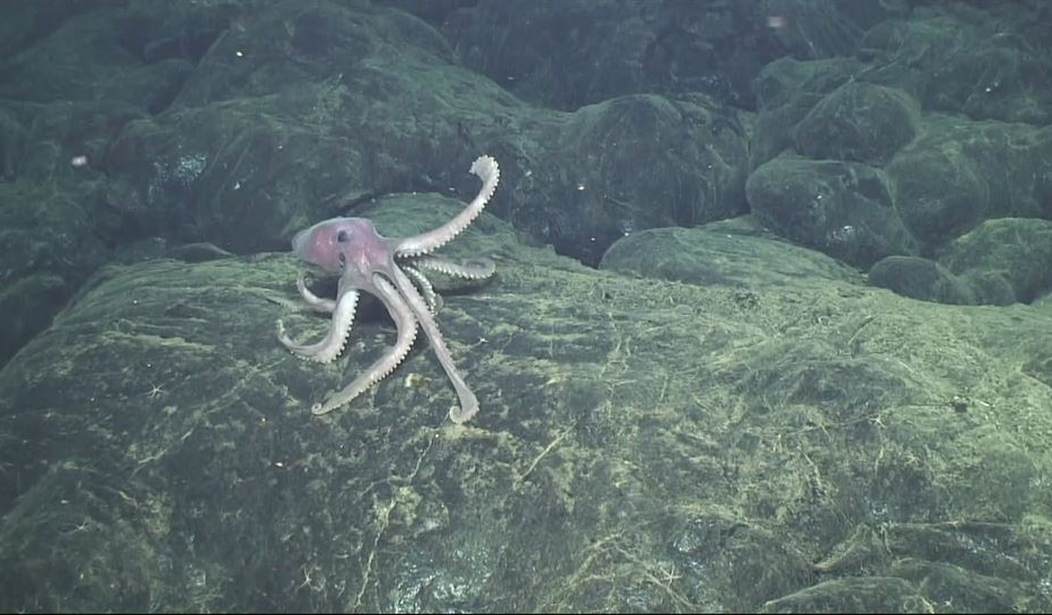

Nearly 4,600 feet beneath the Pacific Ocean, on a narrow rock face in Monterey Canyon, a mother settled over her eggs. She stayed as the seasons turned, as years passed, and as the people who first discovered her returned again and again.
For 53 months, she guarded the next generation. Then she disappeared.
In April 2007, a remotely operated research vehicle spotted a solitary deep-sea octopus moving toward an exposed patch of rock. Thirty-eight days later, the researchers returned. She had climbed the rock and was covering a cluster of eggs with her arms. Distinctive scars helped researchers identify her each time the camera returned.
Her species has a name that isn’t exactly bedtime-story-friendly: Graneledone boreopacifica. Unlike many octopuses (octopi?) that brood for weeks or months, this female was beginning a vigil nobody had ever documented for so long.
The setting made her watch even more remarkable. She lived in darkness, in water only about 37-38 ºF. Her eggs were fastened to a vertical surface, where currents delivered oxygen. They needed tending and protection. A crab wandering too close could meet an arm that firmly pushed it away.
The research team visited the site 18 times during the following four and a half years. Each time, they found her centered over the same growing clutch. Occasionally, she shifted or lifted an arm, but they never saw her abandon her post.
Nor did they see her eat. Crabs and shrimp sometimes moved nearby, but she kept them at a distance. When researchers offered her pieces of crab using their underwater vehicle, she ignored the food. They couldn’t watch her every minute, so nobody can say she never ate. The extraordinary part is what they actually witnessed: a mother still protecting her eggs, year after year.
From the PLOS One website:
During the periods when we had the female under observation, she never left the eggs unattended; but our presence included only a small fraction of the protracted brooding period. While the proximity of our ROV was surely conspicuous because of its lights and vibrations, we never disturbed the brooder mechanically.
On two occasions we used the reverse water flow of our suction sampler to gently lift the web between her arms so that we could view some of the eggs for laser-referenced size measurements. While she occasionally shifted her position slightly, or uncurled and lifted one or two arms, the female always remained centered over the clutch of eggs.
Time left its mark: her once-textured, purplish skin grew pale and slack, her eyes grew cloudy, and her body appeared smaller. Meanwhile, the eggs continued developing. By the 40th month, researchers could make out the tiny octopuses’ shapes inside their cases.
Imagine the patience required, even without assigning human thoughts to an animal. The cold water slowed the young octopuses’ development, but the long wait had a purpose. When these babies hatched, they would emerge as unusually well-developed little octopuses, ready to live on the deep ocean floor rather than drift through a vulnerable early stage.
In September 2011, the mother was still there. The next month, the vehicle returned to an empty patch of rock. The octopus was gone. Her eggs had hatched, leaving ragged cases and marks where approximately 160 had been attached.
From PLOS One:
In September of 2011 the brooding female and her eggs were still in place. When we returned in October of 2011 she was gone and the rock face she had occupied held the tattered remnants of empty egg capsules. Thus the total length of the brooding period we measured was from May, 2007 to September, 2011, or 53 months.
From HD video frame grabs of the empty capsules and the characteristic green cement of their anchor points we estimate the clutch size to have been between 155 and 165 eggs.
The researchers didn’t witness her death or follow the young into the darkness. Many female octopuses die after their eggs hatch, and changes in this mother’s body suggested she was nearing the end. Her final moments remain unknown.
The 2014 discovery established the longest egg-brooding period ever documented in any animal: four years and five months. Countless opportunities to retreat, while a tiny patch of ocean floor became the scene of something both scientifically astonishing and strangely moving.
I keep coming back to the final visit. No mother, no eggs, just the torn remains of what she’d spent years guarding. Somewhere beyond the camera lights, roughly 160 young octopuses had entered a world their mother had prepared them to face.
She had no applause, no record book, and no way of knowing anyone would tell her story. For more than four years, she stayed. When the researchers returned, her work remained, even though she didn’t.