





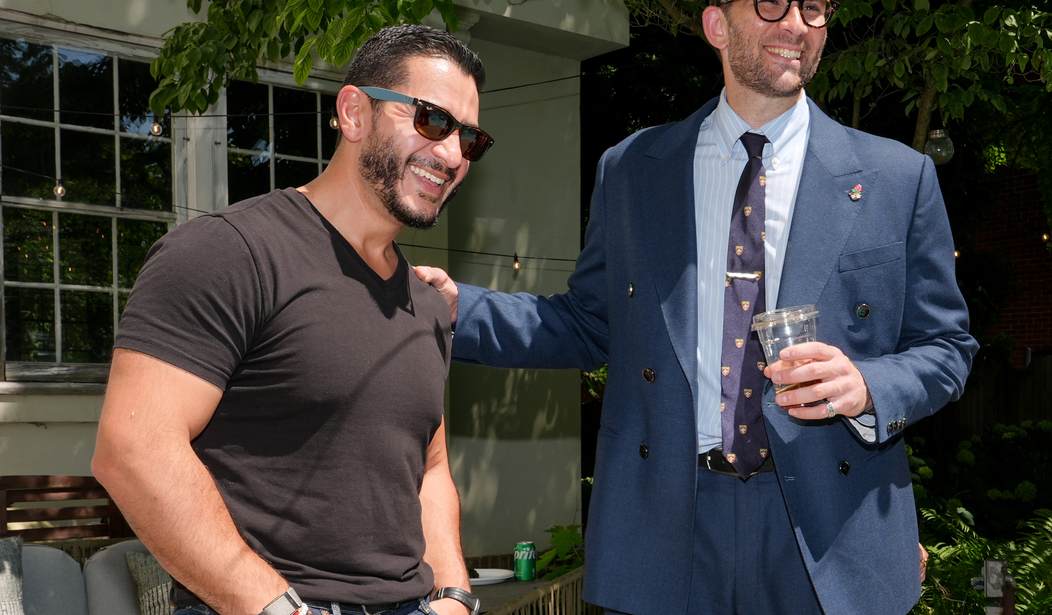
Two prominent Michigan Democrats have put an uncomfortable choice in writing. Former state party chairman Lon Johnson and longtime strategist David Kramer say they will leave the U.S. Senate contest blank rather than support their party’s nominee, Abdulrahman Mohamed El-Sayed, or Republican Mike Rogers.
Their October 16 essay argues that winning a primary doesn’t excuse a candidate from earning the trust of Democrats who supported someone else. They accuse Abdulrahman Mohamed El-Sayed of failing to unite his party, and they have attached their names to the criticism. Both have spent years in Democratic politics, making their public break notable.
From the Detroit News:
El-Sayed had a responsibility to unite Democrats. Instead, he has dismissed substantive concerns as distractions and failed to provide the clarity many Democrats sought. Those asking difficult questions were not necessarily his enemies. Many wanted to support him. They simply refused to abandon their principles.
We remain Democrats, committed to electing outstanding candidates up and down the ballot and protecting the party's future. We reject the notion that declining to support one nominee makes anyone less of a Democrat.
Supporting a candidate is a choice, not an obligation. Party loyalty is not blind obedience. Support must be earned, and a vote is never owed.
Their objections go beyond campaign style. Johnson and Kramer cite El-Sayed’s associations with people they say have minimized terrorism, his handling of inflammatory rhetoric, and positions they consider extreme.
The declaration follows El-Sayed's appearance at campaign events with livestreamer Hasan Piker. Following Piker’s controversial comments about American Jews, El-Sayed condemned antisemitism and said nobody outside his campaign speaks for it.
Some Democrats wanted a clearer break. Their disagreement is now visible well beyond Michigan’s primary electorate.
Related: El-Sayed Wants to Talk Affordability, but His Old Posts Keep Talking About America
Meanwhile, El-Sayed has answered renewed questions about his family’s reported ties to the Muslim Brotherhood. In a Saturday interview, he reached for John F. Kennedy’s 1960 presidential campaign. Kennedy, a Catholic, had faced doubts about whether he would follow the Constitution or take instructions from the Vatican. El-Sayed said he was facing a similar suspicion of divided loyalties and defended his constitutional rights as a Muslim American.
From Fox News:
El-Sayed invoked Kennedy's 1960 presidential campaign while arguing that questions about his family were intended to cast doubt on his allegiance to the United States.
"I also know that I tread a long history of this: when John F. Kennedy ran for president, he was asked about whether or not his allegiance would be to the Constitution or to the pope and the Vatican…" he began.
"The Constitution guarantees me the right as I choose to pray or any of us, to pray as we choose to pray or not to pray at all," he continued. "Nobody understands how important that document is like somebody who has their rights constantly threatened and so I will stand for that constitution. And it's a crazy thing to assume that somehow I'd have dual loyalties as somebody who's avidly running to protect the right to choose, who's running to protect LGBTQ rights, who's running to protect religious freedom…"
Kennedy’s history is real. In his Sept. 12, 1960, speech, he rejected any religious test for public office and insisted that public officials owe their allegiance to the Constitution. Yet the current dispute includes more than a candidate’s religion. It also includes specific statements from El-Sayed’s half-sister, Eman Abdelhadi, about their relatives’ political affiliations.
In 2012, Abdelhadi wrote that her family had long been connected to the Muslim Brotherhood and described her mother’s activism in the organization at college in Egypt during the 1970s. In 2013, she discussed relatives who supported the movement and others who had been jailed.
El-Sayed has denied personal or family ties. He told an interviewer that he wasn’t raised by his mother and described the questions as relying on hearsay from social media. At a town hall, he explicitly disavowed the Brotherhood, then challenged the question, saying it implied suspicion about his religion and loyalty. Both his denial and his half-sister’s statements are part of the public record.
👀 Michigan Senate Candidate Confronted Over Muslim Brotherhood at Heated Town Hall Abdul El-Sayed, the Democratic nominee for U.S. Senate in Michigan, faced a tense exchange with an audience member at a town hall in Caro, Michigan, over the Muslim Brotherhood. He is running against Republican Mike Rogers. Asked, “Will you disavow the Muslim Brotherhood?” El-Sayed answered, “Yes,” then asked why the man assumed he would not. The attendee said he had not heard him disavow it; El-Sayed turned the question back on him, then challenged the implication of dual loyalty and said his allegiance was to the U.S. Constitution. The exchange follows renewed scrutiny of old social media posts by his half-sister describing their mother’s involvement with the Brotherhood in Egypt during the 1970s. El-Sayed has denied ties to the organization and says he was raised by his father and stepmother. Jewish breaking news
— TheJewishAlly (@TheJewishAlly) October 18, 2026
Another older issue has surfaced this week. In a 2011 study, El-Sayed and co-author Sandro Galea examined more than 21,000 births to Arab-American mothers in Michigan. They found an association between a non-Arab father and higher odds of premature birth. The paper’s use of the phrase “interethnic mating” has drawn sharp online reactions. But the researchers didn’t establish a genetic cause or advise people to marry within their ethnicity. Those limits are essential to an accurate description of the study.
These controversies concern different things: a family’s history, a candidate’s public responses, political associations, and an academic paper. Collapsing them into a single allegation would obscure the evidence. At the same time, El-Sayed’s answers can be compared with the questions asked, including whether his family’s reported history aligns with his broad denial of family connections.
When two prominent Democrats publicly say they’d rather leave their party’s Senate candidate off their ballots than vote for him, El-Sayed should consider that everyone else isn’t the problem.
Johnson and Kramer have laid out their objections, while El-Sayed seems more interested in challenging the questions than putting controversies to rest. He can invoke JFK, complain about unfair scrutiny, and dismiss his critics until he’s blue in the face.
Unfortunately for him, Election Day doesn’t come with a safe space, a sympathetic moderator, or an exemption from answering uncomfortable questions. And Michigan Democrats who once might have held their noses and voted for him are now publicly saying they’d rather keep their pens in their pockets.
If you value journalism that checks political claims against original documents, become a PJ Media VIP member today. Get 60% off your membership with promo code FIGHT and help support independent reporting.

Join the Conversation
VIP members get the ability to comment on articles.