







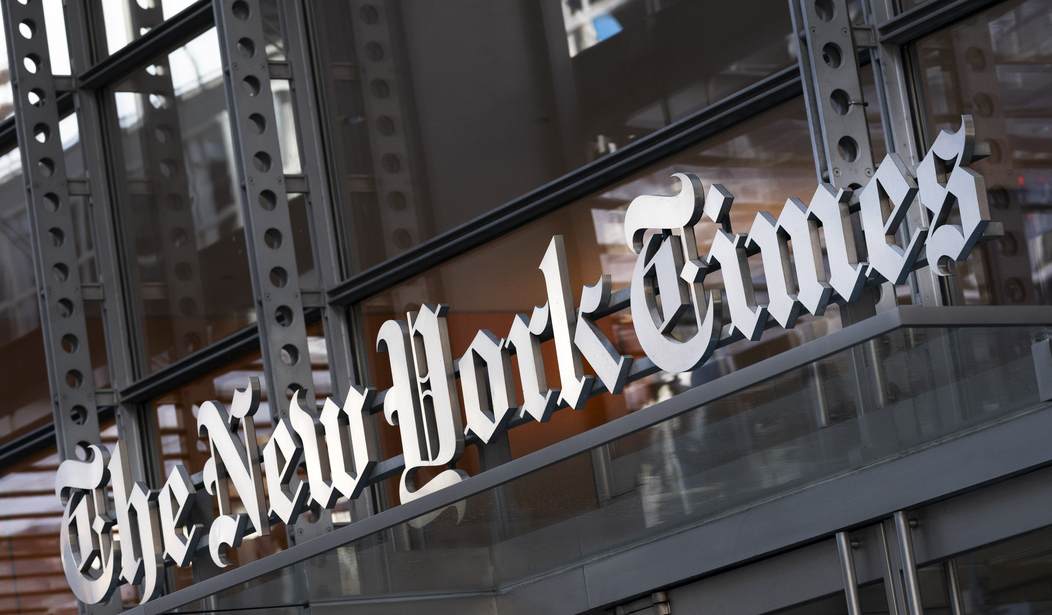
Kai Spears was 18 years old and a freshman walk-on basketball player at the University of Alabama when his name became tied to a murder he didn't witness.
A newspaper article, from the ancestors' archive of choice, the New York Times, placed him inside Brandon Miller's car at the scene of the January 2023 shooting that killed 23-year-old James Harris.
Spears wasn't there.
On Thursday, an eight-person federal jury decided that the mistake was worth $9.25 million.
Ha! Good.
From the Associated Press:
Kai Spears, who played for the University of Alabama men’s team, sued the Times in 2023 after it published a report, citing a person familiar with the investigation, that indicated he was a passenger in a car involved in the shooting. The Times reported that the person had spoken “on the condition of anonymity to discuss sensitive matters.”
Days later, the Times acknowledged its error in an editor’s note and corrected the story.
The eight-person jury delivered its verdict after a nine-day trial in the U.S. District Court for the Northern District of Alabama. Matt Glover, an attorney for Spears, said he was pleased with the decision and believes “this verdict will improve journalism throughout the country.”
The Times was reviewing its legal options after losing in court, spokesperson Charlie Stadtlander said.
“We’re disappointed the jury found The Times liable for an honest mistake,” Stadtlander said in a statement Thursday. “We thank the jury for its service, but believe the verdict and award of damages are contrary to law and not supported by the evidence.”
Three other basketball players from the school were present at the January 2023 shooting, which killed a 23-year-old mother. In the lawsuit, Spears claimed the inaccurate reporting had caused him emotional distress and forever linked him with a murder.
I don't say that because I enjoy watching journalism suffer; I spent part of my career in journalism. I say it because reputations have value, words carry consequences, and a powerful institution doesn't get to shrug when it gets something this important wrong.
Well. Okay. I fibbed a little bit. I don't enjoy watching journalism suffer; I get pumped up when the arrogant, dinosaur media gets put in its insufferable, room-sized egos' place.
The court record makes Spears' case difficult to wave away. He had been with Miller earlier that night, but he didn't know Miller had been asked to deliver a gun. He didn't know the gun was in Miller's car, and when Miller left, Spears didn't go with him. He headed toward his dorm and was two or three blocks away when the gunfire started. He learned about the shooting afterward.
Yet the article put Spears in Miller's car at the shooting scene and connected him to a story about basketball players being "involved" in a killing. U.S. District Judge Annemarie Carney Axon ruled in May that a reasonable jury could find those statements materially false and could conclude the article portrayed Spears in a highly offensive false light.
The jury finally got its turn. After a nine-day trial, jurors deliberated for about five hours and found for Spears on defamation and false-light claims. The Times called what happened an "honest mistake" and says it's considering its legal options. It also acknowledged something remarkable: it hadn't lost a U.S. defamation lawsuit involving one of its articles in more than 50 years.
There's some delicious history here, too.
In 1964, New York Times Co. v. Sullivan grew out of an Alabama libel judgment and became one of America's defining press-freedom decisions. The Supreme Court ruled that public officials generally must prove "actual malice" when suing over defamatory statements concerning their official conduct.
The decision gave the press enormous constitutional protection.
Sixty-two years later, Alabama produced another memorable defamation verdict involving the same institution. Spears was a private citizen, so the legal circumstances aren't the same.
The geography is still hard not to savor.
Free speech deserves fierce protection, and so does a free press, and neither principle requires ordinary people to accept having their names falsely linked to a murder without recourse.
The legacy press has spent years lecturing the rest of America about misinformation, accuracy, accountability, and protecting democracy from falsehoods.
Fine.
Those standards shouldn't disappear when the mistake comes from behind an expensive newsroom desk.
Kai Spears got something corrections can't always restore: a jury publicly saying he was wronged.
And a $9.25 million reminder that words still have a price.
The legacy media has plenty of money, institutional power, and friends willing to protect it. Independent conservative journalism needs readers willing to fight back. Join PJ Media VIP today and save 60% with promo code FIGHT.
Join the Conversation
VIP members get the ability to comment on articles.