





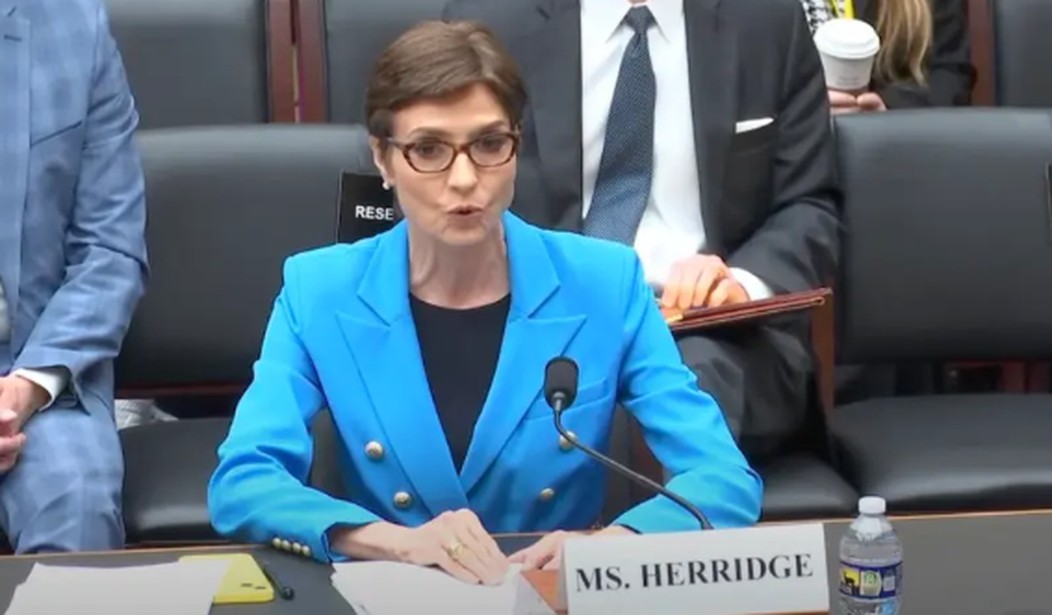
Catherine Herridge is being asked to do what every serious investigative reporter fears most: burn a source after giving her word. Refuse, and the price is $800 a day. Comply, and the next nervous whistleblower watching from inside government learns the lesson fast: a reporter's promise may last only until a judge orders otherwise.
Herridge, now an independent journalist, has been held in civil contempt over her refusal to identify a confidential source tied to her 2017 reporting on scientist Yanping Chen, who was investigated by the FBI but never charged.
Chen sued the government under the Privacy Act, arguing that leaked information damaged her life and career. Her lawyers say they need the source's identity to prove who leaked the material.
U.S. District Judge Christopher Cooper ordered Herridge to answer questions about her source or face the $800 daily fine. The U.S. Court of Appeals for the District of Columbia Circuit upheld the contempt order in 2025. From the Associated Press:
Herridge published a series for Fox News in 2017 that examined Chen’s ties to the Chinese military and raised questions about whether the scientist was using a professional school she founded in Virginia to help the Chinese government get information about American servicemembers.
Fox News Media expressed disappointment in the decision.
“Protecting the confidentiality of journalistic sourcing and the integrity of the newsgathering process is fundamental to a free and functioning democracy. While we are deeply disappointed by the Court’s decision, our commitment to defending these critical First Amendment principles remains unwavering and we will be reviewing our options to further fight this injustice,” the network said in a statement.
Herridge’s attorneys did not immediately respond to messages seeking comment.
The stories relied on what Chen’s lawyers say were items leaked from the probe into statements she made on immigration forms related to work on a Chinese astronaut program.
Chief Justice John Roberts briefly paused the mandate on June 26, but the Supreme Court denied Herridge's stay request on July 2. Justice Brent Kavanaugh would've granted it.
The case isn't clean or easy. Chen has rights too. If a federal official unlawfully leaked private information from a government investigation, Chen deserves a legal path to find out who did it. Free press arguments shouldn't become a hiding place for every abuse by a government employee with access to private files.
Yet the larger warning remains; confidential sources aren't some dirty little trick invented by political hacks. They're often the only reason the public learns what powerful people want buried.
A source may risk a job, clearance, pension, reputation, or prosecution. Before that person talks, one question comes first: Can I trust you?
If the answer becomes “only until a court squeezes me hard enough,” investigative journalism loses one of its central tools. Reporters can still write press releases, they can still quote official statements, and they can still repeat what government offices want released. But the hard stories, the ones that start with fear, conscience, and a phone call after dark, become harder to tell.
The irony is hard to miss.
Anonymous sourcing is treated as normal when powerful institutions use it to drive the preferred story of the day. Readers are asked to accept sweeping changes from unnamed officials, people familiar with the matter, and sources not authorized to speak.
Yet Herridge, a reporter known for careful national security work, now faces financial punishment for keeping the same kind of promise that newsrooms defend when the source helps their own narrative.
There's no federal shield law giving reporters clear protection across federal courts. State protections vary, and federal judges have had to work through a patchwork of precedent.
The Reporters Committee for Freedom of the Press noted that the Herridge fight turns on the scope of reporters's privilege in the D.C. Circuit.
The facts of the case are pretty straightforward. The plaintiff ran a school that enrolled many servicemembers. The Justice Department conducted a counterintelligence investigation into the plaintiff that did not result in any charges. Herridge, then a correspondent at Fox News, reported on the investigation and included material that the plaintiff says must have been leaked by government officials, in violation of the federal Privacy Act. While Herridge is not a party, the plaintiff seeks to force her to identify her source or sources.
What’s not as straightforward is the legal question at play in the contempt finding: that is, the scope of the reporter’s privilege in this jurisdiction, which protects reporters from having to name their sources. The U.S. Court of Appeals for the District of Columbia Circuit has unfortunately left the answer to that question muddy. Judge Cooper felt that he had to apply “binding” precedent to hold Herridge in contempt. But, as Judge Cooper noted, the Herridge case could present an opportunity for the D.C. Circuit to finally clear up the answer, and, in doing so, “recalibrate” the reporter’s privilege in D.C. federal courts.
The whole issue has its origins in an organized crime investigation. Anthony Zerilli was the alleged head of the “Detroit Partnership” in the 1970s. During criminal proceedings against him in 1971 in California, the government revealed that it had planted a listening device, without a warrant, that picked up Zerilli discussing illegal activities. A judge ordered the fruits of the surveillance sealed at the Justice Department, with very limited access. In 1976, the Detroit News published a series called “Inside the Mafia” referencing information gleaned from the bug. Zerilli sued under the Privacy Act and tried to depose the reporter, who refused to identify his sources, citing the reporter’s privilege. Both the district court and the D.C. Circuit found that the privilege applied.
That's especially true in Privacy Act cases where plaintiffs may have few other ways to identify a leaker.
A free country needs both privacy and a free press; it needs courts that can remedy real government misconduct and reporters who can expose government misconduct. The hard part is protecting one without gutting the other.
In Herridge's case, the pressure falls on the journalist, while the unknown government source who may have leaked the material remains hidden unless she breaks.
A reporter's promise should never be handed out cheaply. Names should be used whenever possible; anonymous sourcing can be abused, and readers have every right to be skeptical.
Still, some stories can't be reported any other way; some truths only surface because someone with knowledge believes a reporter will keep faith when the heat comes.
Herridge's case should alarm people across the political map. Today, the reporter in the crosshairs is one side's favorite target. Tomorrow, the same rule can reach a reporter they like, a story they need, and a whistleblower whose warning could protect the country.
The First Amendment doesn't exist to protect comfortable journalism. It exists because free people need information that the government would rather control. If courts can turn source protection into a daily meter running at $800, fewer sources will talk, fewer reporters will dig, and more government secrets will stay exactly where the powerful want them.
America can defend privacy without making confidential journalism a courtroom trap. Catherine Herridge kept her word; a free society should think long and hard before making that kind of integrity financially ruinous.
Help PJ Media keep digging where the powerful would rather we stop. Right now, you can get 74% off VIP with promo code AMERICA250.

Join the Conversation
VIP members get the ability to comment on articles.