







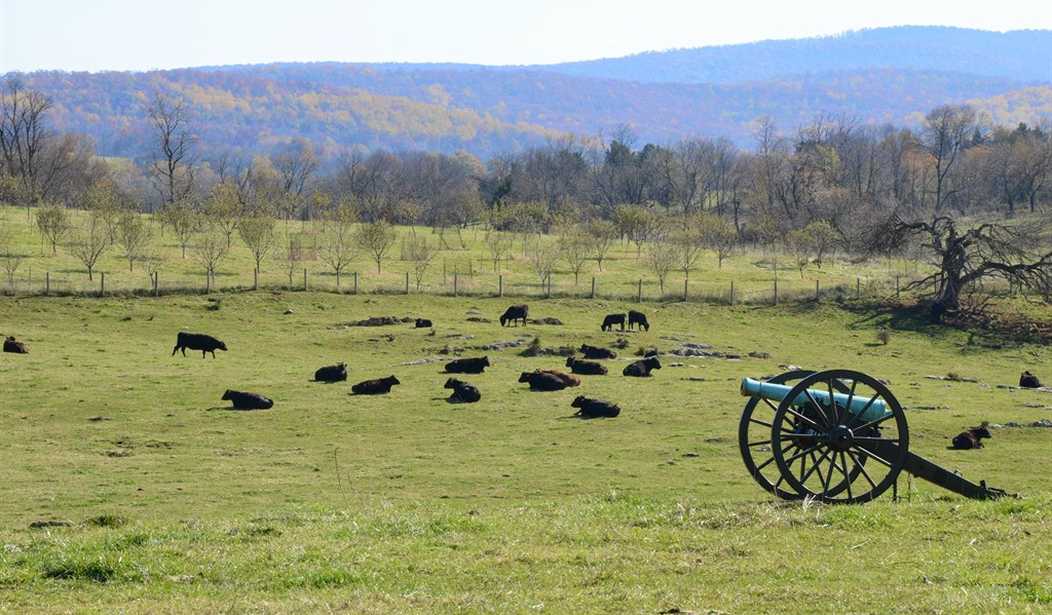
September 17, 1862: The battle fought between Antietam Creek and Sharpsburg, Md., with its 22,720 killed, wounded, missing or captured, remains America’s bloodiest day. With Lee having retreated back into Virginia, though, it was enough of a victory for Lincoln to finally issue the Emancipation Proclamation he had proposed months earlier, when his cabinet suggested postponing it, Seward saying it would be “our last shriek on retreat.”
Contrary to Lincoln’s hopes and expectations, McClellan did not pursue Lee and perhaps end the war then and there. Lincoln dismissed him, for the second and final time. The war would go on, and on.
A few days later, Lincoln wrote a note to himself, which was only discovered by his secretary, John Hay, after his assassination. It is called Meditation on the Divine Will, written with much the same purpose as Marcus Aurelius’ Meditations – as a way to clarify his own thoughts, and not meant for public consumption. It began: "The will of God prevails. In great contests, each party claims to act in accordance with the will of God. Both may be, and one must be, wrong. God cannot be for and against the same thing at the same time. It is quite possible that God’s purpose is something different from the purpose of either party…"
Elizabeth Keckley, a former slave who had bought her own freedom and who had become a maid and close confidant of Mary Lincoln, later in life related a story of a time in early 1863 when Lee’s Army of Northern Virginia, coming off its victory at Fredericksburg, surprised and defeated the Army of the Potomac once again at Chancellorsville. She had been helping Mrs. Lincoln measure a dress when the president walked in, looking very despondent.
“Any news from the War Department?” Mary asked. “Yes, plenty of news, but no good news. It is dark, dark everywhere,” he answered, then plunked himself down on a couch, holding his head in his hands. Soon, he reached for a small Bible nearby and began to read. After a while, Keckley noticed that the president seemed more cheerful; “The dejected look was gone, and the countenance was lighted up with new resolution and hope,” she wrote. Curious about what exactly he had been reading, she made an excuse about needing more cloth, approached, and glanced over to see. It was the Book of Job.
With the victories at Gettysburg and Vicksburg, both within a day of each other on the 3rd and 4th of July 1863, Lincoln was elated. But once again, Lee had been allowed to escape across the Potomac back into Virginia. When General Meade reported that “the enemy has been driven from our soil,” the frustrated Lincoln was heard to say, “When will my generals learn that it is ALL ‘our soil!’” The war would, again, go on. But as he prepared his “few appropriate remarks” for the dedication of the cemetery at Gettysburg that November to which he had been invited, Lincoln perhaps began to see a glimmer of the purpose that was “something different from the purpose of either party.”
The war had become more than just a quest to preserve the Union, or even in its later stages, to free the slaves. It was to purify the principles upon which the nation had been founded, as in “all men are created equal,” and to give the nation “a new birth of freedom,” so that “government of the people, by the people, for the people shall not perish from the earth.”
By the time of Lincoln’s second inaugural address on March 4, 1865, it was clear that the South would lose the war. Grant had Lee trapped at Petersburg, Va., and Sherman was tearing the guts out of the heart of the Confederacy, first by taking Atlanta and his “march to the Sea,” then by marching north through the Carolinas. Lincoln’s address was by no means the “Rah! Rah! We’re winning!” speech many expected. Of the two sides, he said, “Both read the same Bible, and pray to the same God… The prayers of both could not be answered – that of neither has been answered fully.”
The war had taken its toll on him and on the nation, but a price was being paid:
Fondly do we hope, and fervently do we pray, that this mighty scourge of war may speedily pass away. Yet, if God wills that it continue until all the wealth piled up by the bondsman’s 250 years of unrequited toil shall be sunk, and until every drop of blood drawn with the lash shall be paid with another drawn with the sword, as was said 3000 years ago, so it must still be said, “The judgments of the Lord are true and righteous altogether.”
Then came the finale, which may rival the Gettysburg Address as Lincoln’s most eloquent: “With malice towards none; with charity for all, with firmness in the right, as God gives us to see the right, let us strive on to finish the work we are in; to bind up the nation’s wounds; to care for him who shall have borne the battle, and for his widow, and his orphan – to do all which may achieve and cherish a just and lasting peace among ourselves, and with all nations.”
What shall we think and do when we consider the more than 600,000 dead, the many more wounded and maimed; when we see the neat rows of stones at places like Shiloh, Antietam, and Gettysburg? Lincoln gave us our marching orders. We are “…to take increased devotion to that cause for which they gave their last full measure of devotion.”
Let the shedding of their blood bind us together in a new covenant, for a truly UNITED States, that will always remain, as Lincoln foresaw, “the last best hope of earth.”
Editor's Note: Do you enjoy PJ Media's conservative reporting that takes on the radical left and woke media? Support our work so that we can continue to bring you the truth.
Join PJ Media VIP and use promo code FIGHT to receive 60% off your membership.

Join the Conversation
VIP members get the ability to comment on articles.