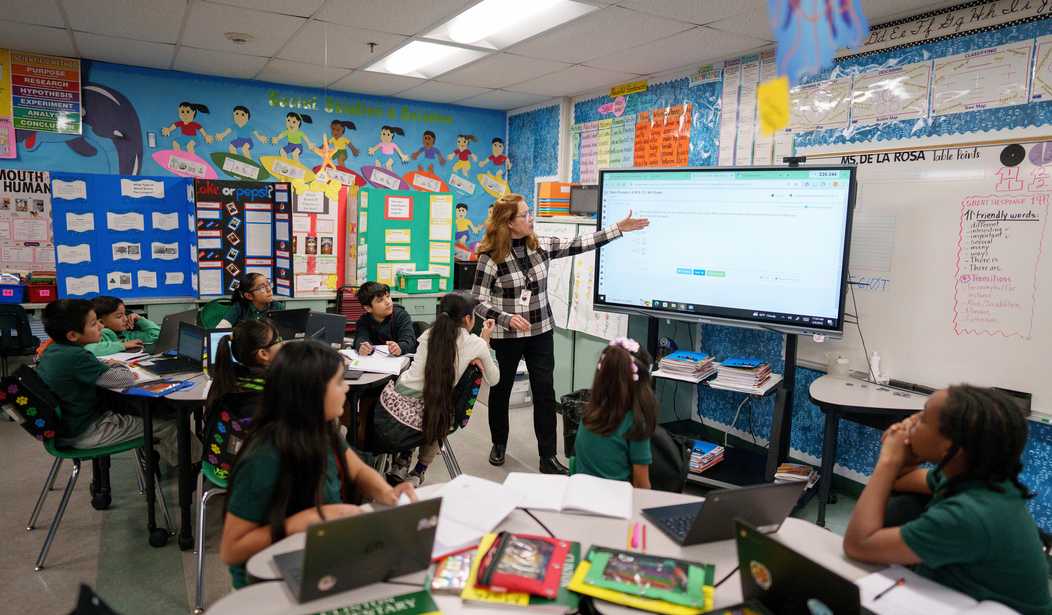

The latest global education assessment found that students in East Asia are miles ahead of American students in math, whose scores have been on the decline for nearly a decade.
The Programme for International Student Assessment (PISA) is the world’s largest international comparison of how well 15-year-olds can apply what they have learned in school to real-life challenges.
Since 2000, PISA has tested students in reading, mathematics, and science. The most recent round, PISA 2025, was released in September 2026.
More than 760,000 students across 91 countries and economies participated, representing about 33 million 15-year-olds worldwide.
Here are the main takeaways from the 2025 PISA results for the United States.
In 2025, American students scored 463 in math, two points below their 2022 score and 15 points below their 2018 score.
Meanwhile, seven East Asian education systems outscored the U.S. in the same assessment — Beijing, Shanghai, Jiangsu, and Zhejiang (B-S-J-Z), China (612), Singapore (563), Macao (549), Chinese Taipei (546), Japan (525), South Korea (522), and Hong Kong (522).
For reference, the lowest recorded 2025 score in math is 312, which was Rwanda's score. That means that the 59-point gap is about one-fifth of the 300-point spread between the highest and lowest scores.
For reference, the lowest 2025 math score was 312, which Rwanda scored, so scores span about 300 points. The 59-point gap between the U.S. and South Korea and Hong Kong is about a fifth of that.
PISA also sorts students into proficiency levels, and American students performed significantly below their East Asian counterparts on that scale, too.
Level 2 in math is classified as the baseline for functioning in modern life. Students at this level can identify relevant information, interpret simple data, and solve basic mathematical problems.
Levels 5 and 6 represent the highest levels of mathematical proficiency. According to the OECD, students at these levels can solve complex, unfamiliar problems, apply advanced reasoning, develop their own problem-solving strategies, and justify their conclusions.
In the U.S., 65% of 15-year-old students scored at Level 2 or higher in mathematics, and 35% scored below the baseline proficiency level.
Only 8% of U.S. students reached the highest proficiency levels in math — the same percentage as the OECD average across participating countries and economies.
In East Asia, 15-year-olds were far more likely to reach levels 5 and 6, the highest levels of mathematical reasoning:
B-S-J-Z, China: 54%
Singapore: 37%
Chinese Taipei: 32%
Macao: 29%
South Korea: 23%
Japan: 22%
Hong Kong: 21%
Compared to the U.S.’s 8%, the East Asian students were between roughly three and seven times more likely to reach the highest math levels.
Only 4% of students in the four Chinese regions and 11% in Singapore scored below Level 2, compared with 35% of American students.
America’s 2025 math scores, according to the country note, are now at the OECD average — among the lowest ever recorded for the U.S. in PISA.
It’s also worth noting that the U.S. was below the average in 2018 and 2022, so it reached the average mainly because the average fell.
These results should concern lawmakers, and although there has been an uptick in bipartisan congressional attention to this matter, it isn't enough.
The ripple effects of poor mathematical instruction in K-12 were highlighted recently in an open letter that thousands of University of California faculty signed, including professors at UC Davis, who said instructors were having to re-teach basic math to incoming students.
At UC San Diego, 921 incoming freshmen in fall 2025 (11.8% of the class) placed into remedial math below high school level, up from 32 in 2020, and about 70% of them (665 students) placed into a course covering middle-school material.
These findings were used to argue the need to reinstate mandatory college entrance exams such as the ACT and SAT, which UC removed during the COVID-19 pandemic. But the data is consistent with the PISA results, and points to a deeper root issue: students were never properly taught to begin with.
As economic and geopolitical competition between the United States and East Asia — Communist China, in particular — amplifies, so does the need for a strong domestic workforce in math-based subjects like science, technology, and engineering.
Not simply mathematical competence, but mathematical excellence, is crucial if the United States hopes to maintain its position as a global superpower.