





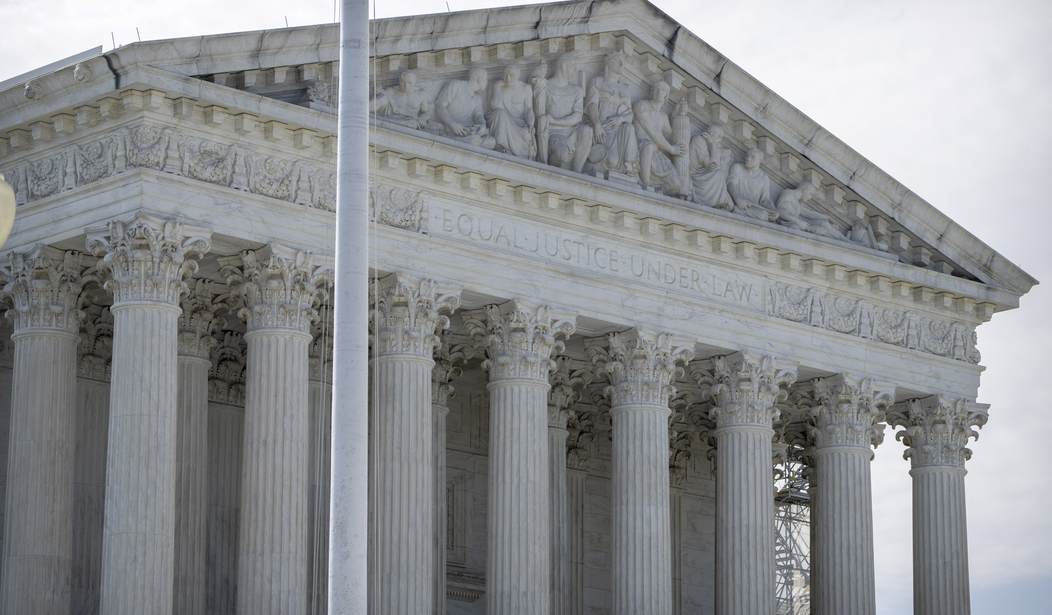
In yet another 6-3 decision, the Supreme Court reversed a Ninth Circuit Court of Appeals ruling that aliens who haven’t reached the U.S. border could consider themselves “asylum seekers.” As is the case with so many SCOTUS rulings these days, justices decided the case along party lines.
BREAKING: The Supreme Court delivers a MASSIVE win for Trump's immigration agenda!
— Townhall.com (@townhallcom) June 25, 2026
SCOTUS reverses a lower court ruling that forced the federal government to accept migrants who hadn't even reached the border as "asylum seekers."
The vote is 6-3.
An alien standing in Mexico does not “arriv[e] in the United States” by attempting, and failing, to set foot in this country. An alien “arrives in the United States” only when he crosses the border. The INA thus neither entitles an alien standing in Mexico to apply for asylum nor requires an immigration officer to inspect him. Pp. 7–18. (a) This case is not moot. The District Court’s declaratory judgment, which the Ninth Circuit affirmed, continues to bar the Government from using metering to deal with border surges within the jurisdiction of the Ninth Circuit. The Government represents that it would like to resume the use of metering when border conditions warrant it. The controversy remains live because a ruling for the Government could reverse the declaratory judgment and thus give the Government the effectual relief it seeks. Chafin v. Chafin, 568 U. S. 165. P. 8, n. 7. (b) The phrase “arrives in the United States” in §§1158(a)(1) and 1225(a)(1) carries its ordinary meaning: A person arrives in a geographic location only when he enters it. To “arrive” is to “reach a destination,” American Heritage Dictionary 102, and the preposition “in” means “[w]ithin the limits, bounds, or area of ” a place, id., at 910. A person arrives in a destination when he enters within its area—not before—and that conclusion does not change because someone or something blocks entry. Everyday examples of how people ordinarily use the phrase “arrives in” confirm this understanding.
“This case presents a straightforward question: whether an alien who seeks to enter the United States from Mexico ‘arrives in the United States’ when he or she is still in Mexico. In the decision below, the United States Court of Appeals for the Ninth Circuit answered ‘yes,’" Justice Samuel Alito wrote in the majority opinion. “That is wrong. In ordinary speech, no one would say that a person ‘arrives in’ a place — for example, a house, a city, or a country — before the person enters that place.”
Justice Clarence Thomas issued a brief concurring opinion in which he agreed with everything Alito said. He also reinforced that the statute does not extend extraterritorial protections or asylum rights to those still physically outside U.S. territory.
One of the most interesting features in this ruling is Justice Sonia Sotomayor’s dissent, which, at 35 pages, was nearly double the length of the majority opinion. Ever the drama queen, she began:
The Court today holds that the Executive Branch may circumvent all these mandatory procedures by having U. S. immigration officers stand at the border and physically block noncitizens from setting a foot onto U. S. soil. They may do so even if the asylum seeker is at the threshold of a port of entry designated to receive all noncitizens who seek entrance into the country. Even if the port of entry has ample capacity to inspect that person, including an available asylum officer trained to process asylum applications. Even if the asylum seeker is certain to be persecuted, or killed, if she is turned away. The Court’s illogical interpretation is driven almost entirely by a fixation on a single word: “in.” Words, however, must be read in context and with attention to how they fit into the statute as a whole. The majority ignores the statutory context and history, not to mention the longstanding position of the Executive Branch, all of which show that any noncitizen arriving at our doorstep and seeking admission must be inspected and allowed to apply for asylum, regardless of whether her foot has crossed the threshold. Because the Court today blesses the Executive Branch’s decision to slam the door shut on all who are fleeing persecution, despite the detailed inspection and asylum system that Congress enacted and commands, I respectfully dissent.
Alito offered an off-the-cuff remark about Sotomayor’s dissent, which is an unusual move. SCOTUSblog’s Amy Howe commented in a livestream, "I didn't get the exact wording, but he said something along the lines of there was 'much that I would have added' to his statement from the bench."
Editor's Note: Do you enjoy PJ Media's conservative reporting that takes on the radical left and woke media? Support our work so that we can continue to bring you the truth.
Join PJ Media VIP and use promo code FIGHT to receive 60% off your membership.

Join the Conversation
VIP members get the ability to comment on articles.