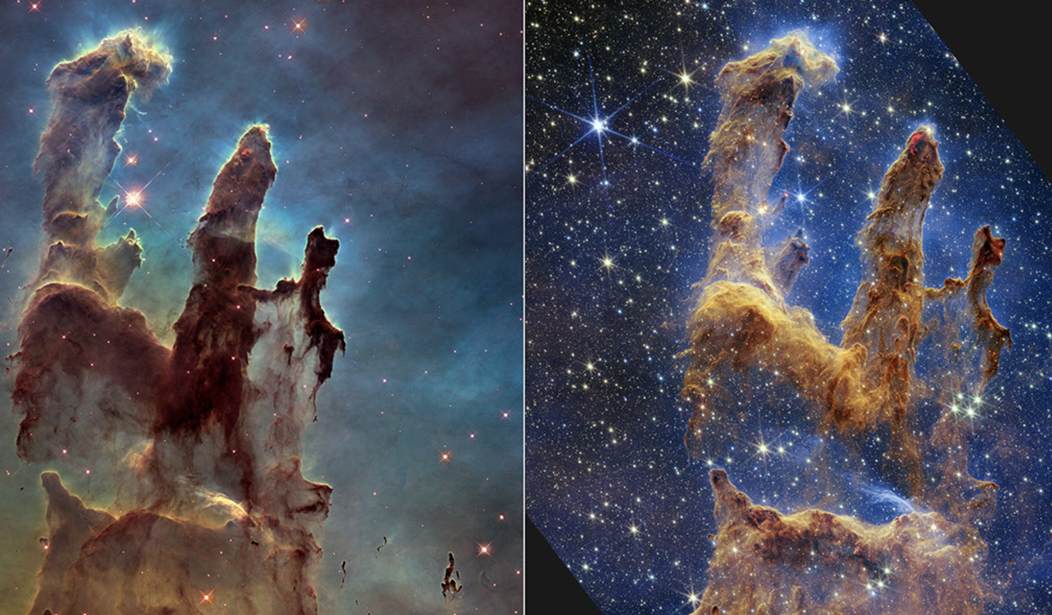

It's actually starting to feel like autumn in Kansas.
And the fall colors are definitely out at the ISS.
One of my favorite Milky Way photos from ISS, with the multicolored lights of Southeast Asia streaking across the exposure from orbital velocity, while distant stars remain fixed by my star tracker. The long exposure intensifies the atmospheric airglow into a thick red band! https://t.co/dhAmRTIdwV
— Don Pettit (@astro_Pettit) October 27, 2026
Stellar nurseries seem to make for great photos.
🆕 Just in time for Halloween, a ghostly nebula lurks within sight of Hubble & @esa_webb The Cat’s Head Nebula 🐱 is a star-forming region located approximately 7,500 light-years from Earth. It is named for its resemblance to a cat sitting with its back towards Earth, its ‘head’ turned to the side. 1/4
— HUBBLE (@HUBBLE_space) October 29, 2026
It's early for fireworks.
Scientists are still learning about a cosmic 'string of pearls,' a unique celestial relic left by a supernova witnessed by humanity around 850 years ago, which has a zombie star at its heart. https://t.co/3DiJ1sMnbz
— SPACE.com (@SPACEdotcom) October 27, 2026
It looks like cold weather in the outer system.
Behold the ghostly ice giant: Neptune, glowing like a pale pearl adrift in the dark, its delicate rings razor-sharp for the first time in more than three decades—faint dusty bands that last glinted under Voyager 2’s gaze in 1989 now revealed in infrared by the James Webb Space Telescope. 🔭 Beside it, the captured moon Triton blazes brighter than its planet, a nitrogen-ice mirror reflecting ~70% of the light that hits it, crowned with Webb’s signature diffraction spikes while methane darkens Neptune’s atmosphere and bright methane-ice clouds streak the southern hemisphere. A frame of cosmic elegance: the distant ice world, its ethereal rings, and its brilliant retrograde moon, captured July 12, 2022.
— Black Hole (@konstructivizm) October 28, 2026
Related: Astronomers Have Discovered an Object Beyond the Orbit of Neptune That Could Be Another Dwarf Planet
Colder here.
New dwarf planet just dropped. For now, it's called 2026 ED138. It appears to be ~1000 kilometers (600 miles) wide. If confirmed, that would make it a dwarf planet about half the size of Pluto. https://t.co/Sp68Aj41iP https://t.co/M6Z2KJPpma
— Corey S. Powell (@coreyspowell) October 27, 2026
The Large Magellanic Cloud is — or was — making new stars too.
The @NASAWebb telescope recently spotted stars brewing in this cosmic cauldron. This region of toil and trouble, named N159, is 161,000 light-years from Earth, in the Large Magellanic Cloud. https://t.co/CT6zPZbA1u
— NASA (@NASA) October 26, 2026
This is a great picture, slightly misnamed. The "-jima" suffix means "island" in Japanese. So this is named "Cherry Blossom Island" — which is also a little bit misnamed, because Sakurajima connected itself back to the mainland in 1914, so it's no longer an island. The mountain itself is named Ontake. And there's your random geography lesson for the day.
Amazing footage of a meteor exploding over the active volcano Mount Sakurajima in Japan. https://t.co/7b9X3p9L8w
— Wonder of Science (@wonderofscience) October 26, 2026
Related: Another Day, Another World-Changing Milestone From SpaceX
Now, you can listen to the sky as well as look.
Eye see you 👁️ The sonification of the Helix Nebula scans from left to right, where redder colors correspond with lower pitches while bluer colors are associated with higher pitches. It has been called “The Eye of Sauron" for its uncanny and all-seeing appearance. https://t.co/o1G5ELFsoL
— NASA Goddard (@NASAGoddard) October 26, 2026
Related: California Startup Tests Sci-Fi Plan to Put Thousands of Mirrors in Space and Turn Night Into Day
A colorful image of the Moon. Notice this is not false-color: McCarthy combined 50,000 images to give more detail and enhance the colors.
I took about 50,000 photos through a 14" telescope last night to produce this: A hyper-detailed photo of the full moon. The fidelity of the photo was great enough to allow me to greatly enhance the color, revealing a hidden world of geological diversity. https://t.co/jMLhUe3kmj
— Andrew McCarthy (@AJamesMcCarthy) October 26, 2026
A high-definition view of Andromeda.
Andromeda in High Definition💫 https://t.co/wL7WwNS8IR
— Night Sky Today (@NightSkyToday) October 26, 2026
This is a planetary nebula around a Wolf-Rayet star 18,000 light-years from us. Its nickname is "the Lawn Sprinkler Nebula".Another nebula.
AstroBin's Image of the Day: "NGC4361" by Wolfgang Promper https://t.co/i4DVYEqKGD #astrophotography https://t.co/ejYPLiz4eU
— AstroBin.com (@AstroBin_com) October 25, 2026
As I'm sure most of you heard, Sir Patrick Stewart died this week. I'm going to close with just a couple of the many tributes.
We mourn the passing of Patrick Stewart, who inspired countless individuals at NASA (and beyond) to boldly go where no one has gone before. https://t.co/qnLWiLX9RW
— NASA (@NASA) October 30, 2026
Rest easy, Captain. We have the helm. ✨ This is Webb’s look at Westerlund 1, a super star cluster. Because our galaxy is past its peak of star formation, and because stars live relatively short lives, only a few of these clusters exist to give us clues to that past era. https://t.co/bAuCjvsyyz
— NASA Webb Telescope (@NASAWebb) October 30, 2026
So that's another Sky Candy. Have a good Halloween, Samhain, and All Hallows Day (son of a gun, that's why it's Halloween!) and come back next week. And watch for the Sunday Supplement.
And comment. Lots of comments.