
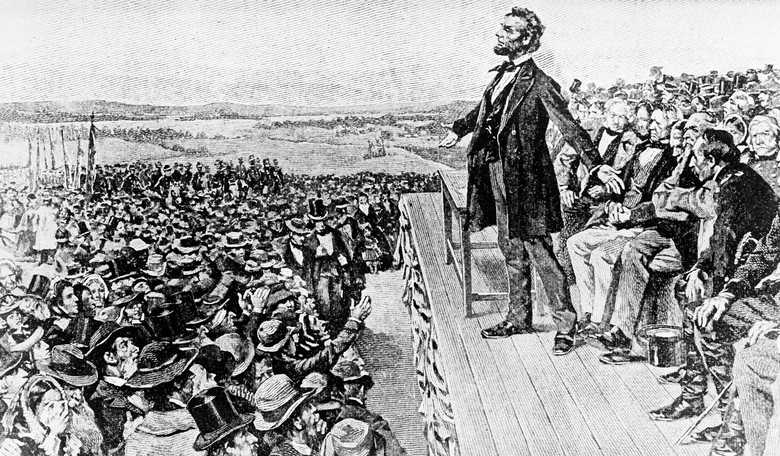
On Nov. 19, 1863, President Abraham Lincoln delivered a war cemetery dedication speech of only 10 sentences that would become one of the most famous in American history. His “Gettysburg Address” not only inspired soldiers to keep fighting for reunion and liberty, but it continues to inspire Americans and freedom-lovers around the world to this day.
“Four score and seven years ago our fathers brought forth on this continent, a new nation, conceived in Liberty, and dedicated to the proposition that all men are created equal,” Lincoln began. “Now we are engaged in a great civil war, testing whether that nation, or any nation so conceived and so dedicated, can long endure. We are met on a great battle-field of that war.”
He said those words to honor the fallen troops of the July 1863 Battle of Gettysburg. That battle was the bloodiest one of the very bloody Civil War, with three days of killing that left over 50,000 men dead. It was also the turning point of the war in the Union's favor, signaling the ultimate victory the patriots would have over the traitors and slaveowners.The president had declared, “in a larger sense, we can not dedicate — we can not consecrate — we can not hallow — this ground. The brave men, living and dead, who struggled here, have consecrated it, far above our poor power to add or detract.” Lincoln ironically said in the speech that he didn't expect his words to last beyond that day: “The world will little note, nor long remember what we say here, but it can never forget what they did here.” What Lincoln did want to ensure was that not only those present in the audience but all patriotic Americans would remember that at America’s founding, it was a nation with aspirations of liberty and equality in rights for all men. He was only fighting to realize that original dream.
The ending of the address expresses Lincoln‘s hopes for the future and is a rallying cry still relevant today:
It is for us the living, rather, to be dedicated here to the unfinished work which they who fought here have thus far so nobly advanced. It is rather for us to be here dedicated to the great task remaining before us — that from these honored dead we take increased devotion to that cause for which they gave the last full measure of devotion — that we here highly resolve that these dead shall not have died in vain — that this nation, under God, shall have a new birth of freedom — and that government of the people, by the people, for the people, shall not perish from the earth.
Related: America 250: When Mickey Mouse Went to War
A crucial part of the backdrop for the speech is what war crimes the Confederates committed in Pennsylvania before the battle. Confederates were rounding up and enslaving as many black people as they could get their hands on, including some who had been freedmen their entire lives. Women and children were especially vulnerable to the blatant kidnapping. In one town, Greencastle, the white citizens captured back a group of black women and children and defied the Confederates despite the threat of having their town burned down. The only reason the town escaped is that the Battle of Gettysburg started before the Confederates could follow through on the threat, and they had to refocus their attention on the Union Army.
Nor was Gen. Robert E. Lee’s army doing something spontaneous in this kidnapping and killing. The Retaliatory Act of the Confederate government specifically sanctioned and commanded such actions. While many modern people try to pretend the Civil War wasn’t about slavery, the Confederates certainly believed it was, and after Gettysburg, a lot of Unionists had to admit the same. American Patriots were fighting an existential battle with Democrats who truly believed that their ability to enslave others and sabotage Republican policies was more important than the survival of our nation.
In America's 250th year, we are fighting a political and cultural battle with the same enemy that Lincoln faced over a century ago. The Republicans and Unionists of the 1860s won their war to realize liberty for all and the preservation of the Union. The question is, are we willing to do what it takes to win our war and achieve the same victory?