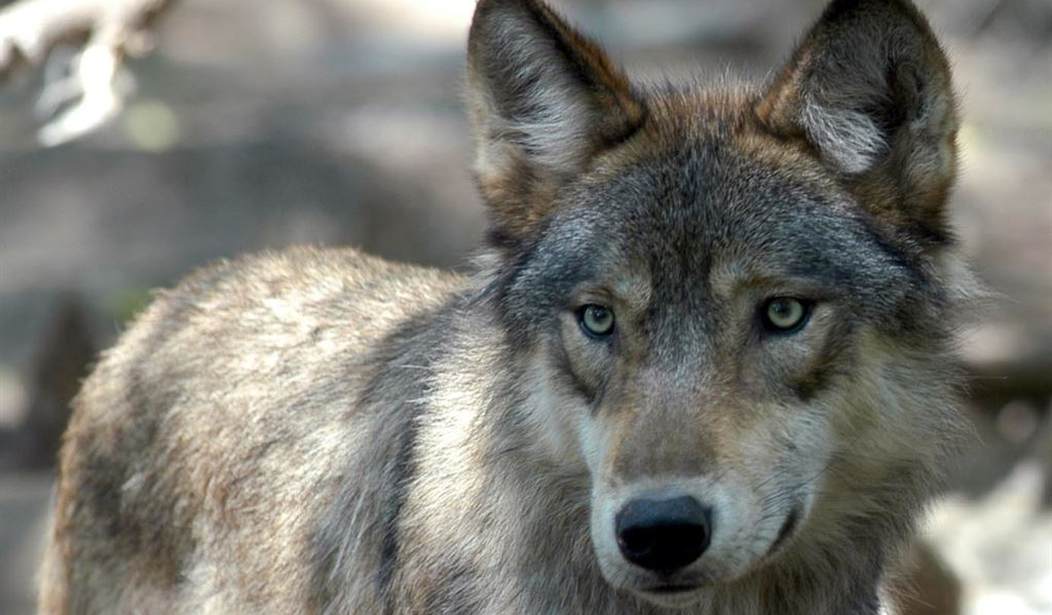
In an earlier column in this “Predator Watch” series, I wrote about seeing coyotes during walks in my neighborhood. After some initial wariness, those encounters fortunately ended without incident. I do remember a thought crossing my mind after the coyotes scurried away: “I’m glad it wasn’t a wolf.”
Of course, it wouldn’t be a wolf, as there haven’t been any gray wolves in Los Angeles County, where I live, for over a hundred years. At least there hadn’t been until February 7, when a three-year-old black-coated female visited Southern California. Wildlife officials said she traveled more than 370 miles from Northern California, which they know because the wolf, known as BEY03F, was fitted with a GPS collar in May 2025. The reason for the long journey? It’s breeding season, and the wolf was looking for a mate, which she is not likely to find in Los Angeles County, so she’ll probably head back north.
Looking at the video, had I ventured onto the scene, I’m pretty sure that, as a non-wildlife expert, I would have thought it was a coyote at first glance.
Jacob Keating of the California Wolf Center explained the significance of the sighting:
But the wolves are coming back on their own. They’re saying, “Hey, look at this area in California that we like. This looks like a good place for us to be able to live and persist and reproduce.” And so the wolf’s recovery story in California is really exciting.
Unaware of the history of wolves in California, I did a little research and found the following information from The Guardian:
The continental United States was historically home to thousands of gray wolves, but hunters and trappers extirpated the species, with the last wild wolf in California shot in 1924. In 1973, the population was protected by the Endangered Species Act and later reintroduced to Yellowstone National Park in the 1990s. Those wolves eventually dispersed across the lower 48 states, with the first wolf crossing into California in 2011. By 2024, the California Department of Fish and Wildlife estimated that there were at least 70 gray wolves in the state, up from 44 the year before.
What about the history of wolf attacks on humans, which is the focus of this series? I was surprised to learn that there has been a fatal attack this century. In 2010, a 32-year-old teacher named Candice Berner was killed by two or more wolves near the village of Chignik Lake on the Alaska Peninsula.
Related: Predator Watch: Former 'The Voice' Contestant, 26, Dies After Snake Bite
She was jogging at the time — an activity that has often appeared in stories of animal attacks in this series. Fish and Game Biologist Lem Butler said at the time that it was unknown whether the wolves had been hunting Berner or if she had surprised them, provoking the attack. The wolves did feed on her body afterward.
NBC News reported on how the fatal attack unnerved residents of the small village, accustomed to living in close quarters with wild animals, and made them hesitant to venture outdoors. “It’s scary. People are afraid,” one villager said. “It’s just something we’re just going to have to adjust to, but the sense of trust with a wild animal is totally going to be different.”
The NBC News report explained just how rare fatal wolf attacks on humans are:
It was the first fatal wolf attack in Alaska, and only the second documented case of a wild wolf killing a human in North America. There are an estimated 60,000 to 70,000 wolves in North America, including 7,700 to 11,200 in Alaska.
In the only other documented fatality, a pack of wolves killed Kenton Joel, a 22-year-old Ontario engineering student, in the woods of northern Saskatchewan on Nov. 8, 2005. Carnegie had gone for an afternoon hike and didn’t return to the surveyors camp where he was working. Authorities said at the time that wolves were drawn to the remote area because people had been leaving garbage in open dumps.
Statistics from a study reported by The Guardian show why wolf attacks on humans are so rare. Humans approached wolves 125 times in Scandinavia. The wolves ran away 123 times. Regular readers of this series can probably guess the scenario during the other two times. That’s right. It was a female wolf showing “defensive” behavior near her pups.
The most recent attack that made headlines occurred in Finland in September 2025. A woman protected her dog from a wolf using only her hands. While the woman and her dog suffered only minor injuries, the Finnish Natural Resources Institute said the wolf showed no fear of human presence.
Finland was also the site of perhaps the most horrific wolf attack story in history — so horrific that it seems more like a story from some absurd Hollywood blockbuster than reality. Wikipedia has the story of the "Wolves of Turku":
The Wolves of Turku were a trio of man-eating wolves which in 1880 and 1881 killed 22 children in Turku, Finland. The average age of the victims of these wolves was 5.9 years. Their depredations caused such concern that the local and national government became involved, calling help from Russian and Lithuanian hunters, as well as the army. The wolves killed their last victim on 18 November 1881. On 12 January 1882, an old female wolf was shot and twelve days later, an adult male was poisoned, putting an end to the attacks. One of the dead wolves was sent to the hunting museum of Riihimäki, the other in the St Olof's school where they can still be seen today. The third wolf ended up as a doormat and disappeared.
If you encountered a wolf, would your mind venture to the stats that show how incredibly rare an attack is, or to horror stories, like the notorious wolf attacks in Finland?