
Sometimes the best way to expose the absurdities of modern politics and culture isn't another political lecture, think-tank report, or congressional hearing. The most effective weapon may be laughter. After all, there's nothing quite as unsettling to people who take themselves seriously as becoming the punchline.
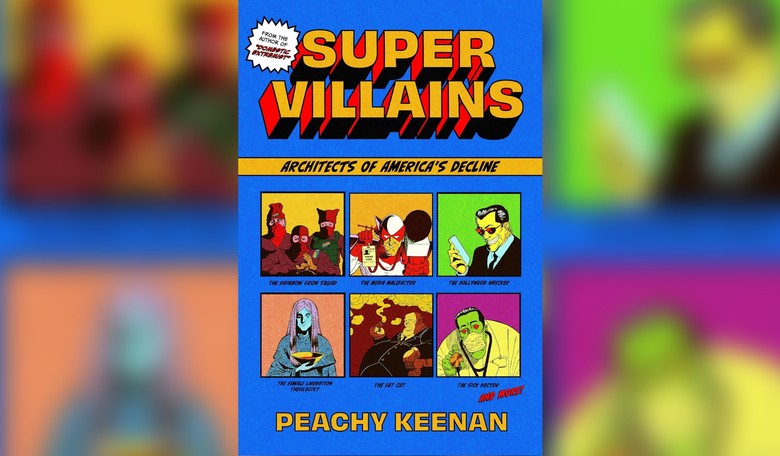
That was the spirit of my conversation with Peachy Keenan on my Dangerous Laughter podcast. We discussed her new book, Super Villains: Architects of America's Decline, an irreverent examination of the personalities and movements Keenan believes are undermining America's cultural institutions, traditions, and values. And she's not afraid to name names.
Keenan is a fascinating character: a mother of five, practicing Catholic, professional writer, and self-described domestic extremist. Her previous book, Domestic Extremist, established her reputation for blending sharp cultural criticism with humor. Her latest effort takes that approach further, assembling a rogues' gallery of people she believes have helped push America in the wrong direction.
But before getting into the villains, I wanted to understand the woman behind the pseudonym.
Keenan grew up in Pacific Palisades, Calif., in a politically Republican but largely secular household. She attended an elite all-girls school and an Ivy League university. Like many young women of her generation, she absorbed the prevailing cultural attitudes of the 1990s: feminism, abortion rights, and the assumption that voting Democrat was simply part of the required package.
That began changing through conversations with her future husband. Their debates about politics, morality, and abortion challenged assumptions she had rarely questioned. Eventually, they embraced Catholicism and made faith central to their family life.
Her professional career took her to Hollywood, where she wrote copy for major entertainment brands, including Disney and HBO. By 2019, she was increasingly interested in political commentary and began writing under the name Peachy Keenan. The pseudonym offered some protection in an industry where openly expressing conservative opinions could jeopardize a career.
Think about that for a moment. An industry that constantly celebrates diversity and inclusion apparently has considerably less enthusiasm for diversity of political opinion.
That experience helped shape the perspective behind Super Villains.
I asked Keenan whether the people she identifies as villains recognize themselves as such. After all, nobody wakes up believing they're the bad guy. Even Thanos, the infamous Marvel villain, thought he was saving the universe. His solution — eliminating half of all life — was extreme, but he considered it necessary for the greater good.
Keenan sees a similar dynamic among today's cultural revolutionaries. They don't view themselves as villains. They believe they're the heroes fighting for a better society. In their minds, those who challenge their precious worldview are the dangerous ones.
Part of her inspiration came from the treatment of dissent during COVID. People who questioned lockdowns, vaccine mandates, or prevailing cultural narratives often found themselves labeled irresponsible or dangerous. Some faced censorship and professional consequences simply for expressing disagreement.
Her concern is that America has increasingly moved toward an ideological orthodoxy in which debate is replaced by intimidation and conformity.
I've watched these political and cultural transformations unfold for more than two decades. Donald Trump's entrance into the 2016 presidential race was one of those defining moments. While Washington's establishment dismissed him, I recognized that he was connecting with voters who had grown tired of being ignored by the people claiming to represent them.
Keenan understands that same appetite for disruption. And one of the most interesting aspects of our conversation was the role humor plays in challenging established power. We discussed Saul Alinsky's observation that mockery is one of man's most potent weapons. It's an interesting irony that someone associated with the political left understood so well the power of ridicule.
I also brought up Aristophanes, the ancient Greek playwright who made a career out of mocking politicians and powerful figures. His work reminds us that political satire isn't a modern invention. For centuries, comedy has challenged authority, exposed hypocrisy, and reminded the powerful that they aren't untouchable.
Related: Let's Laugh at the Left's Supervillains With Peachy Keenan
Another revealing part of our conversation involved Keenan's experience as a mother of five. She believes marriage, motherhood, Catholicism, and raising a large family have become surprisingly countercultural in certain circles.
She recalled being pregnant with her third child when a neighbor reacted with disbelief. Later, while expecting her fifth, a colleague casually asked why she hadn't considered abortion after already having four children.
Her response was simple: She is Catholic, and she wanted the baby.
That exchange illustrates a larger cultural divide. What previous generations considered ordinary family life can now be treated as something requiring explanation or justification. The nuclear family has become the enemy.
We also discussed what Keenan calls the divorce evangelists: social-media personalities who portray divorce as liberation and marriage as an obstacle to personal happiness. Their message turns normal marital challenges into a feminist crusade, persuading women that trading husbands for a lifetime of bitterness is somehow a victory — leaving them to embrace the role of the miserable, unmarried wench.
Our discussion also touched on prominent figures featured in her book, including California Gov. Gavin Newsom, Dr. Anthony Fauci, entertainment-industry executives, and political and cultural activists. Keenan believes they represent different pieces of a larger movement that has reshaped American institutions and challenged longstanding cultural values.
Readers won't necessarily agree with every characterization in Super Villains. But that's not the point. The more important questions are who shapes our culture, who influences our children, who decides which opinions are acceptable, and who holds the powerful accountable when they abuse the institutions entrusted to them.
That's where Peachy Keenan's book hits its mark. In an age when powerful people increasingly demand to be taken seriously while treating dissent as an offense, satire becomes more than entertainment. It becomes an act of resistance and strips away the self-importance, exposes the hypocrisy, and reminds those who think they control the cultural conversation that they don't own the punchline.
And sometimes the best way to expose a supervillain isn't to give him another microphone. It's to make him the joke.
That's the power of dangerous laughter — and why Peachy Keenan is wielding it at exactly the right time.