






The Board Is Set; The Pieces Are Moving
[NOTE: For my latest updates on Hurricane Sandy, follow me on Twitter.]
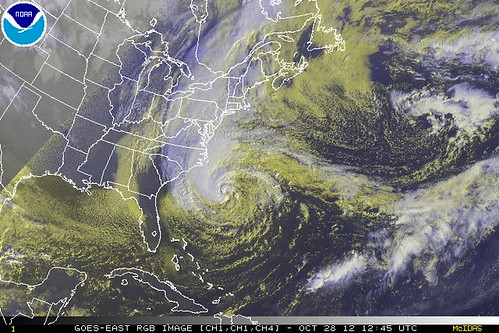
Hurricane Sandy’s barometric pressure dropped from 960 millibars at 5am EDT to 951mb at 8am, and new convection is appearing around the center. The lessening of wind shear, and the influence of the warm Gulf Stream waters underneath Sandy, are having the expected effect: deepening of the low pressure at the storm’s core. Meanwhile, the wind field continues to expand, to historic proportions. Sandy is now the largest hurricane in Atlantic history, with its tropical storm-force winds having a diameter of more than 1,000 miles!
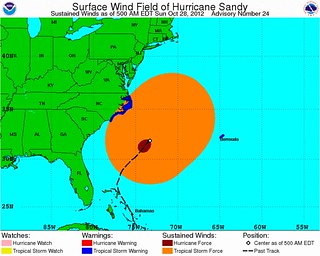
The computer models continue to forecast this storm remarkably well, particularly given its uniqueness and complexity, and there’s really no reason at this point to doubt the remainder of their prediction: Sandy will keep getting better organized today, will “bomb out” tomorrow — not long before landfall — into a monster storm with possibly record-low pressures for the Northeast/mid-Atlantic, will hang a sharp left turn into New Jersey, and will bring a huge, devastating, life-threatening, wind-driven storm surge (worsened by extremely high surf and astronomical high tide) into Long Island Sound, New York Harbor, the south shore of Long Island and the Jersey Shore. Coastal damage will be extensive. Wind damage will also be severe, including well inland, due to the sustained battering and the possibility of unusually extreme gusts due to PV towers and tropopause folds. Property losses will be extraordinary. Loss of life is probable if people do not take this storm very, very seriously.
After making landfall, Sandy will finish its transition to an extratropical (but still-powerful) storm, and will dump heavy snow on portions of West Virginia and Pennsylvania. Elsewhere, it will dump heavy rain, producing inland flooding in some areas (though it probably will not be as bad as the devastating inland floods from Irene, because the ground is less saturated). Millions will lose power, many through Election Day and beyond.
If you’re in an impacted region, today is your last day to prepare. By tonight, weather conditions will already be deteriorating. So, as the weather service always says at times like these, “Preparations to protect life and property should be rushed to completion.” (Preparedness links can be found at the bottom of this post.)
If you’re in a surge-vulnerable coastal area, you may need to leave. Listen to what local officials say about whether you should evacuate — unless you live in New York City, in which case you should ignore your foolish mayor and, if you live in Zone A or Zone B and are vulnerable to a possible surge of up to 10 feet, GET THE HELL OUT! (Criticism of Bloomberg’s bizarre, inaccurate press conference yesterday is damn near universal in the meteorological community. I’ve never seen anything like it.) Wherever you are, DO NOT STAY PUT, IGNORING EVACUATION ORDERS, SIMPLY BECAUSE YOUR HOME WAS FINE IN SOME PREVIOUS STORM. Every storm is different, and this storm will be historically bad in many places. If you’re ordered to leave — leave. If it’s even suggested by your local officials that you leave — leave. Do not risk it. It’s not worth it.
Beyond that, it’s difficult to think of new things to say about Sandy. Assuming the computer models — so accurate to this point — aren’t totally out to lunch, we basically know what the storm is going to do, and where its center will go (with the computer model forecast “envelope” now being essentially from South Jersey to North Jersey), and what its impacts will be. We’re now pretty much just waiting for it all to happen. The board is set; the pieces are moving.
Connecticut meteorologist Geoff Fox writes:
Hurricane Sandy is less than two days away. It is a major threat to our state. Don’t think that kind of weather doesn’t happen here, because it does and there’s every indication it will!
I am fearful. I suspect fear is now a common emotion in Connecticut. It is warranted.
What struck me today is how few surprises there were. Considering Hurricane Sandy has a structure like no other storm we’ve seen and is taking a path unlike any I’ve experienced, the computer guidance has been amazingly consistent.
Consistent model agreement implies the computers have properly latched onto Sandy’s salient features.
What’s come into sharper focus is the potential for shoreline flooding. If the guidance is right this will be a coastal inundation of historic proportions. The damage and destruction will be the most seen since the Hurricane of ’38, maybe more! …
Stay safe. Protect your family. Protect yourself. Be smart.
UPDATE: Bloomberg has ordered a Zone A evacuation in NYC, thank goodness. I’m still a bit concerned about Zone B, or at least parts of it. The water level at Battery Park is currently forecast to exceed 11 feet at its peak. That would break records.
More this evening. I intend to do a live tidal gauge / radar / satellite / wind gauge / etc. post, like I did with Irene and Isaac. That will go live sometime tonight. Stay tuned.





Sounds like the Bloomberg wants to be the Ray Nagin of 2012. How can anyone in public office be so irresponsible after Katrina and the near miss that NY experienced last year. It is clear this is a monster storm. Two days ago my son in South Florida was getting lots of the backwash with nasty winds and huge rains – it closed the kids school in Palm Beach. That is testament to the sheer size of the thing. Interesting, that the computer models have been so accurate so far with an apparently atypical storm. As always, thanks for your reporting.
What is it with PJ media that it posts drivel from someone that has no idea on severe weather. This guy, LOY, blew it with Isaac. Everybody in FL with hurricane experience (including the mighty Rush) knew it was coming nowhere near Tampa.
If you want the straight skinny the local weather TV in Tampa (FLA) and Fort Myers (NBC) has it best.
Way too much hysteria.
Even money this track is way off. There is a ton of wind sheer.
Geoff Fox says, “The 00z GFS still shows landfall on the Jersey Shore late Monday evening. From there Sandy heads inland, then southwest. That’s new, but changes little!”
I’m not seeing this southwest turn depicted anywhere. Can you tell me more about the change in path that he refers to? I’m in the path from NJ to PA. I guess Sandy’s big enough that it doesn’t matter if the track is 20 miles or 60 miles from my house, but I’d like to know.
As a 60yr old born and raised in New Orleans I can give some advice on hurricanes. I hate to see hundreds of miles of stopped traffic during an evacuation. I have evacuated in the past and it’s not fun, especially with 15 cats, 2 dogs, telescopes, office documents, computers and photographs.
Most damage is done by tidal surge and flooding. Wind impacts mostly trees, electrical poles/wires and poorly built roofs. In south La we’re very flat so any flood water tends to spread very wide and far so the problems on the east coast are going to be a bit different.
For coastal areas that are relatively flat I would evacuate if I were at an elevation 10 feet or less of the predicted tidal surge. But that also depends on the geography and and which way will the prevailing wind comes from as the storm approaches and which direction the wind switches too as the storm moves. If you are in a cove that will pile up water at the back end of the cove, be aware of higher water than predicted. In Pass Christian, Ms. during Katrina, the coastline receive about a 25′ tidal surge. At the back of the bay the surge reached 45′. So be aware of your geography.
For those that live in hilly or mountainous areas the danger is rain and the water funneling down valleys. During hurricane Camille, more people died in West Virginia than in La or Ms. Over 50 people of one family were washed away down a valley. Look at the videos of Irene in NY, Vermont etc. The water washes away everything in it’s path. So if you live in a valley and are expecting a lot of rain, consider leaving. If you live near large trees that could crush your house and you, consider leaving.
Get lots of drinking water, canned food, mre’s, pet food, ice and beer (good for bartering and getting help). Fill up all the vehicles with gasoline. Get your perscriptions filled. There will be none after the storm passes. If you have a chain saw, have lots of gas, oil, bar oil and multiple sharpened blades. Chain saws and tractors are very useful after a hurricane.
I guess my point is to not evacuate if you feel you are geographically safe but do evacuate if it’s borderline. If you stay behind be sure to stock up for a week or 2 of no services.
Good luck and God speed,
Lowell
Ponchatoula, La.
Lester, Brendan Loy knows a heck of a lot more about tropical cyclones than you do. This is a unique situation in which we have a hybrid tropical/non-tropical storm. Wind shear is not going to tear this thing apart like it would a typical hurricane. In fact, the strong jet stream energy coming in from the west over the next two days is going to further Sandy’s transition into a non-tropical storm and deepen the pressure even more. The central pressure should bottom out right around landfall.
I question the timing.
There are two people whose contributions this thread would be better off without. Max von Shtupp’s comment is so inane as to be laughable and lester’s comment is extremely silly, coming from a position of clear ignorance with a large axe to grind. The more worrying person making those sort of comments is Bloomberg. I very much doubt that he would win any re-election attempt to the mayorship of New York City were he to try after this coming debacle. Thankfully even after the change in the term limit from 2 to 3 Bloomberg will out of city hall after the next mayoral election.
A friend of mine lives in Brooklyn and although he is high enough to be out of any realistic danger from the storm surge he is still quite worried. I think the two worst things from this storm will be the likely flooding of the NYC subway system and the sheer size of the area affected. The flooding of the subway system if it happens will delivery a body blow to the economy of the tri-state area. Happening on top of the other likely effects of the storm it will be horrendous for the New York City economy as well as those of New York State, New Jersey and Connecticut more generally.
Brendan Loy, weatherputz:
Instead of engaging in hyperbolic conjecture, would you be so good as to, if you’re not too busy, explain to us mere mortals the following bizarre contradictory info promulgated by, I guess, the idiots at NOAA and such.
I have provided the links.
Why is the observable data from buoys totally out of sync with the BS from guys like you?
http://www.ndbc.noaa.gov/radial_search.php?lat1=32.8N&lon1=71.9W&uom=E&dist=300&ot=A&time=3
Note the wind speeds and gust speeds. Yes, it’s rainy and windy. It’s a hurricane! REALLY rainy and windy. Just not THAT rain and windy.
http://www.nhc.noaa.gov/text/refresh/MIATCDAT3+shtml/281459.shtml?
Why, if we plot these data points, do we find Sandy about 50 miles due South of Fire Island (probably between Fire Island Inlet and Moriches Inlet)at approx 11 AM Tuesday, when you and your apocalyptic buds say it will be in West Virginia by then?
Maybe Bloomberg ain’t so stupid. Do you have a billion dollars? You don’t get that by being stupid, twice. I’ve been through 12 Long Island hurricanes, and Bloomberg’s description is much closer to observed reality than your movie script allows. The water rises, the water recedes. The shore of the Great South Bay is full of hundred year old houses, right at the waterline. Those barrier reefs sure do work good! New York City is not built like New Orleans. It’s brick, granite, and steel. The breakwaters are not mud mounds, but steel and concrete and stone walls, 20 feet thick.
I watched the buoys in real time during the last stupid hurricane, and the data never, ever matched with yours (not to worry. It isn’t just you. No buoy ever recorded hurricane winds at any time over the 24 hours prior to landfall). As I am a mere engineer, I wouldn’t presume to discern a conclusion based on mere factual data, so I am curiuous about the methods of necromancy you and your compatriots in the weather ozone use to defy what NOAA and their National Hurricane Center are clearly saying.
Pray enlighten us, instead of just blowing more disinformation, wishful thinking and incoherent jargon to us mere trogs.
Crying wolf is always a bad idea, or didn’t your Mom ever tell you that? If NOAA’s wrong, you need to refute these links. Don’t be Michael Mann, for God’s sake.
I’ve lived my whole, long life within stone’s throw of the Gulf and the Atlantic. My home is about 6 feet above mean high water. If there is something to this, I’d like to know. But I’ll never know, since every weatherputz now acts like a CNN reporter, all breathless and factless. Another reporter standing on a rainy and windy beach is just not interesting,. I don’t even know why they bother. It must be like hazing at a fraternity.
Pray enlighten me otherwise. If you actually know.
Considering the economic impact, can the NYSE and other trading companies handle being without power for days on end? And can the headquarters of the major banks handle it as well? I guess we’ll find out soon enough.
http://www.nhc.noaa.gov/text/refresh/MIATCPAT3+shtml/252035.shtml
SANDY EXPECTED TO BRING LIFE-THREATENING STORM SURGE FLOODING TO
THE MID-ATLANTIC COAST…INCLUDING LONG ISLAND SOUND AND NEW YORK
HARBOR…
THE WATER COULD REACH THE FOLLOWING
DEPTHS ABOVE GROUND IF THE PEAK SURGE OCCURS AT THE TIME OF HIGH
TIDE…
…LONG ISLAND SOUND…RARITAN BAY…AND NEW YORK HARBOR…6 TO 11 FT
John J, I’d rather guess on the heavy side with something like this than “Shouldn’t be too bad”, and then try to explain to trapped/flooded people why I said that.
“Crying wolf is always a bad idea, or didn’t your Mom ever tell you that? If NOAA’s wrong, you need to refute these links. Don’t be Michael Mann, for God’s sake.
I’ve lived my whole, long life within stone’s throw of the Gulf and the Atlantic. My home is about 6 feet above mean high water. If there is something to this, I’d like to know.”
Here’s a clue to help you out Sparky, as of around 9:30 pm Eastern time, the storm surge at Battery Park is over 3 feet, for Irene it PEAKED at 4.
How freaking hard it that to understand?
Let me add the hurricanes of my familiar to beat JohnJ about the ears with. A picture of the Escambia Bay Bridge post-Ivan, 2004. A bridge, mind you, on the north end of an inland bay that has no direct, open avenue to the Gulf, but caught a 20 foot storm surge, floating 58 slabs off their piers and damaging another 66 beyond repair. The people on the coast, if you could find the wood from the houses, looked a good deal worse.
Front Beach Drive, Biloxi, post Katrina’s surge. Where once there was the most beautiful line of almost TWO HUNDRED YEAR OLD antebellum homes ever, full of families who stayed put because THEIR homes had “made it through Camille”. All slabs the day after.
Aw, what the hell. We were in Jacksonville, NC for the “Eyes of ’96″. At the end of THIS post, there’s a series of three pictures of some condos at Topsail Beach, NC, before and after. Hurricanes Bertha and Fran, Cat 2 and Cat 3, which came in 56 days apart on a virtually identical track.
You know what’s the shame, John? There’s always some knucklehead brainiac like YOU, who, instead of offering his knowlege and opinion in a fashion that could help, does what you did and I hope no one gloms completely on to it and winds up on a slab.
CptNerd: All of the major players have global diversity backup. If the primary datacenter goes down everything automatically flips over to a datacenter in another geographic location.
I am also curious why the closest buoy to the current hurricane (buoy 41001) shows no current wind reading or history the last two days above 49 knots? btw If I were in a low lying area I would be evacuating but there has to be some explanation.
Underground weather at thelink you provided also includes readings from the latest hurricane hunter http://www.wunderground.com/tropical/tracking/at201218_hd.html
The highest recorded wind speed is 65.
Educate us please. I am not trying to minimize the danger of this storm but these are legitimate questions.
For those who might be staying in flood prone areas. Make sure you put a hatchet or something in your attic to chop through the roof when the water reaches your ceilings. To many died in Katrina, in their attic, scratching at their roof.
Also, if you survive, the bodies will be in the trees so look up, not down. The children will be the saddest since they will have had no choice.
John
I don’t know what engineering school you went to, but you can’t read lat/lon coordinates OR apparently understand GMT/Z times. Nowhere in the NHC time series on the discussion you linked to is there an 11am Tuesday time and the coordinates for Tuesday morning (39.8N 75.8W at 8am EDT Oct 30) place the center of Sandy just north of DE in SE PA – pretty much in line with all of the forecasting by the NHC for the past few days. (Not “50 mi due south of Fire island” – read maps much?) BTW – that same discussion says that as the transition/merge with the system heading east completes “THIS TRANSITION IS EXPECTED TO BE COMPLETE WITHIN 24 HOURS…BUT IT WILL NOT DIMINISH THE OVERALL IMPACTS FROM WINDS TO HURRICANE STRENGTH…LIFE-THREATENING STORM SURGE…AND FLOODING RAINS ASSOCIATED WITH THIS DANGEROUS WEATHER SYSTEM.”
All of the national and regional weather forecasts call this hybrid system unprecedented and dangerous. Including the NHC and NOAA – which you seem to think is reporting something different from the information found here. (Again, not sure what engineering school you went to… I hope you don’t build bridges or anything.) Brendan is simply compiling data from multiple sources and putting it out here for us in a convenient format. But you know better. I sincerely hope that you are out of the way of the surge + astronomical high tide (that means the monthly extreme high lunar tides) + up to 20′ swells on top of it, partly because I wouldn’t want emergency responders to have to risk their lives to get you out if you don’t evacuate when you should.
Brendan
I’ve been checking in with you during the big storms since Katrina, and now that you have work and family to attend to I, for one, really appreciate your continuing efforts slogging through all the news and updates from seemingly everywhere, and the materials from the WeatherBell guys, which I would otherwise not have access to.
phaedruscj
If you read the NHC discussions, they mention the 65mph winds near the center – but say that there are higher winds to the southwest in this storm than near the center, which is why they are still giving it hurricane status (for now). They also anticipate some strengthening tonight while Sandy is over the gulf stream – up to around 80mph sustained. It is entirely possible that with large swells the surface buoys are not reliable wind gauges. If they were we wouldn’t need hurricane hunter planes and satellite measurements. I see a shipboard gauge that is getting consistently higher readings (presumably not a small ship out in that) but don’t focus on a wind speed number. The wind is high enough. Duration, rain and tides and swells will do the damage – and in the more westerly and mountainous areas of VA and PA, the heavy wet snow. I’d be happy if every forecast was wrong and it suddenly went bust, but I wouldn’t bet my LIFE on it.
Even money this track is way off. There is a ton of wind sheer.
Good call, lester.