






Wisconsin and California Show that Local Taxes are a Political Death Trap
Here’s a simple piece of arithmetic to keep in mind after Wisconsin voters overwhelmingly supported Gov. Scott Walker and California voters backed pension cuts for retired municipal workers. I reviewed some of these numbers last October in this space, and add some state-level detail below. Back on Jan. 24 I insisted that “Obama is toast” because of the rotten economy. It’s sure starting to look that way.
State and local property tax collections (blue line in the graph below) have risen by 10%, from $400 billion to $440 billion, since 2008, even though the price of homes in most American markets (red line) has fallen by 30% since 2008. Your house is worth less and your property taxes have gone up. Most of the $440 billion in property taxes is paid by homeowners. That compares with the $380 billion a year or so that homeowners pay on the $10 trillion in outstanding home mortgage debt. Homeowners now pay roughly as much in property taxes as in mortgages interest. It used to be a quarter to a third as much. No wonder home prices remain depressed.
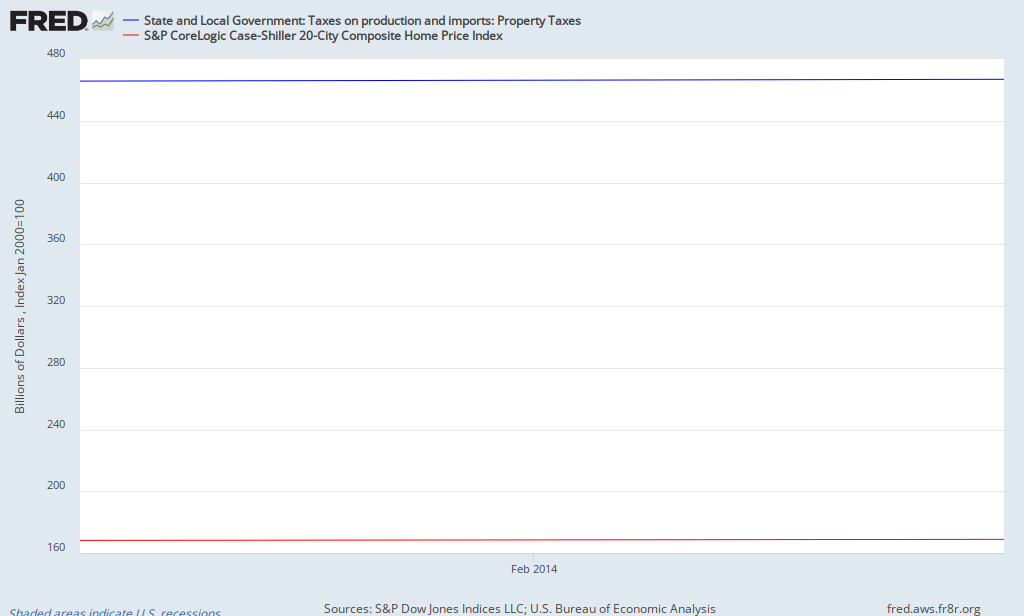
Things are even worse in Wisconsin than in most American states. As shown in the chart below, property tax collections have risen by nearly $25 billion, or almost 20% in Gov. Walker’s state, compared to a 10% increase nationally. No wonder Wisconsin voters backed Walker by a margin of nearly 3:2. There are a lot more people paying property taxes to pay the salaries and benefits of government workers than there are government workers.

California is the worst of all: Despite one of the weakest housing markets in the country, property tax collections in California spiked by nearly 50% since 2008.

State and local government spending doubled since the property boom began in 1998:
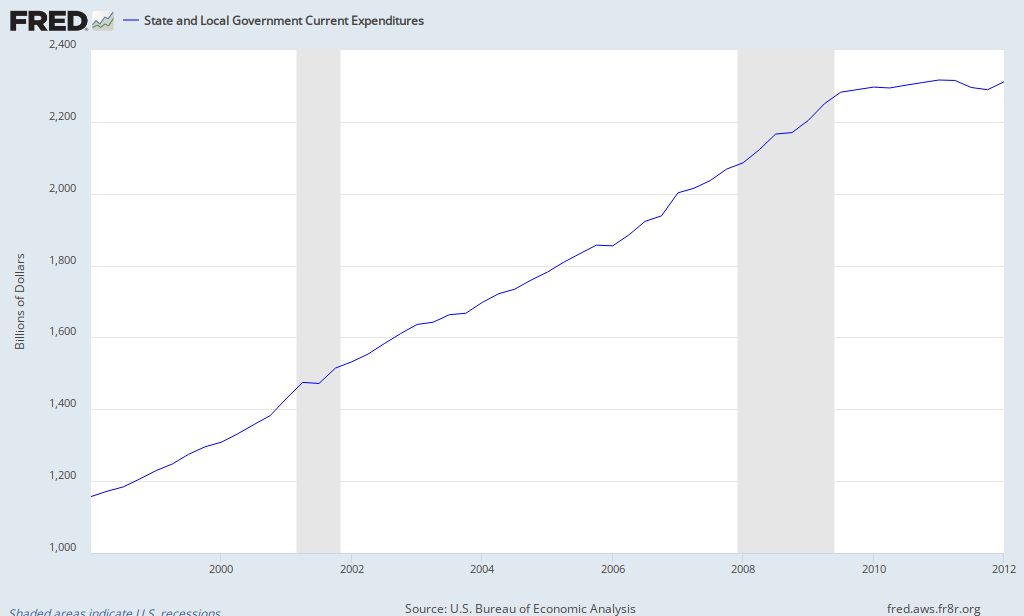
The federal government’s spending rose even faster, but it is borrowing $1 out of every $3 it spends, but state and local governments can’t do that by law. So they have pushed up tax collections even while federal tax collections have fallen.
Federal (Left-hand scale) vs. State+Local (Right-hand scale) Tax Collections

Source: Census Bureau
Because it’s easier to push up property tax rates than to pass new sales or income taxes, that’s where the incremental tax burden has fallen.
Property Taxes as a % of Total State and Local Tax Collections

Source: Census Bureau
State and local governments are standing on the sore toe of the American middle class–the housing market. It’s much worse than under the Carter administration. During the 1970s, home prices tripled while consumer prices doubled, so the net worth of the middle class actually rose. Now the 30% collapse in housing prices has wiped out the net worth of perhaps half of American middle-class families, at a moment when less of the population is working than at any time since the data have been kept:




64% employment-population ratio for men? So roughly 4 out of every 10 men are under or unemployed? Seriously?
You’d think Romney might mention this a few times…
High testosterone, alpha male politicians do not care about average men. They specialize in manipulating women. Ordinary men have the jury box and ammo box as viable expressions of will; opinions and elections are very safely ignored.
Obama openly praises the Stonewall riots, and even Republicans praise the civil rights movement. They don’t even hide it anymore. Men are not taken seriously outside of some sort of use of illegal power, at a minimum the mass destruction of property. Even the ultra wealthy and/or erudite, the National Review crowd, can only pretend to have any kind of influence. When has that crowd ever changed history?
The video game playing, dope addled, service economy losers will be seen (accurately) as expendable fools until they start smashing windows, and other things. Occupy Wall Street with teeth, when they start acting like the men on their t-shirts. It would actually accomplish something. Probably negative, but that’s how creative destruction works. Or, they can vote Demublican and wonder why nothing ever truly happens, nothing but a downhill decline.
Ron Paul’s failure just shows that the majority will never vote for its freedom. A minority has to fight for it. If you don’t like taxes, then just don’t pay them, and you can eventually change the system like Greece. Or, vote and pay your (and his) bill, like Germany.
Huh? Um creative destruction has nothing to do with smashing windows. It is when an industry or technology becomes obsolete in the wake of innovation.
There’s no point in responding. I think Higher Game’s incomprehensible rant was generated by a bot.
I suspect that number includes those who exited the work force, including those retired, not just those unemployed.
Raymond,
That is correct. It is an employment to population ratio so it compares all men in the population to all men who are working. Therefore, unemployeed, students, retired, disabled, discouraged are all in the denominator.
The bottom line is that it does not matter why someone is not working. They still need shelter, housing, medical care etc. The money to support those not working has to come from those working. Another example that there are fewer people pulling the wagon and more people riding in the wagon.
I’d really love to see an analysis of that last graph, and perhaps extend it to before WWII. How much of it is policy and how much the effects of the war wearing off?
You’d think Romney might mention this a few times…
But he won’t. He might mention it to camera once or twice, but that’s just to punch the clock. There’s a score of urgent facts that Mitt has not covered, and won’t. Watching elections is to get a fresh validation of the reality we don’t have an opposition party, and desperately need one. When I watch the discourse, even on Fox or in the WSJ, my first thought is, hey, the Republicans seem to be playing along with the socialists again. Like it’s a conspiracy! Nah, they’re just RINOs. And that sullen beast exists, and wins control of the opposition because Marxism long ago spilled over from the Democrats to them.
The charts Spengler put up here, but all that is supposedly too complicated or too time consuming to cover. This is how fictive realities are born, supposedly necessary filtering by putatively objective news entertainers. It’s a Kabuki, and RINOs look funny dancing cuz they’re so big.
High testosterone, alpha male politicians do not care about average men.
True, and in practical terms that lack of caring translates into effectively anti-American policies. But it’s verboten to ever question another’s loyalty as an American. The loss of that tool, the ability to point out what’s clearly true and urgently dangerous has left us unable to defend ourselves.
One might HOPE that Obama is toast. Yet the mainstream media worships him and his allies on Wall Street and the D.C. bureaucracy may be able to temporarily boost the economy in the two months or so before the elections, or at least fudge economic numbers to make it look that way.
There is an anomaly in the property tax data for California. Proposition 13, in 1978, froze property tax assessments for homes that did not change hands and allowed only 1% per year increases. A spike in tax rates then can only mean that homes are changing hands at an increased rate. This must be related to the housing crisis in that sales and foreclosures have accelerated the rise in property tax rates. Banks are paying those taxes, I suspect.
I have one of those “grandfathered”, Prop-13 homes, and my taxes this year – inexplicably – went down slightly.
Perhaps we finally paid for some street lights.
Well, my property tax is about the same and they finally filled in two pot holes on my street. Which was after the beatified one of the streets running through the town. Of course they can’t fix 1.2 miles of tank traps that they call a road by my street.
I think the conclusion about the cause of increases in California property tax collections is incorrect. Because of Proposition 13, property taxes can only increase by 2 percent per year and must be based upon actual value. While some assessors have been fudging their assessments a bit to keep values inflated so as to justify not decreasing assessed property values, it is highly unlikely that any assessor has been able to justify an increase in assessed values during the past four years. Most Californians therefore have not seen, and cannot be assessed, a property tax increase within the current down housing market, no matter how much state and local governments might be hurting for revenue.
So too, special assessments must be passed by a plebiscite and cannot be assessed in lieu of a property tax increase. I am not aware of any significant assessment passing in a California city or county since the beginning of the housing downturn.
What most likely accounts for the increase in property tax collections is the first wave of foreclosures following the housing market collapse. Speculative and over-their-head homeowners let property tax liens be put on their properties as property taxes went unpaid. To clear title on these properties, banks or other purchasers at foreclosure sales had to bring properties current on their taxes, thus, the state probably saw an influx of previously unpaid assessments as these foreclosed properties were turned over to new owners. This is more likely the cause of the increase in collections rather than property tax increases that could not, as a matter of law, have been assessed.
I generally agree with the theme of the article and the position of the author, but the conclusions regarding California are incorrect and should not be relied upon in supporting the author’s conclusion.
You missed the point. Whether the banks or homeowners pay the higher taxes is of secondary importance; any prospective new buyer would have to pay the higher taxes, wich depresses the price.
David, you’re a little unclear on California law: whenever property changes hand the value is reassessed and the new owner’s property tax will be based on the new assessed value. This has been the case since Prop 13 was passed. The spike in property tax revenue since 2008 – in California, if nowhere else – is probably what was suggested: a combination of back taxes being paid and new owners paying a higher rate, as they always do. Though for someone buying property last sold in 2005 or 2006, the new owners may well be paying a LOWER rate since home prices are back to maybe 2003 levels in much of California.
I don’t argue that property taxes are overall too high, and that the government has been raising them more than they should. But thanks to Prop 13 California is an odd case. The model here seems to be “spend the money anyhow – then scream that taxes are too low and Prop 13 prevents us raising them”. Spending LESS just doesn’t seem to be on the radar somehow.
The property tax pays for schools, road repairs, police and fire services. These things are generally performed by unionized public service workers. They get good wages and benefits compared to their counterparts in private service jobs. Scott Walker in Wisconsin does have the “answer” this and he actually won against the union driven recall vote.
So Sacramento will get the back taxes, but won’t next year’s bill be based on the (lower post-foreclosure) sale price? The revenue drop gets shifed to the right by a year or three but it will still happen. Also guaranteeing that even if the macroeconomy improves, California’s finances are still bleeped for the foreseeable future….
I appreciate the point that an increased property tax burden will generally depress the housing market, if, e.g., such incremental tax burden prices potential buyers out of the market. But you very clearly attribute the spike in property tax collections in both Wisconsin and California to some affirmative governmental action to increase property tax rates, i.e., “The federal government’s spending rose even faster, but it is borrowing $1 out of every $3 it spends, but state and local governments can’t do that by law. So they have pushed up tax collections even while federal tax collections have fallen.” and “Because it’s easier to push up property tax rates than to pass new sales or income taxes, that’s where the incremental tax burden has fallen.”
But such an action was not taken in California, and for the reasons identified by me and other commenters, legally cannot be taken in California without a popular vote of the sort that Jerry Brown has been lobbying for since he took office. So California’s increase in property tax collections was not due to an increase in rates.
Further, if the increase in collections was due to a spike in collection of past due taxes following foreclosures by the noteholder, this cost would have only a marginal impact on the market itself. Such a spike does lower the amount of capital available to invest in housing, but it does not necessarily add a cost to the purchase price that would negatively affect buyer’s choices to purchase. Because most of these delinquent tax collections are going to be borne by noteholder, when the property is put back into the market, it will be free and clear of tax liens. Whether the noteholder reselling the property charges a premium on the selling price based upon it having to have serviced the delinquent tax obligations is unknown, but it seems unlikely this cost could be passed along to the next buyer given that the surrounding market will control the price obtainable for the home, without regard to whether the seller incurred greater costs in clearing title.
There can be only two effects on the housing market to noteholders having to service delinquent taxes. One is that noteholders will be less willing to put property up for sale until they believe they can recoup their losses, including the cost of removing property tax liens. This is a plausible explanation for why a housing market may be depressed, but its not the conclusion you are attempting to draw in your article, i.e., you claim that the increase in the incremental tax burden on homeowners is causing the housing market to stay depressed.
The second effect is that financial institutions who are forced to service delinquent taxes to put a property back onto the housing market will have less capital to lend to potential buyers to purchase homes. But again, this is not your basis for your conclusion about the effect of increases in property tax collections. Further, empirically, lenders have ample capital to lend at competitive rates, and other than industry-wide and quasi-governmental restrictions on lending such capital under the riskier conditions that precipitated the housing crash, e.g., zero-down loans, no-doc loans, etc., there are no significant barriers to lending capital to buyers at this time.
Other than the fact that a bubble has burst and the price trend is harshly down.
Other than the fact that the Federal Government is hip deep in dictating lending policies — meaning that no market-scale lender CANNOT avoid making bad loans / risky loans if such an institution decides to play.
Other than the US Government is hip deep in actively providing mortgages itself — causing lending margins to seriously compress — especially risk adjusted margins.
Other than existing regulations mandate that these same institutions delever their balance sheets, pronto.
Other than real estate prices track only one thing: the ability to finance — which in non-bubble markets means WAGES.
Real wages are trending flat to down — especially in California.
Should government action ever reverse this trend, real estate prices would vault straight up out of the grave.
Until then, the market is a bleeder. History suggests that this can limp along for a generation, or two.
What struck me about the last chart is that since 1950 only once, during the 1980s, did the post-recession increase in workforce participation ever climb back up to what it had been immediately before whichever slump. The pattern holds all the way back to the 1950s; each recession (with the single exception) has resulted in a permanently lower percentage of the male population in the workforce. I can understand that those who were already near retirement age might have just gone ahead and hung up the cleats, but the boomers’ entry into the workforce from 1962-1982 should have dwarfed that effect, if the boomers’ labor force participation rate as a subset was at least equal to the overall male workforce participation rate. Additionally, with increasing lifespan and better overall health in the population, there ought to be some offsetting influence of older workers working longer. And the 1950s era, which predated the Great Society’s paying people to stay home, shows the same permanent loss of workers. It also predated the flood of women into the workforce, so those missing men weren’t being replaced by female workers. So what gives? Any thoughts?
I’ll take a guess: pensions. There was a large number of industrial workers from the early 20th century retiring in the 1950s and ’60s. They were the first wave of workers to be covered under pension plans (and Social Security). Because the retiree-to-worker ratios were so good back then, the plans could afford to be generous and there was no incentive for many of these workers to remain in the work force past the minimum retirement age. I had a great-uncle of that generation who retired in the early ’60s and lived to 1987, enjoying a generous pension the whole time. I think that would have more than offset the effects of the early Boomers entering the labor market. The 1980s ramp-up that you noted coincides with the collapse of the private-sector industrial pension plans.
The increase in the number of women in the workforce had to have something to do with it, also the number of illegals and temporary legal workers, who are not fully accounted for in the population figures.
What? State and local govs can’t borrow like fedgov? Municipal bonds anyone?
The proceeds from municipal bonds can’t be used for the city’s operating expenses; only for capital projects. By law, their budgets have to balance every year, whih is unlike the federal government which can pay for an unbalanced budget by issuing more Treasury bonds.
Except, CA under both Davis and Ahnold IIRC, did pass bonds to pay for operating expenses – the carrying charges are just another small bite that adds to the structural deficit in Sacramento.
Another issue in California is how the burden falls on households. Buyers who purchased during the boom have a much larger burden relative to the longer term property owner – 10 years +. Given the meltdown in the Inland Empire and outlying bay area markets (plus Sacramento and Central Valley)the property tax issues are even worse. Imagine paying high taxes on a house with no or negative equity.
No, everybody has re-fied a couple times already. The home is re-assessed and the property taxes adjusted. This stuff works out, it just looks awful during the process.
Mr. Goldberg, nice article and interesting. Taxes are and pretty much have been an excellent election issue. Tax burden is both a real threat and a tactical campaign lever.
Please though, there is no need for presentations like the graph “Federal (Left-hand scale) vs. State+Local (Right-hand scale) Tax Collections.” The scale on the right is strongly amplified to make it look almost as though state increases balanced Federal decreases. Not at all, the total state increase in tax covered perhaps 10% of the Federal decrease. Leave bad graphing to the left.
Just curious, does anyone know if there are any safeguards against abuse by assessors? How do homeowners ensure that their home is not overly assessed or that they have been targeted for an assessment because of their political beliefs? Am I being paranoid or is this scenario possible? Are assessors held accountable or audited in any way to prevent abuse? It seems as if the tax takers have most of the power and the taxpayers have little power to control ever increasing taxation.
Hire a lawyer who specializes in property tax valuations and reductions. They usually charge a percentage of the savings.
We poor suckers in California enacted Proposition 13 in 1978 for that exact reason: assessors were taxing people out of their homes simply because someone sold a house on their street for a Carter-inflated price.
But even with Prop 13, I see here that our esteemed Gov. Moonbeam is ramming more taxes upon us to pay for him allowing public workers to unionize the last time he was governor.
First ol’ Jerry said we were $9B in deficit. Now it’s $16B and, knowing Dem pols, I’m sure that’s untrue also.
All to pay for his union butties to retire early with fat pensions and full medical.
FDR was opposed to public employee unions while supporting private employee unions. He was well aware that governments would give in to the public employee unions because they could raise taxes to cover the costs. While private employers operating in the free market couldn’t raise prices without giving their non-unionized competition a big advantage over them. The UAW for example understood this and made sure all the US auto makers were unionized so that none had an advantage over the other. The crunch came with non-union Japanese auto plants who thus had an advantage over our domestic producers.
In California and I assume in other states you can appeal the assessor’s valuation. Forms are available at the County Assessor’s Office, and if you are lucky they are available online. Typically you must do some market analysis of similar homes to yours which have recently sold, in order to demonstrate their current market value. Here in California I was happy to pay a modest fee to http://www.easytaxfix.com, which provided choices of the nearby similar properties, let’s you make minor adjustments, and then you print out and mail in the forms. Several times in the past few years I have saved many hundreds of dollars, including about $800 in one instance.
In general spot on. Obama is toast, but, as with last night’s election coverage and the laughable “exit polls” it is in the MSM’s interest to pretend it’s close, if only for their ratings. (They also need to keep the Democrat morale from completely collapsing (ala Republicans in 2008) to save as many Democrat Senate and House and state seats as possible.
My only quibble is with David’s explanation of the post-2008 property tax increases (as a percentage of state and local total taxes), which he assumes are because rates are going up. I suspect it is more a function of declines in sales tax collections and lagging property valuation (usually on 2-3 year intervals); elected local officials raising rates would have felt the electoral pain first.
No, absolute collections are going up as well. Read the article.
Yes, the collections went up, but that could be a function of the lagging, look-back nature of property valuation. The 2006-07 bubble effect would not be reflected in valuations fully until 2009 or 2010, which would drive property taxes up without any rate increase. (Speaking from experience, that also drives taxpayer anger up, although it initially is focussed on the County Assessor who tries to explain that your current 2008-09 cratered valuation is legally irrelevant until the next cycle of valuation in 2010!)
Although I would love to attribute Scott Walker’s victory to the economy and a rise in republican supporters, I suspect that it was more of a matter of principle. A large number of voters disagree with the idea of a recall election and will vote for the incumbent anyway. Source: http://politicalwire.com/archives/2012/06/06/many_didnt_think_recall_was_legitimate.html
I would not get optimistic about Obama’s re-election chances just yet. Bush won his second election even when most people suspected his losing–Kerry wasn’t much of a replacement, so the democrats decided to be patient and wait for the next round. There was talk of Hillary running days after Bush’s second win.
Romney will need the Ron Paul vote if he wants to assure himself of victory, but that is unlikely.
“Romney will need the Ron Paul vote if he wants to assure himself of victory…”
HAHAHAHAHAHAHAHAHAHAHAHAHAHAHAHAHAHAHAHAHA
OK, I got it under control. Really. I promise.
HAHAHAHAHAHAHAHAHAHAHAHAHAHAHAHAHAHAHAHAHA
David
Bush’s reelection was one of America’s most shameful moments. We needed anyone but Bush then, even John Kerry; the race honestly should have been Kerry vs Nader. Nader would have been great.
Most recall elections are absolutely legitimate, and most incumbents deserve to lose their jobs. Romney’s disrespect towards the Ron Paul movement exposes this election as a rare case where the only honorable choice is third party.
Reagan was the last president to deserve reelection.
Kerry v. Nader?
Breathtakenly Stupid!
Of course blue states are made to look bad but no analysis of Bus’s criminal tax cuts for the rich, which were a disaster for women, children, minorities, and gays. Obama is bringing fairness back to America, which is why he will beat the out-of-touch corporate raider Mitt Romney.
Wow, penetrating analysis. By your logic, there are no rich women, no rich sons and daughters, no rich minorities, and no rich gays.
Brian, do you write Eds for the NYT/WaPo?
No, G. Whiz writes for his several mirrors.
And just what, pray tell, do tax cuts have to do with Homosexuals *( I will NOT call them anything other than what they are) other than the ‘marriage’ thing, which is a line item in the tax code. FYI, married couples pay MORE then singles do, so IMNSHO it’s a non-starter except for those with an adjenda.
Peter Schiff: Economic Reality Bites 06 Jun 2012
http://marketplayground.com/2012/06/06/peter-schiff-economic-reality-bites/
In 1978, the CA Legislature refused to listen to property owners about people being re-assessed out of their homes, resulting in Prop-13.
Any elected official who refuses to recognize the difficulty that property owners in particular, and taxpayers in general, have with today’s level of taxation v. economic conditions is pointing a gun at his/her own head.
As is repeated endlessly:
What cannot continue, won’t!
“DH
There’s no point in responding. I think Higher Game’s incomprehensible rant was generated by a bot.” I think tweets and comments about Ron Paul supporters allegedly supporting Assad killing thousands of his people (since it’s now patriotic to back Muslim Brotherhood guerillas, apparently) or being Kremlin tools are generated by some DARPA spinoff contractor somehwere in Northern VA or Maryland. See @ReginaldQuill, @LibertyLynx (45,000 tweets and counting) et al.
There is a game changer at work. It’s called DEFLATION. During the Great Depression unemployment skyrockeed to 24%. I think we’re still under 10%. With an out-flux of population from California, because jobs are elsewhere.
Japan is a very good example of DEFLATION. They call the 1990′s their LOST DECADE. And, of course, they had the tsunami.
There really is no recovery. Not on a global scale. Ahead there will be countries that default on their debts. The bankers holding the most paper? The German’s. Who have yet been willing to take a bite. They haven’t suffered any losses.
Will the EU conflate? What’s been keeping it afloat? Merkel’s hands are really tied. It she attempted to underwrite the debts of other countries … she’s a gonner. Her government would go into free-fall. It’s only held together (now that Sarkozy’s been dumped) … by a fearful German population that does not want to “hold the bag.”
China? Losing business. And, over there, there is NO rule of law! It’s the same as the Russian dilemma. But at least in Russia you know Putin is in charge.
Obama? He’s entered Carter country. And, like Carter, those around the president won’t tolerate getting tossed out of their jobs.
How does Obama cope? He smokes. And, he screams a lot. Not sure if Carter screamed much. But he did take after a “killer rabbit” with an ore.
Can things stay bad for 30 years? Yup. Wall Street’s not trusted. And, just keeping interest rates low … still hasn’t encouraged “paper investing.”
Plus, another problem. We’ve OVER-EDUCATED out population! You didn’t know the Greeks did this? Given too much education means you’ve inculcated a fantasy that a college credential gives you a free pass to a high paying job.
Janitorial skills are also not in demand. Too many people compete for the low level pay! What does a college degree mean, here? Well it means you’re probably not illiterate.
“Well it means you’re probably not illiterate.”
I wouldn’t bet on it unless the graduates have a degree in the hard sciences or engineering. You are right about too many people competing for the same low paying jobs and they are competing against illegal aliens who are working for really small pay. Not a good position to be in but with a liberal arts degree what else is there.
Back on Jan. 24 I insisted that “Obama is toast” because of the rotten economy. It’s sure starting to look that way.
Yet Barack Hussein is neck and neck in the polls. When the gubmint buck gets passed down from the feds to the states, the option to print currency goes away. But can Joe Six Pack ferret out that the states are going broke because it’s being FDRd, this time not by Franklin or Lyndon, but by Barack Hussein.
Also, there’s the increasingly popular question how the nearly half of the population who rely on gubmint money will vote. Will they vote to do the right program and unleash prosperity engine using the policy proved by Ron, Jack and Arthur a quarter century ago? Or will they vote for gubmint money they get every month?
If I were Mitt I’d be putting the thought out about who will pay them if the whole economy fails. In that scenario the gubmints would be out of money; who do pays them then?
I’m finding it hard to believe property tax revenues have risen in Florida. Valuations are way down, and have reacted quickly to market conditions. Millage is limited and new forms of assessment limitations seem to come around every year. One factor could be that low prices are attracting foreign buyers -Brazilians and Germans, say, who tend to have money and like to have a bolthole in the sun. As foreigners, they may not qualify for homestead assessment limitations. Also, massive numbers of foreclosures have put many properties back up to market value.
But, still, the picture I see is of local governments retrenching madly and hurting badly for money.
It can actually go up by 2%. And that’s the general state property tax. Lately they’ve taken to adding “fees” because those don’t have to pass a 2/3 vote. And the local school districts and fire districts and ems districts always manage to convince the voters (who are mostly renters) that they need more money for “the children” or some other such nonsense. Governor Moonbeam just added a $150 fee to my tax bill for “rural fire protection”. Not that there’s actually more money going to the fire agencies; the state is taking an equal amount OUT of that agency’s fund and putting in the state’s general fund.
I am now paying nearly $6K in taxes on a property that cost me $230K to build back in 2003. The State will get you one way or another.
On June 12, 2012 will North Dakota be brave enough to eliminate property tax?
I hope so!
http://www.youtube.com/watch?v=cFlTec7R9X8&feature=plcp
Read an article that permitted comments at NYT about the California cities, San Diego and San Jose, trying to cut back public pensions. Even at that liberal site, there were more in favor of cutback than against. Truly the tide is turning.
As unsettling as the property tax situation is, I can only imagine these numbers would have been far higher without the stimulus which didn’t so much create new jobs as advertised but instead largely went to plug holes in State budgets.
As regards budget cutting, we’ve kicked the can down the road at some expense. However the argument was made and still holds, that if the private sector is shedding jobs resulting in decreased tax revenues and increased demands on State programs, is it wise to dump public sector workers?
The other side of the coin is that public sector workers received wage increases often to keep pace with rising housing costs. Carve out too much budget from State employees and they’re going to have to dump more properties onto that already depressed market.
Overall this propping up is unsustainable, but the question is how to have an orderly transition that reflects our current economic reality.
One item that could facilitate an orderly transition would be to dial back on obvious pay/benefit disparities between the public and private sector. For example, have the public sector workers begin paying more into their retirement plans and into their health plans, at a level more commensurate with the private sector.
This tends to keep the workforce stable, reduces the need for tax hikes, and lowers public deficits.
David
How can you write for a publication like Tablet?
http://www.tabletmag.com/jewish-news-and-politics/56447/mondo-weiss?utm_source=TabletMagazineList&utm_campaign=b608819091-1_20_2011&utm_medium=email
giving legitimacy to excretia like mondoweiss?
feh
Tablet has a policy of being inclusive — I think any coverage of Philip Weiss goes too far. Most of Tablet is on the side of the angels, though.
Here’s an interesting – somewhat polemical – article on Florida property taxes by a Florida property appraiser:
https://www.brevardpropertyappraiser.com/mainhtml/Press_release/FloridaPropertyTaxSystemExposed.pdf
And I do agree that many public employees are overpaid and overbenefitted compared to the average private worker, even under Governor Scott.
MM
David,
I thought you’d find this Krugman versus Forbes controversy mildly interesting regarding Estonia, if nothing else because it illustrates that sometimes it’s neither the Left nor the Right’s proscriptions that matter, but the demographics. Estonia is indeed still doing well, but the economy in neighboring Latvia has tanked severely since 2008 as the flood of cheap loans from Germany and the rest of the EU withdrew. Latvia of course has one of the worst demographic profiles in terms of baby making in all of Eastern Europe, Russia included, and does not have the large population base or tolerance for non-former Soviet immigrants that Russia has partly demonstrated (Latvia, not Estonia, is also the place where SS veterans still march, though I’m told they weren’t ‘that SS’). At least one online publication has published an article about Latvian women lamenting the absence of men that are good enough for them (apparently many of the most talented Latvian males all went to Germany and forgot to take brides with them). Nonetheless, I think it illustrates the limits of the ‘Good Baltic States, Bad Russia’ narrative advanced by the likes of the Economist’s Ed Lucas and many others down through the years.
http://www.forbes.com/sites/danielmitchell/2012/06/07/estonia-and-austerity-another-exploding-cigar-for-paul-krugman/
One wonders whether California voters will begin to flip their legislature this Nov.?
At Calwatchdog.com I documented that San Diego and San Jose had cut 412 and 1,443 employees respectfully since 2008 to 2012 ——-BUT their General Fund budgets grew by +12.3% in San Diego and by 23.0% in San Jose over the same period. Pensions grew by 4% in San Diego and by 12% in San Jose over same period. So even as these two cities were touting cutting staff their operating budgets were growing by 2.35% in San Diego and by 4.24% in San Jose per year on a compound basis. Pension funds were gobbling up all the budget increases.
If San Diego and San Jose had had to cut their operating budgets by, say, 10% since 2008 (instead of increasing their budgets) the percent of pensions of their General Funds would have grown to 24% in San Diego and 37.8% in San Jose. It would not have been long before pensions would have consumed more than half of municipal budgets.
See: “Pension Reform or Double Dip Storm in San Diego and San Jose” at Calwatchdog.com
A little light reading now that this blog entry has fallen off the top of the page……’>…….
http://books.google.com/books/about/Wisconsin_Death_Trip.html?id=ZPhvC31QIMoC