My Take on “The Dark Knight Rises”
![]()
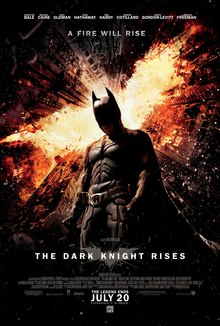
My reaction to the conclusion of Christopher Nolan’s excellent Dark Knight trilogy is in the Wall Street Journal today:
Murder is the opposite of art: destructive, impoverishing, nihilistic. To discuss the act of a killer as if it had some relevance to a work of culture is to usher the age-old enemy of mankind into one of his citadels. So I will pass over the massacre in an Aurora, Colo., theater in a silence respectful toward its victims.
But the film that was playing in that theater—”The Dark Knight Rises”—deserves to be loudly celebrated as a masterful and stunningly honest work of Western popular culture.
The movie is a bold apologia for free-market capitalism; a graphic depiction of the tyranny and violence inherent in every radical leftist movement from the French Revolution to Occupy Wall Street; and a tribute to those who find redemption in the harsh circumstances of their lives rather than allow those circumstances to mire them in resentment.
You can read the rest here.


I’m on vacation up in Old Orchard Beach, Maine (sea, sand and kinetic grandkids aplenty) so I have to wait until Saturday to see DKR but I’m looking forward to it mightily. KOTC and all his faithful readers, enjoy the week and hold the commies at bay for me until I get back.
Regards,
John
The last paragraph of the review is a masterful statement of the crisis the Socialist Democrats are bringing upon the nation and will certainly go into my quote list. It is the type of rhetoric that needs to be heard from the conservative candidate, but not bloody likely. Maybe in some Tea Party ads?
(“This used to be someone’s home,” mourns Catwoman, her conscience awakening. “Now it’s everyone’s home!” exults her unrepentant colleague, gloating over the ruin.)
I have not seen it, but I will at some point. From what I’ve heard so far, it sounds like Nolan is drawing on a lot of sources: The Count of Monte Cristo, The Scarlet Pimpernel, and from the quote above, Dr. Zhivago, in that scene where he find his Father-in-law’s mansion has been appropriated by the Soviets. The local apparatchik huffs self-righteously that this mansion that could house twenty families was used by only one. Dr. Zhivago agrees it’s silly, but despite even his own attempts to argue the point with himself, he never seems quite convinced.
“Maybe it’s time we all stopped trying to outsmart the truth, and let it have its day.”
When in the movie does Alfred say this? What was it in support of? Just curious.
Your take on this film and that of many others affirms my own dismay in watching it: it is being discussed like it is a book. It is not a book, it is a film.
I certainly understand the value of a film production which draws attention away from conspicuous displays of arty editing or cinematography or art direction and concentrates on story telling. It simply didn’t work for me here. Rather than subverting the language of film to enhance the project, it simply throws that language aside to little effect or purpose.
I understand why one thinks presenting such material in a matter of fact manner lends a certain verisimilitude or gravitas to rather crazy events. If that was the reason behind the film’s presentation, it didn’t work for me. If there is a way to depict the crazy world of Batman as more “real,” this wasn’t the way to do it.
I don’t understand why someone would wish to suck all the fun out of such material in the first place. I understand why not having Catwoman in costume all the time works, at least theoretically. But we get to the point where we’re going, “why is she even the Catwoman at all.”
Batman has always been famous for eccentric and psychotic victims that mirror Batman’s own weirdness. Bane is the most boring of Batman villains.
To perhaps properly place what was attempted in context, I would refer you to one of the most forgotten yet seminal films in the history of horror, a made-for-TV film from 1972 that changed everything called The Nightstalker.
This isn’t something you can read about and understand. You have to be alive at the time and steeped in the culture to understand what that film meant. Instead of having some dumb cop fruitlessly shooting at a slowly advancing monster and then throwing his gun at it, you have cops with nightsticks and riot gear piling on this vampire like might’ve occurred in real life. People at the time went “Yaaay. Finally.”
The Nightstalker had no money to really do otherwise, and used that fact to great effect in a brilliant screenplay. Nolan did have money and wasted it if he was trying to invoke a similar effect. As far as I am concerned the entire trilogy is a disaster which sucks the eccentric fun out of Batman. It is a boring, redneck, adult and mainstream take on one of my favorite characters. Since when is Catwoman Emma Peel?
Both Iron Man films, The Avengers and this film should all thank their lucky stars they can use such flat screenplays to make so much money. In my mind, it is a tribute to the characters and not the films. Had such screenplays been used on an unknown character, they would’ve sunk without a trace.
Okay, I’ll bite. What is an example of a good comic book hero movie?
““’Maybe it’s time we all stopped trying to outsmart the truth, and let it have its day.’
When in the movie does Alfred say this? What was it in support of? Just curious.”
For Langenbahn above who asked this. Alfred had just revealed to Bruce Wayne that his love from the last two movies, Rachel Dawes, had decided to marry Harvey Dent and not wait for Wayne to stop being Batman. Rachel gave Alfred a letter that said, this but Alfred burned it to spare his feelings when Rachel was killed by the Joker. Alfred was attempting to convince Wayne not to become Batman again and that he could do more for Gotham as Bruce Wayne.