
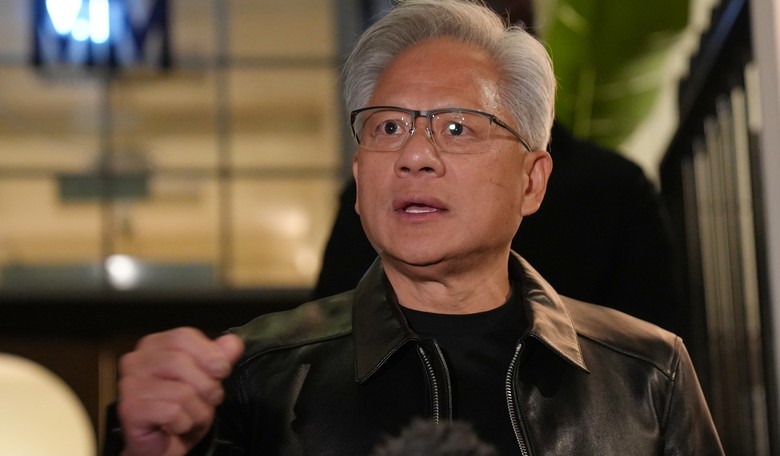
Nvidia's Jensen Huang resigned today as CEO and, in an unusual step, also gave up his position on the company's board in the midst of a growing spy and sex scandal. So before we explore this story any further, let's acknowledge that Huang had to go. When you're the chief executive of the world's most important AI hardware company, and you've been (allegedly!) diddling the company's vice president of healthcare and a purported Chinese intelligence asset, corporate harakiri is your only out.
But that doesn't mean that, now that Jensen is out, we shouldn't ask: Cui bono?
Because while Jensen's affairs were unbecoming and even dangerous, this is when things get truly interesting.
For that, let's first go to French AI CEO (yes, they have a few of those, but not at scale) Brivael Le Pogam, who last month made headlines for warning Americans against voting Democrat because "you don't want to be France."
"I'm not saying the [Huang] scandal is made up," he posted to X on Thursday. "I'm saying: look at who is using it, and for what." Le Pogam continued: "To understand, you have to ask one question. What does the power of what I call the globalists actually rest on? Not money. Not weapons. A monopoly: the monopoly on expertise."
Now for a lengthier excerpt:
The technocracy in Brussels and Washington, the big international institutions, the NGOs, the major newsrooms, the consulting firms: the whole system lives off an asymmetry. They know, you don't. They read the 400-page reports, you don't. They interpret the numbers, you live with the consequences. They write the rules, and you pay lawyers to understand them.
Hayek saw it: central power feeds on the pretense of a knowledge no one really has. For decades, that pretense was impossible to challenge. It took years of study, networks, resources.
Now imagine superintelligence.
Any citizen can audit a budget in ten minutes. Read an EU directive and see every consequence. Check an official statistic. Tear apart a junk study. Draft a legal challenge. Build a company alone, without asking anyone for permission.
The asymmetry disappears. And with it, the monopoly.
The blogosphere broke the news gatekeeper monopoly a quarter of a century ago and democratized the discovery and (most importantly) the distribution of information. Superintelligence promises to do the same for expertise — and none too soon, because our so-called experts aren't so expert these days. They've mostly built regulatory moats around their power and income streams.
The coming revolution — provided we don't snuff it out in a fit of self-destructive populism and Chinese influence — promises to destroy all kinds of monopolies on expertise. This is from an Instapundit item I posted earlier today:
Microsoft's diagnostic AI solved 83% of 304 complex New England Journal of Medicine cases. Generalist physicians with reference materials solved 36%. We need to get this technology into clinics safely and fast. We need to stop making people wait for the right answers.
— Peter H. Diamandis, MD (@PeterDiamandis) November 11, 2026
Patients could be informed and empowered like never before, and a single doctor armed with AI could care for a seemingly impossible number of patients. And provide them with much more effective care, too.
"If you don't get your s**t together," Ken Berry, M.D. added, "there will be one hourly-wage doctor supervising an LLM that's treating a thousand patients, and a lot of doctors looking for work."
And that's just one profession — a guild, really — currently surrounded by impenetrably high walls.
Despite warnings from Le Pogam and so many others, we're about to have a Democrat-controlled Congress hellbent on throttling innovation via a moratorium on data center construction. And here's Missouri Republican Sen. Josh Hawley jumping on the populist bandwagon: Hawley backs nationwide data center moratorium.
The worst part is that I don't even have reason to believe Hawley is on China's payroll.
In Europe, the EU elites succeeded, if that's the word, in nearly snuffing out innovation long before AI came around. The result is a stunning collapse in economic growth.
Previously, I've written about Britain's stagnation. If the U.K. were a state, 30 years ago it would have ranked the sixth or seventh richest. Today, the U.K. would be the poorest, in 51st place behind Mississippi. But even Germany, long Europe's economic powerhouse, suffered the same fate. Back in '96, when Germany was still paying the costs of reunification, it would have been among the top three or four US states.
Today? Somewhere around 48th or 50th.
That's what happens when would-be innovators have to go hat-in-hand to busybody regulators for permission to do anything. And besides, the European Permanent Sub-commissioner for Saying No is usually away at their beach villa.
In most ways, China remains in second place, developing the most explosively innovative technology ever. It's at this moment that CCP-funded "activists," nanny-state regulators, populist agitators, and threatened experts are all pushing in the same direction.
AI is a dangerous tiger, but one we have no choice but to ride — unless we're happy becoming the Britain to China's Mississippi. If that.
Cui bono?
Recommended: French Author Risks a Year in Prison for Comments About Muslims