
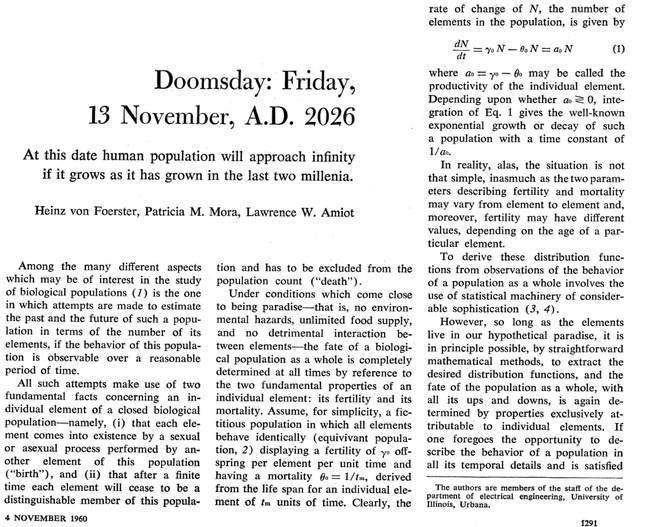
On Nov. 4, 1960, some certified smart people with lots of letters after their names wrote in the Journal of the American Association for the Advancement of Science that Friday, Nov. 13, 2026 would be the last day of humans' existence on Earth.
Friday was Doomsday.
Now, we would have published this story on Friday the 13th, but it seemed poor timing considering that the entire fleet of American commercial jetliners was ordered to land for what initially sounded like a Doomsday scenario of its own. It wasn't, of course, unless you consider Congress doing next-to-nothing to secure funding for 21st-century technology to run our transportation hubs an existential threat. So remember that the next time you're on a plane and someone moves the slide rule to the wrong spot or the copper wires of the Tesla coil fail.
Anyway, on to Doomsday, which is such a ubiquitous concept in human history that it has been granted its own compound word. Hey, that's not nothing in a world where compound words are being deconstructed on a daily basis. Alot.
Most people completely missed the news of humanity's extinction unless they saw my colleague Rick Moran's piece about it a month ago and were properly prepared to be squished by the sheer numbers of humans that would be occupying this little bitty planet.
We've heard of predicted Doomsdays before, of course. Every climate nut has predicted the end of the world. Years ago, Alexandria Ocasio-Cortez predicted we would be cooked in 12 years. Before her and Al Gore were the population bomb predictor who was another certified smart guy with lots of letters after his name. There was the Global Ice Age prediction. Biblical date setters are in the mix, too.
Boom: A Three Aircraft Carrier Armada Is Now Parked at Iran's Front Door, and Explosions Are Reported
Using mathematical formulas to model population expectancies in their paper, Heinz Von Foerster, Patricia M. Mora, and Lawrence W. Amiot predicted that humans wouldn't starve to death or spontaneously combust by Nov. 13, 2026, but hypothesized that if people continued replicating at the same rate, humankind would literally be squished together and unable to survive.
I remember in the old days when we got a bunch of students to go to the King Dome to participate in a contest to see who could get the most people in a human pyramid — or was it a pig pile? A guy on the bottom almost died. Squishing is no small threat.
"It is hoped that the preceding expose will add some fuel to the heated controversy about whether or not the time has come when something has to be done about population growth control," the paper's authors wrote.
They provided a math equation to show their concerns.
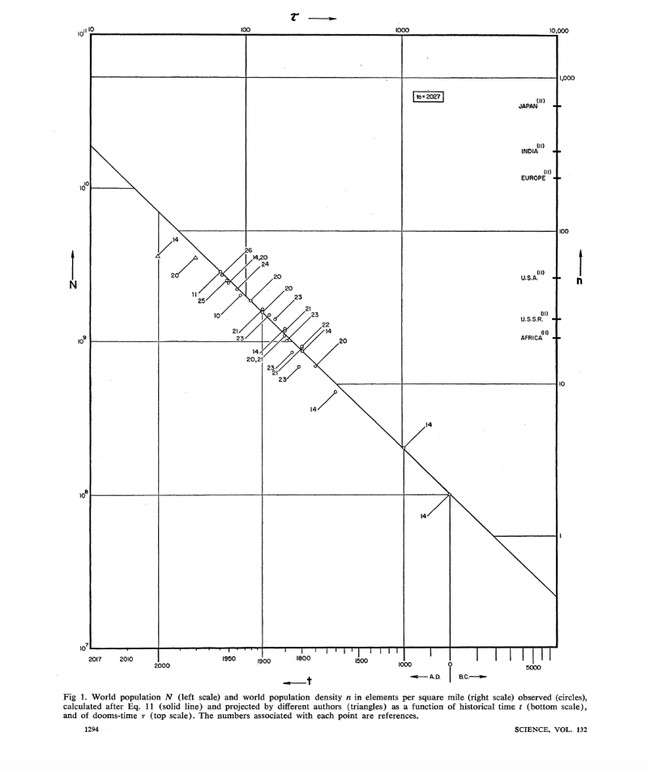
The x-axis is "we're screwed," and the y-axis is for how fast we'll be screwed.
And things looked bad to infinity and beyond. "For obvious reasons, U shall be called "doomsday," since it is on that date, t = to, that N goes to infinity and that the clever population annihilates itself," they wrote dispassionately.
In these equations the constant K represents the fundamental constants a 0 and k as seen in Eq. 9; in Eq. 7 the productivity is given as a function of doomstime and increases more and more rapidly as one approaches doomsday
Duh.
In their mind there were two camps: optimists and pessimists. On one side, optimists welcomed the "expansion of their clientele, be it consumers of baby goods, voters, or devoted souls, and, on the other hand, the pessimists, who worry about the rapid depletion of the natural resources and the irreversible poisoning of our biosphere..."
And, it turns out, the optimists were right. They predicted that "food technology and the industrial sciences will easily keep pace with the develop" not to mention that there was plenty of room on the earth.
But pessimists made good points. They were worried about "a deterioration in human dignity" but predicted that "the ultimate fate of the human race [was to be] a mere vegetation of the individual on the edge of existence."
Proving once again that H.L. Mencken was right when he said, "The urge to save humanity is almost always only a false-face for the urge to rule it," the pessimists really wanted to control how many kids those crazy religious people were having.
They were concerned that "tendencies today do not point in the direction of observable efforts to reduce the mean life span of human individuals," but that problem was obviated when "The Pill" became widely available later that year and birth control abortions would become a "right" in California just a few years later.
Later, Canada, an underpopulated country if there ever was one, would speed the velocity of "observable efforts to reduce the mean life span" with its MAID program.
Crisis averted. Or started.
Anyway, it looks like those pessimists weren't really all that concerned about "human dignity" after all.