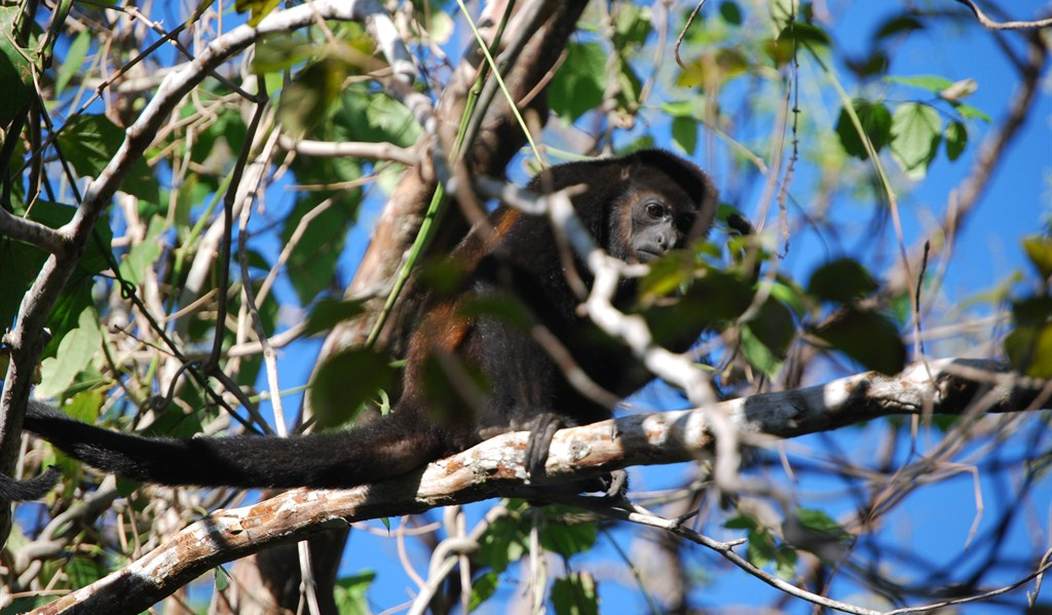

I'll never forget the first time I heard them.
It was my first solo trip to Costa Rica, my first time staying in a home I'd rented instead of a hotel or resort. I'd wanted to experience the country's culture like a local instead of a tourist, and I rented a jungle house up the side of a mountain near Uvita. Getting there had been hell. It was thundering, lightning, and raining relentlessly the whole time, which isn't the ideal condition for making your way up a steep, rocky dirt road along a cliff. One wrong move and it's over. Thankfully, someone else with much better skills than me was doing the driving. I just kept my eyes squeezed shut.
That evening was bizarre. I met the woman who owned the house and the colorful cast of characters she employed — she was actually from the United States and had married a Costa Rican man. They also lived on the property. It was my first time using Airbnb, and I guess I hadn't read the description properly. The house, while beautiful, had no electricity or running water. It relied on solar power, which isn't too helpful on stormy days like that, and the water came in through a filter from a stream.
There were no screens on the windows or doors downstairs, just you and the open jungle. The woman warned me to close the windows at night or monkeys would come up and steal my belongings. She didn't warn me about the bats that would and did fly inside, however. The rest of the evening was equal parts awkward and exhausting for various reasons. By the time I climbed the stairs to my bedroom, I wondered what I was doing there all by myself in the middle of a strange country in a strange house owned by strange people with a strange guy driving me through what felt like a hurricane.
The doors that led to the balconies upstairs did have screens and/or mosquito netting on them, but they didn't lock. The house was three stories, and I was at the top and literally felt like I was living in the trees. It was somewhat hot in the room at first because I couldn't turn on the fan due to the lack of electricity, but I was too tired to care and fell asleep with the doors open — nothing between me and the jungle that night beyond a flimsy screen.
That was one of the best nights of sleep I ever had... until about 5 a.m. I woke up to the most horrific sounds coming from beyond that netting. It sounded like something from a horror film, something otherworldly — a thunderous roar that wasn't made by a human or machine. Later, I went down to breakfast (for a few extra bucks, one of the owner's employees would come make the most amazing food for you each morning). My driver, who'd stayed in a guest room that night, was already awake and drinking a cup of coffee on the patio. "Did you hear the howler monkeys this morning? They were awfully close," he said with a grin.
I have since been back to Costa Rica many times and stayed in numerous houses all over the country, and no matter what, mornings always start out the same. What was once terrifying is now a welcome sound, a reminder that I'm surrounded by some of the most beautiful creatures on the planet. Nature's alarm clock. A sign of what life is like in this lovely Central American nation.
Howler monkeys are some of the loudest land animals on the planet, and you can supposedly hear them from up to three miles away. They live in troops and swing through the canopies of trees quickly, so while you know they're there, you may not actually see them. As a matter of fact, as far as I can recall, the only time I've actually seen one during my travels was in a restaurant in Tamarindo — this particular little guy had come to help himself to some fruit.
But sadly, these magnificent and iconic creatures are facing a crisis in Costa Rica. It's not poaching or loss of habitat or any of the other issues wildlife often face when their lives collide with the desires of humans. It's electrocution. These kings of the country's treetops have taken to swinging on uninsulated power infrastructure and killing or maiming themselves. Some die instantly. Others end up with painful burns, organ failure, neurological damage, and amputations that eventually lead to death in 80% of the injured monkeys. It's the number one cause of death for these guys.
Last year, the International Animal Rescue Costa Rica (IARCR) took in 108 electrocuted animals, and 90% of them were howler monkeys. And those 108 are a very small portion of the thousands of animals that are electrocuted each year.
🌎
— Dr Tom Montgomery (@DrTOMontgomery) June 9, 2026
A baby howler monkey suffering with burns from power cables in Costa Rica.
A downside from growing tourism is the increase in infrastructure—roads, hotels, shops and power lines.
The primates use electric cables to travel between the fragmented forest patches we… pic.twitter.com/YoqpQCqC8d
I've never been shy about the fact that I consider myself an environmentalist. On my own land, I strive to work within the parameters of nature, not against them. And I mean that in the pragmatic — and authentic — Teddy Roosevelt way, not in alarmist, power and money-grab Al Gore way.
In a 1910 speech the late president gave in Kansas, he said, "Conservation means development as much as it does protection. I recognize the right and duty of this generation to develop and use the natural resources of our land; but I do not recognize the right to waste them, or to rob, by wasteful use, the generations that come after us." He called conservation our "national duty."
I believe that wholeheartedly myself. I believe the best outcomes are achieved when humans are good stewards of the earth. While it's not in the United States, Costa Rica is a popular vacation destination and even a hotspot for U.S. expats. It sits just a three-hour flight away, in our own backyard, as we like to say about the Western Hemisphere. It's also one of the most biodiverse places on the planet, home to 5 to 6% of all known species. I think it's important that it stays that way. And the situation with the howler monkeys is a perfect example of how it can — of how humans are handling a problem before it becomes detrimental.
Costa Rica is taking steps to save them. In January, "the country's constitutional court ruled that the state-owned electricity company, Costa Rican Electricity Institute (ICE), and the Ministry of Environment and Energy (MINAE) had failed to put in place effective measures to reduce and prevent the electrocution of wildlife, mainly involving howler monkeys, on uninsulated power lines in Nosara district. The court gave them six months to implement 'the necessary measures to correct the problem present in the power lines that ICE has constructed in the district of Nosara using bare wiring.'"
It took the voices of 20 various conservation organizations and animal rescues to stand up and say enough is enough, but they made it happen. They didn't push to stop development. They didn't push to stop tourism or immigration (Nosara is a hotspot for people from the U.S. and Europe). They simply asked for safer environments so the humans and monkeys could live in harmony.
Francisco Sánchez, a veterinarian at IARCR, says he is happy with the ruling, but he hopes these plans to make changes go beyond just the Nosara area. They must be implemented across the country, and this summer, ICE and MINAE are supposed to be coming up with a plan to do something within the next three years. While it may take some effort, it's symbolic of some of the simple solutions that can help keep our planet alive and well.