
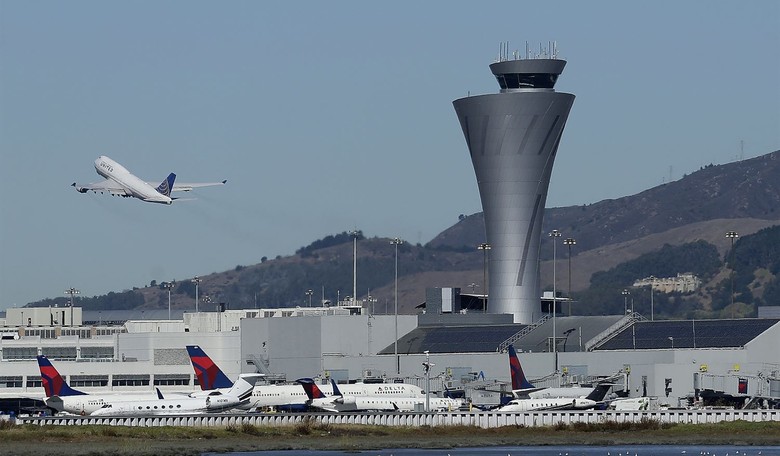
For the second time since 9/11, airplanes in the U.S. were given a "ground stop" order, meaning aircraft on the ground (at the gate or on the taxiway) were prohibited from taking off. Planes already airborne were not forced down mid-route; they continued safely to their destinations or were diverted to alternate airports as directed by air traffic control.
"Secretary of Homeland Security Markwayne Mullin said in a 5 p.m. White House press briefing that the agency had no current indications of outages being tied to a cyberattack or potential terror threat, adding that the nationwide ground stop was 'just a telecommunications outage,'" according to the industry news publication The Air Current.
Transportation Secretary Sean Duffy told a media briefing that the cause was not the new AI-driven air traffic tool, SMART (Strategic Management of Airspace, Routes and Trajectories), installed this week. “There was no possible way SMART would have impacted what happened today,” he said. Nor were the breakdowns connected to Microsoft's cloud and email disruptions that occurred the day before.
"Duffy said the FAA began seeing unstable radar and communications data at air traffic control facilities across the country at 12:36 p.m. Pacific," reports Geek Wire. "Aging switches and routers in the agency’s telecom network 'got overloaded with data' and began producing inconsistent information, he said, adding that the FAA still relies on '1980s little copper lines.'”
“Our new IP switches did not go down. It’s the old hardware that went down,” Duffy said. The FAA restored service after deploying fixes to reduce the overloading on its switches, he said. The FAA was installing "patchers into the system" and “new equipment and new technology,” which “was overwhelming the older system.”
I'm far from being an expert. But couldn't technicians installing the new "patches" and equipment have foreseen a problem like this? I still think a lot of what happens online is close to sorcery or magic, but I have plenty of common sense. Shouldn't that have been a concern before they began mucking with the system?
The FAA is in the middle of replacing its legacy telecom network with a modern internet-protocol network. AT&T took over the lead role on that project in August with an initial $74.3 million award, as the FAA works toward a goal of finishing by the end of 2028.
Duffy and Mullin used the briefing to press Congress for money to finish rebuilding the air traffic control system. Mullin said President Trump has declared the situation a national emergency.
The administration has asked Congress for an additional $30.1 billion for aviation infrastructure, AeroTime reported. Duffy said at the evening news conference that he wants $50 billion.
Democrats are going to try and blame Donald Trump, but that's idiotic. The air traffic control system is just now phasing out floppy disks! It's 40-year-old technology that should have been buried 30 years ago.
Both parties should be punished for this stupidity.
The current "Modern Skies" overhaul was secured through the "One Big Beautiful Bill" reconciliation legislation in 2025. The funding targets the physical backbone of air traffic control with a target completion date of 2028. It focuses on ripping out 1980s-era hardware, including replacing legacy copper wiring with fiber-optic lines, upgrading analog voice switches to Internet Protocol (IP) systems, replacing aging radars, and phasing out paper flight strips in control towers.
You read that right. Controllers would hang small, rectangular paper slips to manually track every aircraft operating within their sector or airspace. Couldn't they put the freaking information on a tablet or phone?
Geez Louise.
Floppy disks, copper wiring, analog voice switches, gosh-darn paper strips hanging in front of controllers; it must have felt like getting into a time machine every day the controllers showed up for work.
Currently, the FAA has completed roughly two-thirds of the telecommunications line replacements and nearly half of the voice switch upgrades, though radar replacements remain in the early stages. The entire overhaul is expected to be completed by 2028.
To give you an idea of how government spending works, the previous $14 billion "upgrade" was completed in 2025. Authorized by Congress in 2003, the Next Generation Air Transportation System (NextGen) was designed to transition U.S. airspace from ground-based radar to satellite-based navigation, digital pilot-controller data communications, and upgraded en route automation (ERAM).
Federal audits noted it suffered from years of delays, delivered a fraction of its initially projected efficiency savings, and left much of the FAA's underlying ground telecommunications hardware and copper wiring untouched.
So, Duffy was asking for $30 billion to fix what should have been fixed in the 2003 spending bill, and now, after the ground stop, he wants $50 billion.
What did S.R. Haddon say, delivered with delightful, evil playfulness by John Hurt in the film Contact?
"First rule of government spending: why build one when you can have two at twice the price?"
Exclusively for our VIPs: What Has SETI's Most Comprehensive Search Program Accomplished in the Last 10 Years?