
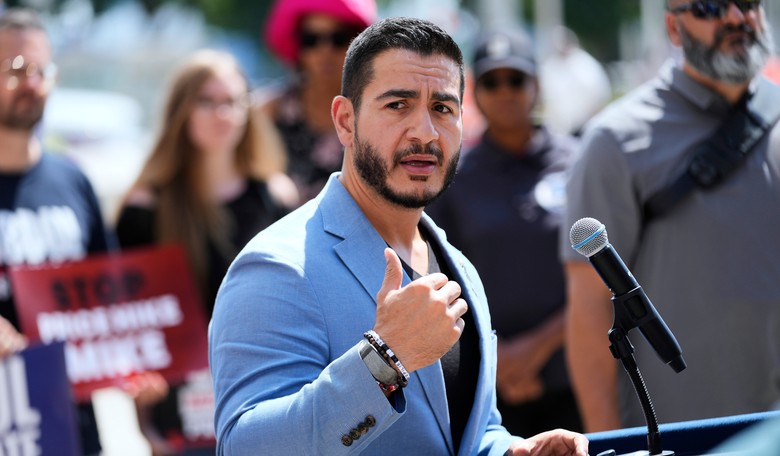
Abdulrahman Mohamed El-Sayed has spent the general election telling Michigan voters he wants to talk about gas, groceries, and healthcare. “I want to talk about why you can’t afford your gas, why you can’t afford your groceries, why you can’t see a doctor,” he said in September.
It’s a smart message in a state where affordability is near the top of voters’ concerns. (However, be sure to not tell Michigan voters they’re the reason things are so expensive by consistently electing Democrats.)
Newly resurfaced posts, however, keep pulling the Democrat Senate nominee back toward a much older argument about America’s role in the world. In an August 15, 2021, post, as Kabul fell to the Taliban, El-Sayed wrote that Americans should look back to the decision 20 years earlier to wage what he called an “endless, aimless war.”
The point wasn’t simply that the withdrawal was mishandled; he criticized the decision to fight the broader war itself.
From Breitbart News:
Michigan Muslim socialist Abdulrahman Mohamed El-Sayed implied that the United States was responsible for the Taliban’s takeover of Kabul and the violence of it just days before the bombing at Abbey Gate in Afghanistan killed 13 American service members, seeming to echo his campaign surrogate Hasan Piker, who said that America was “pound for pound” worse than Al-Qaeda.
In newly discovered tweets, El-Sayed blamed “our country’s imperialism” for conditions in Iran, Iraq, and Yemen, and claimed U.S. sanctions contributed to Iran’s COVID-19 pandemic.
On August 15, 2021, El-Sayed said people should be “concerned with what’s happening in #Kabul today,” but blamed it on “the fateful choice 20 yrs ago to wage endless, aimless war in pursuit of an undefined mission under G. W. Bush.”
The same worldview appeared even more plainly in a Jan. 2020 post. El-Sayed blamed “our country’s imperialism” for helping create the conditions that produced Iran’s regime, the circumstances in Iraq, Saudi conduct in Yemen, and the collapse of the Iran nuclear deal.
A March 2020 post argued that U.S. sanctions worsened Iran’s COVID struggle.
Yes, these statements are dated, but they’re not random relics revealed from a forgotten account, disconnected from what El-Sayed believes today. Two days after Kabul fell in 2021, he published a lengthy essay arguing that America’s 20-year war effort had ended in catastrophe and had grown out of what he called a “new American imperialism.” He wrote that the Afghanistan and Iraq wars crowded out domestic spending and helped build a security state that damaged civil liberties.
From the Arab American News:
In a few weeks, my daughter will go back to preschool. Millions of Afghan girls may not have that opportunity again. As a father — as a human — my heart breaks for them. Though Taliban spokespeople have claimed that Taliban 2.0 will allow girls education, their repressive fundamentalist interpretation of Islam, coupled with reports from cities they’ve recently captured, suggests that if anything has changed, it’s their PR savvy. The Taliban’s resurgence is a travesty for human rights, women’s rights, basic freedoms and a free press.
Consider a bacterial infection — trust me for a second. Too often, people stop taking their antibiotics when they’re feeling better, only to be hit with a worse version of the infection that is far harder to treat. Doctors tell you to finish the entire course of antibiotics because you have to kill off the whole infection, otherwise the bacteria that survive are the most resistant to the treatment. By this analogy, Taliban 2.0 is likely to be worse. They’ve been hardened by 20 years of war and feel vindicated by the complete collapse of Afghan security forces as they laid siege. The threat of resistance is unlikely to shake them.
The real issue is simpler. El-Sayed has a lengthy record of assigning substantial responsibility for instability in the Middle East to American military and foreign policy. He was making that argument years before this Senate race, and he’s still making a version of it now. During his Monday interview, he said terrorism is always wrong, and victims are never to blame, then returned to the question of whether American actions create a safer or less safe world.
He also tied the current Iran war directly back to the household issues his campaign wants to own. Why are Americans fighting it? Who benefits? What are families paying for? His campaign now packages foreign policy as affordability, arguing that money spent on war means higher gas prices, higher costs, and fewer resources for healthcare and infrastructure.
ICYMI: El-Sayed Launched His Senate Campaign. Six Days Later, Wayne County Hired Him Back.
Politically, that may be clever, but it also gives Michigan voters a cleaner choice than either side’s slogans suggest. Abdulrahman Mohamed El-Sayed wants voters to see gas, groceries, and healthcare when they hear his name. His older posts show he sees those issues through a much larger theory about American power, military intervention, corporate influence, and what he calls imperialism.
The question for November isn’t whether Abdulrahman Mohamed El-Sayed is allowed to hold those views.
Of course he is.
The question is whether Michigan voters, especially independents and moderates, want to send that worldview to the United States Senate. His campaign wants to keep the conversation at the kitchen table, but his own record keeps widening it to Kabul, Tehran, Baghdad, and Washington.