
Hello, all, and welcome to Monday, Oct. 5, 2026 — the Supreme Court's first day back, so at least one branch of government is showing up for work.
My calendar says it's Do Something Nice Day, Apple Betty Day, Get Funky Day, Child Health Day, Consignment Day, Rhode Island Day, James Bond Day, World Teachers' Day, and World Architecture Day. So do something nice for a teacher, serve an Apple Betty to a Rhode Islander, consign last year's wardrobe, and order your martini shaken, not stirred.
Today in History:
1813: Shawnee leader Tecumseh dies at the Battle of the Thames in Ontario, fighting alongside the British against William Henry Harrison's army.
1877: Chief Joseph of the Nez Perce surrenders in Montana's Bear Paw Mountains, about 40 miles short of the Canadian border, after a fighting retreat of more than 1,000 miles.
1905: Wilbur Wright flies the Wright Flyer III 24 miles in 39 minutes, the longest flight to date.
1910: Portugal becomes a republic after a revolt topples King Manuel II.
1930: The British airship R101 crashes in Beauvais, France, on its maiden voyage, killing 48.
1947: President Harry S. Truman delivers the first televised presidential address from the White House, urging citizens to conserve food for hungry postwar Europe.
1962: The Beatles release their first single, "Love Me Do," and the first James Bond film, Dr. No, opens in London.
1969: Monty Python's Flying Circus debuts on BBC One.
1982: Johnson & Johnson begins a nationwide Tylenol recall after cyanide-laced bottles in Chicago kill seven people.
1984: The space shuttle Challenger launches on STS-41-G with seven aboard, the largest crew yet to fly together, including Marc Garneau, the first Canadian in space.
1988: Chileans vote down Augusto Pinochet's bid to extend his rule in a national plebiscite.
1991: Linus Torvalds releases Linux 0.02, the first official version of the kernel.
2000: Slobodan Milosevic resigns as Yugoslavia's president after mass protests.
2011: Apple co-founder Steve Jobs dies at 56.
Birthdays Today include: Chester A. Arthur, 21st president; Ray Kroc, businessman (McDonald's); Bil Keane, cartoonist (The Family Circus); Steve Miller, singer and guitarist (Steve Miller Band, "The Joker"); Maya Lin, architect (Vietnam Veterans Memorial); Kate Winslet, actress (Titanic, The Reader); Brian Johnson, singer (AC/DC).
If today's your birthday too, you're sharing it with a president, the man behind the Golden Arches, and AC/DC's frontman. Happy day!
* * *
The “Cornell Gang rape” case, if nothing else, is proving to be a memory exercise.
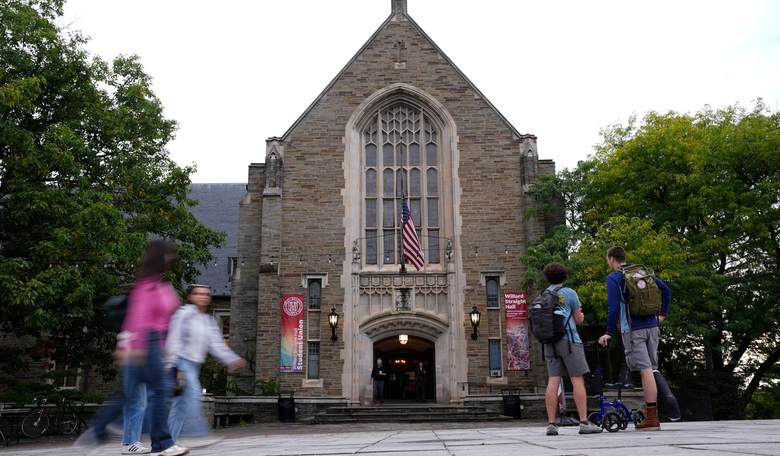
For those not up to speed, the Cornell saga starts on Sept. 16, when a former Cornell student filed a 101-page complaint in New York County Supreme Court under the pseudonym Jane Doe. She sued Cornell, the Chi Phi fraternity (national and chapter), her own sorority, an Ithaca bar, and seven former fraternity members. She alleges multiple men drugged her with ketamine and sexually assaulted her at the Chi Phi house on Oct. 19-20, 2024, when she was 20. She also alleges Cornell failed to protect her and failed to discipline the accused properly. Importantly, none of it has been proven, and no one has been charged.
Recommended: Jack Smith Just Proved He Lied to Congress
"Doe" isn't suing under Title IX. Her claims are negligence, breach of contract, and violations of New York law. Retired federal judge Nancy Gertner told the Boston Globe, which suggests her lawyers distrust the federal route. Actually, given the idea that the unpopular state AG Tish James is in the picture, I’d say they trust that situation to have more leverage.
After her November 2024 report, Cornell suspended the chapter and the seven students and held a Title IX process. Cornell says it expelled two of the seven and penalized the others. Doe's lawyer says Cornell refused a tuition refund when she tried to leave.
One more piece matters for the comparison to come. The Tompkins County DA says her 2024 police statement described the drug use and sexual conduct as voluntary and consensual. Her lawyer says that statement is "not materially different" from the lawsuit. The DA has reopened the investigation, and a grand jury will hear it.
It should be noted that new reporting complicates the DA's account. CBS and NBC have obtained transcripts of Doe's 2024 campus police interview. In it, she said, "I can say with 100% confidence I was raped," and her six-page statement describes being "pretty incapacitated" and unable to make decisions because of intoxication. PBS reports that Cornell police left key information, including that line, out of what they passed to local law enforcement. The DA still says the statement described the conduct as voluntary and conscious, so the statements conflict.
The parallels to the 2006 Duke lacrosse case are becoming (pardon the pun) Crystal clear. I wrote quite extensively of the matter at the time, as did my then co-writer, David L. The memory of that one may be a little spotty, so here's a refresher.
On March 13, 2006, Crystal Mangum, a Durham woman, was hired as a dancer for a Duke men's lacrosse team party at an off-campus house. Later that night, after an altercation that required police, she told officers that three white team members had raped her. The case became a national story about race, class, and town-versus-gown tensions in Durham.
Durham County DA Mike Nifong was in a tough primary fight in a county where black voters made up a large share of the electorate. He gave dozens of media interviews. A retrospective notes that DNA testing found genetic material from several unidentified men on Mangum but none from any of the 46 team members. Nifong and the lab director knew that in April 2006, before two players were indicted. Reade Seligmann, Collin Finnerty, and David Evans were eventually indicted.
The coach resigned and the season was canceled. Dozens of faculty signed an ad that critics say prejudged the players, which became known as the "Group of 88." After the charges collapsed, Duke reached a confidential settlement with the three players, reportedly worth about $20 million each.
It is interesting that Dr. Brian Meehan and Nifong entered into an agreement to withhold exculpatory DNA evidence. In the end, Nifong faced state ethics bar charges, criminal contempt, and civil exposure.
On April 11, 2007, North Carolina Attorney General Roy Cooper dropped the charges and declared the players innocent, calling the case a "tragic rush to accuse" and Nifong a "rogue prosecutor." Nifong was disbarred in June 2007 for withholding DNA evidence and other violations, and spent a day in jail for contempt.
As for Mangum, she stabbed her boyfriend Reginald Daye to death in 2011. She was convicted of second-degree murder in 2013 and sentenced to 14-18 years, and (of course) she claimed self-defense. In December 2024, she said on camera that she had testified falsely in the Duke case and apologized to the players, via ABC11. She wasn't prosecuted for perjury over questions about her mental health. She was given nine months of parole at the end of February, and that will have ended by now.
Of course, the comparison to the Duke case doesn't decide guilt or innocence in the Cornell case. But you can bet your sitting device such comparisons will be made anyway, because they fit so nicely. The Duke case is a lesson in what happens when institutions and the press decide early, and in the interests of being open-minded about this, I’ll say that the lesson applies in both directions here.
Another parallel to the Duke case was Anita Hill and her “sexual harassment” implication of Justice Clarence Thomas. Nothing was ever proven in that case either, but the comparisons were frequent, and also fit rather nicely.
Given all that history, it's fair to ask whether we're watching another rush to judgment at Cornell.
Does anyone really expect the facts in either case to change the popular perception of it? And before you start on me, I mean from either perspective. The Cornell case will, I think, go on for years, as did the Hill and Mangum cases. The comparisons and the premature conclusions are impossible to ignore.
Thought of the Day: Justice rarely fails because the verdict comes late; it fails when the verdict comes before the evidence.
VIP members: Time for you to speak out. What are your thoughts? And if you have memories of the other cases I mentioned, can you tell us about your thoughts from that time and how they compare to your thoughts on THIS case?
Take care, gang. I'll see you here tomorrow.