
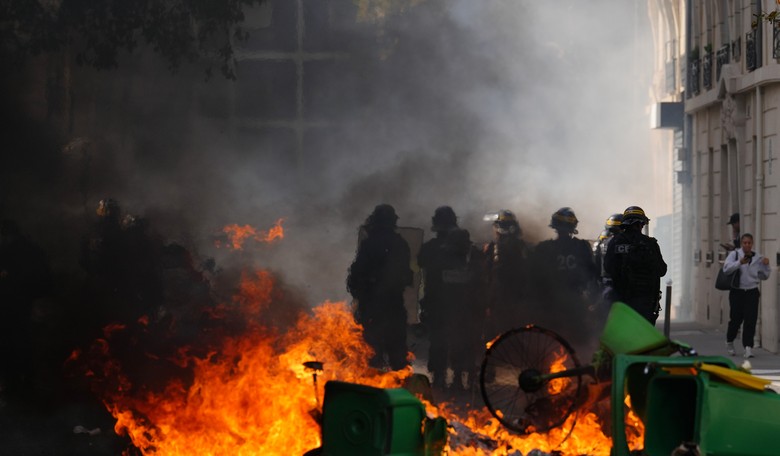
In 1968, French university and high school students took to the streets to protest, well, everything. Universities had begun to absorb the glut of baby boomers going off to college and were simply unable to cope. Classes were overcrowded, and the students chafed at the very conservative, hierarchical nature of post-war French society under President Charles de Gaulle.
There were also the typical left-wing anti-authoritarianism and anti-imperialism gripes, both aimed squarely at the U.S. In the end, even though the riots had the government quaking in its boots, it was a lot of political noise without much to show for it. De Gaulle called flash elections and won in June 1968. However, the movement reshaped French education, workplace rights, and social norms.
Two weeks ago, students in the impoverished Seine-Saint-Denis area of northern Paris took to the streets to protest dilapidated school buildings, unsanitary conditions (including reports of rat and cockroach infestations), and extreme classroom temperatures ranging from sweltering heat to freezing cold due to poor heating/cooling systems.
Protesters cited acute shortages of teachers and support staff, leading to overcrowded classrooms with up to 35 students per class. Students also campaigned against long, grueling daily timetables (such as mandatory 8 a.m. to 6 p.m. schedules).
The kids were complaining that few resources were given to working-class and poorer districts and that it was going to get worse because the French government was dealing with the reality that it was running out of other people's money to spend.
The protests soon spread across Paris and then into its suburbs. The unrest has now become a national crisis, with more than 3,000 students and others arrested and hundreds injured.
🔥 🇫🇷 FRANCE DESCENDS INTO CHAOS
— Lenka White (@white_lenka) October 2, 2026
Schools set on fire. Teachers attacked and doused with petrol. Firefighters forced to flee. Police clashing with protesters.
Nearly 2000 arrested as the student protests spread from high schools to universities across France. pic.twitter.com/VZZAMwuwWh
🇫🇷 High-school students across France are blockading lycées over teacher shortages, overcrowded classes and crumbling buildings. What started in the Paris region has spread nationwide and turned violent: school fires, burning bins, clashes with police, teachers attacked. On… pic.twitter.com/RpmNyj7hj3
— DBS Morocco (@dbsmorocco) October 2, 2026
French National Rally Party leader Marine Le Pen believes the riots were "organized by professionals and overseen by deputies from La France Insoumise."
🚨🇫🇷 Marine Le Pen on the French riots:
— Mario Nawfal (@MarioNawfal) October 1, 2026
"This is no longer about high school student protests.
It is about riots organized by professionals and overseen by deputies from La France Insoumise.
We MUST pass a new anti-rioters law so that participation in a riot is a clearly…
At least some school principals agree.
"According to Education Minister Édouard Geffray, 65 teaching staff including 40 school heads have been injured. 'Most of the staff who were hurt said that the people they were facing… were not their own pupils,'" reports the BBC.
An internal report prepared for the Paris police department which was leaked to the media analysed the opening of the movement in Seine-Saint-Denis. It concluded that students were being "egged on by far-left elements from students unions… and political groups such as… LFI."
It said the tensions "could be part of a flame-kindling strategy… aimed at imposing their ideas ahead of the national elections".
In support of its conclusion, the report's writers cited the presence of protesters who are not themselves lycéens, the vagueness of the demands, the flying of Palestinian and Algerian flags, and the use of tactics – like calling for supplementary protests at police-stations - that come from the radical-left playbook.
The LFI strongly denies doing anything more than lending its natural support to a movement it regards as legitimate. On Thursday Mélenchon called on students to avoid violence "which only serves our enemies' interests".
The LFI – La France Insoumise (translated as France Unbowed or France In Revolt) — is a radical left party emphasizing democratic socialism, eco-socialism, anti-austerity, and populist policies. What has the students' and the radical left's panties in a twist is the release last week of Prime Minister Sébastien Lecornu's draft for next year's budget. It's being referred to as an "austerity" budget because it will cut about $60 billion from a budget of $1.1 trillion.
The package aims to reduce France's budget deficit from an expected 5.4% of GDP down to 5.0%.
The unions and radical left in France are fiercely opposed. As with liberals in the U.S., cutting a dollar from the budget is sacrilegious, and now that the kids are rising in protest, the unions have a ready-made ally to shed blood for them.
President Macron is the least popular president on the record. His approval stands at 16-18% in most polls. If the protests continue, Macron could resign to give an ally a head start in next year's election, where the popular LFI candidate, Jean-Luc Mélenchon, is surging in the polls.
Exclusively for our VIPs: Democratic Primary Turnout Is Off the Charts in Some States. Should the GOP Worry?