
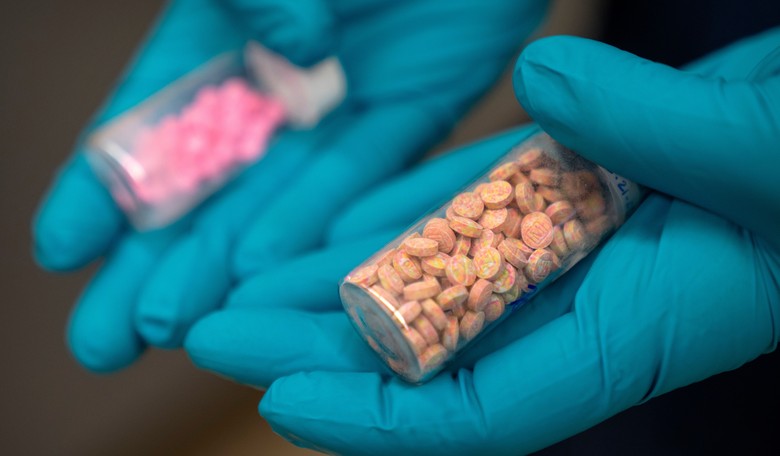
Two days before Xi Jinping walks into the White House, China suddenly has two more fentanyl-related chemicals on its export-control list.
The timing matters: on Tuesday, five Chinese government agencies jointly announced that exporters will now need licenses before shipping two additional precursor chemicals to the United States, Mexico, or Canada. The rule took effect immediately.
Xi arrives in Washington this week for a state visit with President Donald Trump. The White House ceremony is Thursday, and fentanyl remains one of several unresolved issues between the two countries.
On Thursday morning, September 24, the President and First Lady will host a State Arrival Ceremony honoring His Excellency, Xi Jinping, President of the People’s Republic of China and Madame Peng Liyuan. The ceremony, which will be held on the South Lawn, State Floor, and Rose Garden of the White House, will feature 479 military personnel, representing all branches of the United States Armed Forces.
As the arrival begins, the South Drive will be lined with the Armed Forces Full Honor Cordon leading to a national flag display of U.S. and China flags where the United States Army Herald Trumpets will present a fanfare on the South Portico as the President and First Lady welcome His Excellency Xi Jinping and Madame Peng Liyuan to the White House.
China has done this before. Last November, Beijing added 13 precursor chemicals to a special licensing system covering exports to the United States, Mexico, and Canada. More chemicals were added in May, and now another two have joined the list.
ICYMI: How Many Americans Paid for the Biden DEA’s Fentanyl Gamble?
Adding chemicals to a controlled list is useful only if exporters obey the restrictions, regulators enforce them, and traffickers can't simply switch recipes.
That's where the problem becomes much harder.
The DEA says Mexican cartels depend heavily on precursor chemicals sourced from China and India to manufacture synthetic drugs.
Mexican TCOs maintain a complex and robust network to smuggle all major illicit drugs into the United States, using a wide variety of methods to include air cargo, maritime cargo, and overland traffic. The cartels maintain a network of couriers, border tunnels, and stash houses throughout Mexico and the United States to support their trafficking and distribution activities. Mexican TCOs have increasingly employed social media platforms to promote drug products, recruit and train couriers and dealers, advertise the sale of drugs, communicate with customers, and plan transactions.
The DEA also warns that suppliers have adapted by offering "designer" precursors engineered to fall outside existing controls or make detection more difficult.
Think of the problem less like closing a door and more like plugging holes in a screen. Regulators identify one chemical, traffickers search for another route, and governments add another substance to the list. Then chemists alter the process yet again.
China's new controls, therefore, aren't meaningless. The DEA has found evidence that tighter restrictions can make some suppliers more cautious and certain chemicals harder to obtain. But a regulation written in Beijing is only the beginning of the test, not the finish line.
China also argues that it already maintains some of the world's strictest narcotics laws and that America's fentanyl crisis is driven substantially by domestic demand. Chinese and American authorities have conducted counternarcotics cooperation, including joint investigations.
From Reuters:
The two added chemicals are piperidone compounds structurally related to a well-known fentanyl precursor.
China previously expanded the list in May and November, after summits in Beijing and Busan respectively between US President Donald Trump and Chinese counterpart Xi Jinping.
Early in 2025, Trump imposed tariffs on Chinese goods over fentanyl concerns, but China says its counter-narcotics laws are among the world's strictest and fentanyl is a US problem.
After meeting Xi in October last year, Trump agreed to halve the fentanyl-related tariffs in exchange for Beijing cracking down on illicit fentanyl trade. The tariffs were struck down in February by a US supreme court ruling.
So Thursday's meeting shouldn't be measured by another promise, another list, or another photograph of two leaders shaking hands.
The measurable questions come later.
Are Chinese chemical exporters denied licenses? Are suspicious companies investigated? Do precursor shipments into Mexico fall? Do cartel laboratories have greater difficulty obtaining the ingredients they need? And when traffickers invent the next workaround, how quickly does Beijing respond?
Those answers won't arrive during the state dinner.
They'll arrive after Xi goes home.
And that's when we'll know whether those two new chemicals represent another entry on a government list or an actual obstacle in the fentanyl supply chain.