
What if you had to be the hero of your own life? Could you step up?
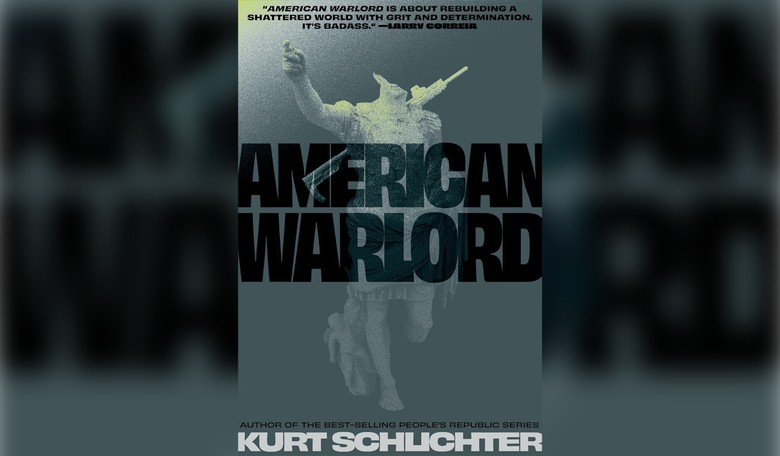
Kurt Schlichter focuses on that question in his new action thriller, American Warlord, coming out November 3. This is not a new book in the Kelly Turnbull saga. Instead, it’s the story of how a mild-mannered operations manager in a mid-sized trucking company saved himself, a community, and put civilization back together after the violent fall of 21st century America.
Vic Kincaid is just an ordinary schmo, albeit one with a love of Roman history and its lessons. He’s trying to navigate a corporate world in which Woke 2.0 came back harder than ever and HR is always on his case. Worse, a newly elected far-left White House and Congress are running America’s economy into the ground.
Since his wife died of cancer, Vic stays busy reading Roman history and doing his job well. He keeps trying to solve his company’s problems in the fracturing economy until he falls sick with COVID-X. While he is ill, the world falls apart. For this reviewer, a child of the comfortable '80s, two of the most frightening sentences in the book are: “The power went out at 6:23 p.m. on October 25th. It never came on again.”
Schlichter takes us through Vic’s journey, from suffering through the plague, to walking endlessly in a futile attempt to find civilization, to realizing that if there is to be a civilization, he’d have to rebuild it. Vic doesn't want to be a leader at first. He takes it on because, as he says: “I’m not a natural leader, I’m not even a good shot. I was just some guy…. We have a dark age to cut short, and I’m the one who has to do it because I’m the one who showed up.”
The Warlord constantly thought about what the Romans would do. If you want to quote the Romans as hero Vic Kincaid did, here are a few books to get you started:
Federico Santangelo, Marius (Bloomsbury, Ancients in Action series, 2015/2016)
Arthur Keaveney, Sulla: The Last Republican (2nd edition, Routledge, 2005)
Karl Galinsky, Augustus: Introduction to the Life of an Emperor (Cambridge University Press, 2012)
Anthony A. Barrett, Livia: First Lady of Imperial Rome (Yale University Press, 2002)
Or you could go to the primary source: Plutarch’s Lives
The book’s prologue and epilogue nod to traditional oral histories and made me think of Norse sagas. An elderly narrator begins the prologue, speaking of the “Warlord.” By the time this narrator returns in the epilogue, some 70+ years after the events of the story, we recognize him as one of the characters who followed and served the “Warlord.”
Related: Kelly Turnbull is the Action Hero We Conservative Women Always Wanted
Schlichter handles the exposition needed to describe the downfall of American civilization in a way that propels the story forward. The strangers Vic meets along the road fill in the gap when he was bedbound with COVID-X. We‘re just as eager as the protagonist to find out what happened while he was deathly ill. In another instance, one traveler sits in on emergency operations meetings. When he tells Vic what he learned from military briefings, we get a look at how badly the politicians botched the crisis.
Wanting More
If I could ask the author to change anything in this book, it would be this: give me more character development. I want to know what some of the other characters experienced and thought about during the collapse. Besides Vic, we get in-depth descriptions about only two people: Jake, an Army captain, and Mickey, an oddball biochem grad student who functions as comic relief. Mickey’s so focused on his lab that he honestly doesn’t register that the world is falling apart around him.
The ending leaves us with hints of a new book, if not an entirely new series. I can’t wait to read it, to find out what happens to Sam, Jennifer, and Mickey, and even the liberal Karen who survives one town over. Does she come to her senses?
I cannot believe I’m writing this, but an American Warlord series could be even better than the Kelly Turnbull books. There are so many stories to tell of the rebuilding of this world. By the time the narrator concludes the epilogue, only 72 years have passed since the events of this novel. Society has re-established internet and TV, as well as started construction on marble buildings.
When I read that I wondered, "How on earth could that happen? How could a society go from subsistence farming to high tech in only 72 years, all the while fighting off attackers?" Then I realized: we’ve done it before, when we built the United States. In 1830 American troops still had forts on the frontier, and 70 years later there were cars and electric lights. Seventy years before we landed on the moon, the majority of the country‘s people lived on farms. Americans built the world’s foremost society during tough times: civil war, the Depression, and world wars. The stories of how Vic and his team rebuild society should be equally epic.