
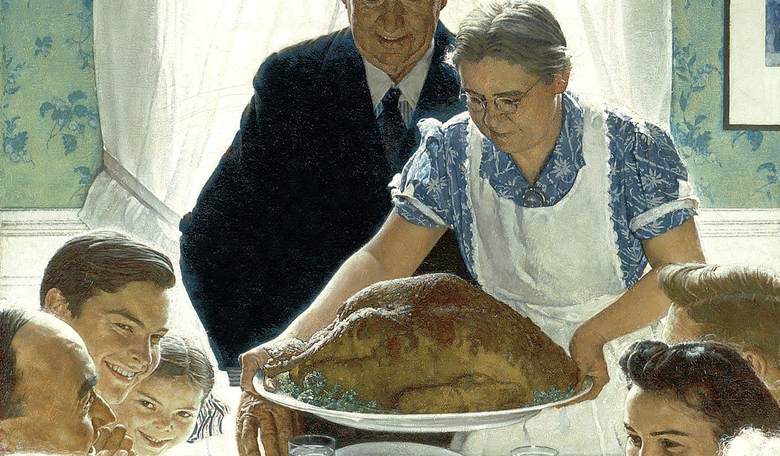
Greetings, and welcome to Thursday, Nov. 26, 2026. Happy Thanksgiving! Whatever's going on in Washington, Albany, Tallahassee, or wherever today... forget it. Today is for family, food, football, and counting our blessings, and there are more of them than the evening news would have you believe. My Buffalo Bills host the Chiefs tonight a little after 9pm eastern, in their first-ever home game on Thanksgiving, so pace yourself on the pie. How that's going to work with the winds they're forecasting? No idea, particularly in a new stadium.
My calendar says it's Thanksgiving Day (Duh, no kidding) and Cake Day. Give thanks, carve the bird, and pass the stuffing. And if anyone at the table objects to pie and cake both, remind them it's a national observance, and you're just being patriotic.
Today in History:
1789: The nation observes its first national Thanksgiving Day, proclaimed by President George Washington.
1832: New York's first streetcar line begins service, horse-drawn cars running along the Bowery in Manhattan.
1863: The nation celebrates Thanksgiving under President Abraham Lincoln's proclamation, beginning the tradition of an annual national holiday.
1922: Archaeologist Howard Carter gets his first look inside King Tutankhamun's sealed tomb. Asked whether he can see anything, he answers, "Yes, wonderful things."
1941: President Franklin Roosevelt signs a law fixing Thanksgiving on the fourth Thursday of November.
1941: A Japanese carrier fleet secretly sets sail for Pearl Harbor.
1942: Casablanca premieres in New York City.
1950: Chinese troops launch a massive counteroffensive against United Nations forces in North Korea.
1965: France becomes the third nation to launch its own satellite, after the Soviet Union and the United States.
1973: President Nixon's secretary, Rose Mary Woods, testifies that she accidentally caused part of the 18½-minute gap in a subpoenaed White House tape.
Birthdays Today include: Willis Carrier, inventor of modern air conditioning, born in Angola, N.Y.; Eric Sevareid, CBS News correspondent; Charles Schulz, cartoonist and creator of Peanuts; Robert Goulet, singer and actor from Camelot; Rich Little, impressionist; Tina Turner, singer from "What's Love Got to Do With It"; John McVie, bassist with Fleetwood Mac ("Go Your Own Way"); and Art Shell, Hall of Fame lineman and the first Black head coach in modern NFL history. If today's your birthday, too, happy birthday from all of us here, and enjoy the extra slice of pie.
* * *
Back in the fall of 1863, the country was in the middle of the worst war in its history. Gettysburg was three months behind them. The casualty lists kept coming, and hardly a family table in the country lacked an empty chair. Gloom wasn't merely a mood that year. It was the national climate, and nobody could argue otherwise.
Even so, on Oct. 3, 1863, the president issued a proclamation listing the nation's blessings and asking his countrymen to set aside the last Thursday of November to give thanks for them. (Yeah, OK, Seward wrote the thing, but let's not get distracted.)
That's the part we forget about Thanksgiving. It isn't about pretending trouble doesn't exist. It's about refusing to let trouble become the whole story. And the biggest threat to gratitude usually isn't hardship. It's comfort.
Lincoln's inventory
The proclamation opens like this: "The year that is drawing towards its close, has been filled with the blessings of fruitful fields and healthful skies. To these bounties, which are so constantly enjoyed that we are prone to forget the source from which they come, others have been added..."
Prone to forget. Remember that phrase. We'll come back to it.
From there, Lincoln goes down the list. The war had pulled men and money away from the farms and factories, yet the plow, the shuttle, and the ship kept moving. The mines produced more than ever. Settlement kept pushing west. In the middle of a war that was burying young men by the tens of thousands, the population still grew.
Then he says this: "No human counsel hath devised nor hath any mortal hand worked out these great things. They are the gracious gifts of the Most High God..."
He doesn't credit his administration, his generals, or his party. In fact, he gives no human hand any credit at all.
Picture a sitting president putting that sentence in an official document today. The firestorm would start before the ink dried. There'd be cable TV panels and op-eds about theocracy, and a lawsuit or two by Friday. I see that as a symptom of something I pointed out last Christmas: People who get used to darkness will fight hard to keep it, even when it hurts them. Doom has a constituency, and that constituency doesn't like competition from good news.
The issue isn't merely that modern political discourse has become uncomfortable with public expressions of religious faith, important as that is. It's that we've become increasingly uncomfortable with the idea that something might exist greater than ourselves—some power beyond government, to which we owe gratitude.
It's an understandable attitude if you believe big government is the end-all and be-all. But the idea of a higher power, one that stands above human government, is foundational to Western civilization. We threaten our own existence when we forget that.
Lincoln wasn't the first to diagnose the problem. Not even close. Washington, too, as I indicated in the Today In History segment today. Our Catherine Salgado gets into the details in her column of Monday:
Recommended: Washington Called for a Day of Thanksgiving and Prayer. America Needs One Now.
Moses saw it coming
Even ol' George wasn't the first. Go back roughly 3,000 years, to Moses standing with the Israelites on the eastern bank of the Jordan, looking into the Promised Land he himself would never enter. They'd spent 40 years in the wilderness, and now the land of milk and honey lay before them.
You'd expect a victory speech, dinner, drinks and a big cake, after all of that. Instead, Moses gave them a warning: "When thou hast eaten and art full, then thou shalt bless the LORD thy God for the good land which he hath given thee. Beware that thou forget not the LORD thy God..."
He keeps going, warning that once they've built fine houses, once the herds have multiplied and the silver and gold have piled up, their hearts will swell, and they'll say, "My power and the might of mine hand hath gotten me this wealth."
Put that next to Lincoln. Moses warns that comfortable people will credit their own hands. Lincoln insists "no mortal hand" did it. Moses warns that people will forget. Lincoln writes "prone to forget." Two leaders, 3,000 years apart, saw the same disease.
We suffer the same illness today. We've gotten so used to how good we have it that we no longer notice it. What we notice is every place where life falls short of our preferences: the price of eggs, gas, the slow Wi-Fi, the guy in the other party. Each becomes an existential crisis, while the blessings underneath them become wallpaper.
Even the supposedly poor here in America have it better than most of the rest of the world. Back in 2011, Dr. Thomas Sowell, whom I quote far too infrequently, said:
Most Americans living below the official poverty line own a car or truck – and government entitlement programs seldom provide cars and trucks. Most people living below the official poverty line also have air conditioning, color television and a microwave oven, and these too are not usually handed out by government entitlement programs.
Those are ideas that many of us have lost sight of. Thanksgiving day exists to fix that, at least for one day. It's a deliberate stop to take inventory of what God has given us, not of what we think we're still owed.
Let's change the scene a little. I'm not talking about any particular town, state, or school, because we've all heard some version of this story, especially over the past several months, with Europeans coming over for the World Cup. I'm showing you a concept, not an event, per se. Allow an example::
Before Switzerland's quarterfinal against Argentina, a Swiss supporter told reporters that back home in Europe they heard constant bad news about the United States, about Trump and about ICE. In person, he said, he kept meeting friendly people and was thrilled to be in the States.
I even wrote on that topic last June.
The publication called The European, ran a long piece arguing that the tournament changed Europe's view of the U.S. by putting ordinary Europeans in ordinary American cities for weeks at a time. It found the word "friendly" coming up again and again in European accounts, used less as a polite remark than as something closer to bewilderment.
For many Europeans, whose own relationship with overt national pride is more complicated and more self-conscious, the sheer unselfconsciousness of it is startling. This is not patriotism performed defensively. It is patriotism performed as celebration – closer to a family reunion than a political statement – and World Cup crowds have absorbed it into the general mood of the tournament rather than treating it as a jarring note. Chanting for Portugal or Morocco one night, then watching a small-town fireworks display the next, visitors have found the two forms of pride sitting comfortably side by side.
Clearly, they ended up facing what they didn't expect. It also noted that visitors who expected a subdued, apologetic patriotism found the opposite. The Fourth of July fell in the middle of the group stage, and visitors saw bunting on Main Streets and fireworks over stadium parking lots.
Friday night lights through the eyes of outsiders
So let's take that a step further. I'm going to tug on your strings of imagination. Imagine with me, a few of those visitors getting invited to the proverbial local Friday night football game. A little fantasy, rooted in reality.
Let's say that a few of those visitors get invited to the proverbial local Friday night football game. That's American high school football: bleachers, band, concession stand, lights, cheerleaders, and the whole town turning out to watch a bunch of 17-year-olds. This did happen often enough in the case of Dallas, where high school football takes on the status of a religion. Big D was host to the largest number of world cup games, after all, so it's easy for us to picture it. Again, I'm not referring to any specific happening here, rather I'm giving you a watercolor instead.
To these visitors, the setting is unfamiliar, but the differences are easy to appreciate.
Then, before kickoff, everyone in the stands and on the field, stands up together, and the whole crowd, however many thousands of people, solemnly sings the national anthem. Reverently, and yet proudly.
Our European visitors had heard rumors of this. Now, they can see it's routine here, not something saved for a special occasion. Back home, in some parts of Europe, the practice is often mocked or treated with suspicion. Either way, the common verdict seems to be that this much open nationalism must be unhealthy.It's an understandable reaction, given Europe's history of two world wars and the attitudes toward nationalism that developed afterward. But now, they see it in person, and it doesn't feel unhealthy. In fact it doesn't feel like what they were told at all. They see that maybe, just maybe, nationalism of itself isn't a bad thing. Kinda depends on the nation.
Some will call it a show of pride, and there's some of that, sure. But I'd argue that something else is going on in those bleachers, and our visitors are watching it, maybe for the first time. Partly, maybe wholly, they're watching people give thanks. It's a crowd of ordinary people standing together to acknowledge something uniquely American: a country, a culture, and a set of freedoms that didn't simply happen by accident. The first step in giving thanks, after all, is recognition. That's what you're seeing here.
That's what Lincoln was doing in 1863. It's also what Moses was begging his people to keep doing. That's what those people with their hands on the hearts, singing the Star Spangled Banner are doing.
The land of milk and honey isn't normal
Which brings us back to Moses and his warning about getting comfortable.
The risk isn't merely that we forget to say thank you. The risk is that we get so accustomed to the milk and honey that we decide it's normal — that everyone everywhere has it. "Let them eat cake."
The feeling starts showing up in normal conversation, that we're entitled to nothing less. Once a blessing feels like a baseline, losing any part of it feels like a crime against us, and gratitude turns into grievance.
I wrote last New Year's about how Niagara Falls had become a little ho-hum for me personally. The big thrill these days is watching visitors see it for the first time. You get vicarious thrills that way. Their smiles are infectious.
It demonstrates something odd: sometimes it takes a visitor seeing our landmarks—or experiencing our traditions—for the first time to remind us of what we've stopped seeing. As Jackie Gleason used to say, "How sweet it is."
Lincoln found reasons to give thanks, even with the country tearing itself apart and graves filling across half a continent. You and I have a warm house, a full table, and the freedom to complain about both in print.
I complain in this column every single day, often bitterly. Because I have the freedom to do so. I'm blessed additionally with a somewhat larger megaphone than most people, granted. That freedom to speak out, is also something to be thankful for.
At the risk of throwing you off the scent, let me break that out a little. One of the stated purposes of this column, and I said this early on, (just about a year ago, now) is to put your thoughts into my words. Part of that process is to examine the logic behind those thoughts and to break them down and examine each element of them. Sometimes, that breakdown comes as a complaint, and others, not so much.
I'm certainly not suggesting that all complaints are invalid. What I'm saying is the ability to speak those complaints and discuss them we need to appreciate, too. Think about it; Can you imagine some of my writings in, say, Cuba or China, or Iran? I'm pretty sure I wouldn't survive the repercussions. Nor I suspect, would many of my readers.
So this Thanksgiving Day, be happy, gloriously happy for what we have as a country. Read Lincoln's proclamation. Read Deuteronomy 8. Then look around the table, empty chairs included, and count what's there. We have no excuse not to.
Oh... one more thing.
Count WHO is there.
The people around your table today, are also on the list of things we should be thankful for. Look them in the eye. Let them know, in no uncertain terms, that you're glad they're there—for no other reason than that they won't always be there.
Understand, please: I'm not making these arguments from the standpoint of nations and cultures, presidents, theologies, and so on. I grant willingly that's my usual canvas. Today, though, I'm making these arguments from the standpoint of the people sitting around a table.
See, that's where Thanksgiving actually happens.
Thought for the Day: Gov. William Bradford wrote that Plymouth Colony nearly starved while farming in common, and thrived once each family worked its own land. That's worth giving thanks for, too.
VIP members: Where finds you, this day? Visiting with relatives, or staying home? Your voice matters.
Take care today, gang. Enjoy the day. I'll see you here tomorrow.