





President Donald Trump walked into the NATO summit in Ankara and reopened a fight most of the political class keeps treating like a brand-new fever dream.
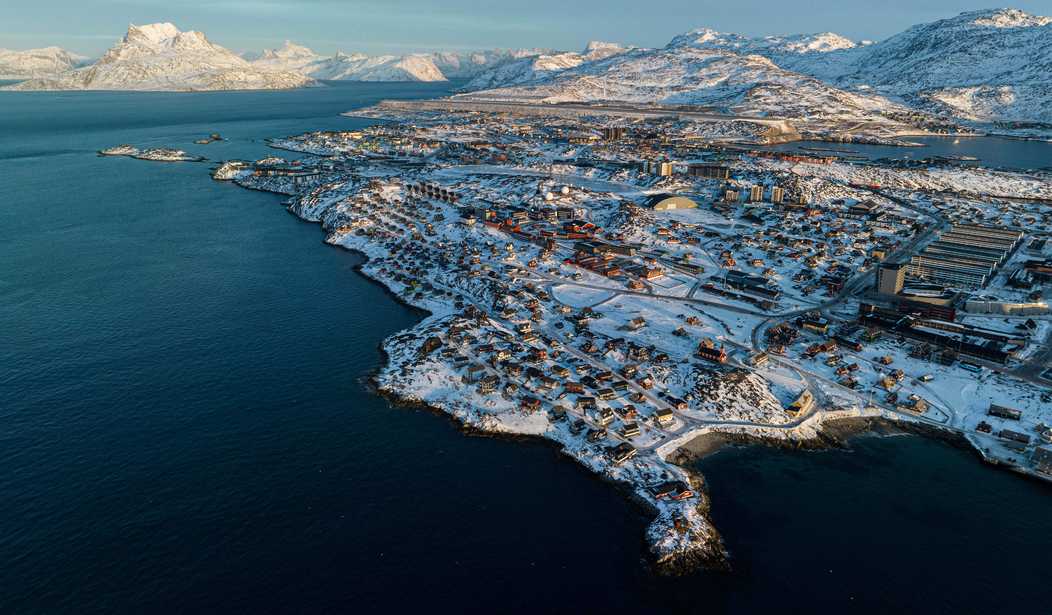
Greenland, he said, should be controlled by the United States, not Denmark.
"That should be controlled by the United States, not by Denmark," Trump said of Greenland in comments to reporters during a meeting with Turkish President Tayyip Erdogan.
Hours later, also speaking in Ankara, Danish Prime Minister Mette Frederiksen said she expected allies to respect the sovereignty of the Danish kingdom and accept that Greenland was not for sale.
"It is a well-known position of the United States that it wants to own and take over Greenland. I hope that it is equally well-known everywhere that this is not going to happen," Frederiksen said.
She added that there were no plans to discuss in Ankara issues concerning the High North, the Arctic or Greenland.
Greenland's Foreign Minister Mute Egede said in a post on Facebook that Greenland's future should be decided by its people.
"That's how it has always been. And that's how it always will be," he said, adding that Greenland should continue close cooperation with its allies.
Danish Prime Minister Mette Frederiksen rejected the idea again, and Greenland Foreign Minister Múte Egede answered with the point Washington should hear clearly: Greenland's future belongs to Greenlanders.
I have zero problem with that idea; nobody with a functioning brain should. Sovereignty counts; Greenland isn't a pawn, and its people aren't furniture to be moved around a room. Still, the fainting over Trump's interest misses a large piece of American history.
The United States has looked north for a long time because geography keeps dragging Greenland into our defense planning. Cold water, ice, air routes, minerals, missiles, Russia, China, NATO, and North America's front door all meet in one place.
Here's something you probably haven't read in the latest batch of headlines from the legacy media: Trump didn't invent the Greenland question.
After the U.S. bought Alaska from Russia in 1867, officials under Secretary of State William Seward discussed acquiring Greenland as part of a broader push. The idea never became a formal purchase offer, partly because Congress had little appetite for another frozen addition.
The question surfaced again in 1910 under President William Taft. American diplomats floated a complicated land swap that would've moved Greenland to the United States through concessions elsewhere; Denmark rejected the idea.
Before the Virgin Islands deal was finalized in 1917, U.S. diplomatic records also included a proposal in which Denmark would surrender its Greenland possessions to America in exchange for Philippine territory that Denmark would then transfer to Germany for land in Schleswig.
From the U.S. State Department, from 1910:
The proposal is:
- That Denmark should surrender to the United States of America all her enormous possessions in Greenland, estimated to be more than 800,000 English square miles in area.
- The United States of America should in return give over to Denmark the southern group of the Philippines, consisting of the Islands of Mindanao, Palauan and the small islands south of these.
- Denmark should then surrender to Germany all her rights to the southern group of the Philippines as she received them from America.
- Germany should then in return for the southern group of the Philippines, give back to Denmark that part of the province of Schleswig which lies north of a line along the middle of “Slien,” along Dannevirke to “Trenen,” following that river to where it joins “Eideren” and then following that river to the point where it flows into the North Sea.
That part of the province of Schleswig to be given back to Denmark would comprise about 2,400 English square miles, or only about 1/15 part of the area of the islands of the southern group of the Philippines to be surrendered to Germany by Denmark.
The possession of Denmark in Greenland to be ceded to the United States would exceed more than 30 times the area of the islands of the southern group of the Philippines, that is to say, that Denmark would in exchange for the above-mentioned part of the province of Schleswig, give territory in Greenland of over 300 times larger an area.
President Harry Truman made the cleanest offer in 1946. His administration offered Denmark $100 million in gold for Greenland at the opening of the Cold War. The reason wasn't mystery or greed alone.
Washington saw Greenland as vital to the defense of the United States after World War II had already shown how quickly the North Atlantic could become a battlefield. Denmark said no, but the military relationship remained.
America still operates Pituffik Space Base in northwest Greenland. The 821st Space Base Group says its mission supports force protection, space superiority, and scientific research in the Arctic for the United States and allies.
The base is also the Defense Department's northernmost installation and includes the world's northernmost deep-water seaport.
Greenland's political status has changed, too. The 2009 Self-Government Act recognized Greenlanders as a people with a right to self-determination under international law.
Denmark still holds responsibility for foreign, defense, and security policy, while Greenland controls many internal matters and has a legal path toward independence if its people choose it.
So yes, Trump's language can be blunt enough to make allies reach for the aspirin. Reuters highlights Trump's perspective on how Greenland has changed our country's relationship with NATO:
Trump said the issue of control over Greenland had harmed U.S. ties with NATO.
"That's what hurt my relationship with NATO, because Greenland doesn't help Denmark. Denmark doesn't spend money to really help Greenland, but it's an important part for the United States, and it's surrounded by China ships and Russian ships, and that's not going to happen," he said.
"They (Denmark) wouldn't go along with it, and with all the money we spend to help them with Russia."
U.S. Secretary of State Rubio said in June that conversations with Denmark and Greenland were continuing on a monthly basis.
He also has a point that Greenland sits in a dangerous neighborhood of history. Russia has rebuilt Arctic military power. China wants shipping routes, resources, and influence.
Denmark has already moved to strengthen its Arctic posture with new vessels, drones, and surveillance after years of thin capacity across a massive region.
The grown-up answer isn't to panic, and Trump's not considering conquest. It's honest pressure inside an alliance, serious investment by Denmark, respect for Greenland's people, and a clear American strategy in the Arctic.
Trump isn't the first president to stare at a map and notice Greenland; he's only the latest to say the quiet part out loud.
Any takers on when the drive-bys will share that nugget of information?
The left wants you angry, exhausted, and willing to believe every panic they sell. PJ Media VIP helps you step back, read the facts, and stay in the fight with clear eyes. Join VIP today and use promo code FIGHT to get 60% off.
Join the Conversation
VIP members get the ability to comment on articles.