



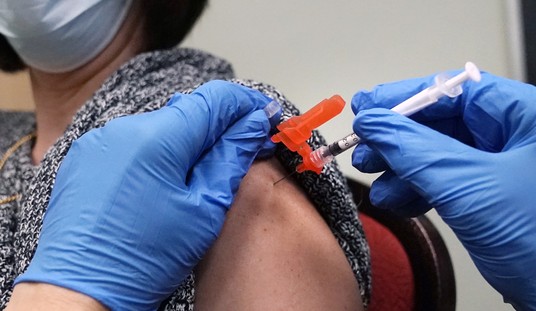
The great flu shot shortage that created such a brouhaha during the election is now apparently an overstock problem. No one seems to want all the leftover vaccine and more is on the way.
“It’s one of those things like Beanie Babies or something,” said Doug McBride, spokesman for the Texas Department of State Health Services. “If you can’t get something, you’ve got more people wanting them.” (hat tip: Sheryl)






I guess that lets the administration off the hook for a clear case of managerial incompetence.
Imagine this, if you will: your company needs dilithium to build widgets. There are only two dilithium suppliers. You get half your dilithium supply from one, half from the other.
One of the dilithium suppliers bought a “troubled” factory and in a 2003 inspection you determined there were still problems at that factory. Despite that, you take the dilithium supplier’s word that everything was going smoothly and you don’t bother to inspect the factory (as you had a right to) at any time during 2004. Suddenly, you discover that that company cannot supply the dilithium you need to make your widgets.
Question: are you still employed?
I work in health care and for years vaccine makers have complained that they were not making enough money. Shortage=demand=higher prices.
I don’t care if it is uparmored humvees or flu vaccine people will always claim the government is not getting the job done.
It struck me that one rather underreported story of the election cycle was the story that American manufacturers of the flu vaccine had been essentially forced out of business by a massive law suit against one American manufacturer, forcing us to import the vaccine from England and elsewhere. The attorney responsible for this predicament was reportedly one John Edwards – the VP candidate – who was out on the stump lambasting the Bush adminstration for incompetence when the story of the vaccine shortage broke.
OK. I admit it. I’m too lazy to google it all out to find out the truth of the matter. I have no aspirations to be a journalist and neither do I want to propogate rumor. But the fact is that the rumor was already there. Maybe its just an urban legend of sorts? But I did see the report several times and it receieved no followup whatsoever, even in the blogosphere. Maybe some of this blog’s many informed readers can shed some light on the matter.
Of course the class action attornies had a big part in screwing up vaccine production. I personally don’t know if Edwards did or not. My understanding was that his specialty was driving Obstetricians out of business. That’s way to make BIG money, as he demonstrated. It’s also why family doctors no longer deliver babies, and why my OBGYN friend and her partners no longer give free prenatal clinics on the nearby Indian reservations.
I agree with Terrye’s observation, but in this case it was als partly the government’s fault. They have public health bureaucracies that do all kinds of obscure things, but they can’t get vaccine for something that kills tens of thousands per year because of a small screwup?
Public health measures are routinely underfunded and misdirected. They are not sexy. They are not exciting. But certain public health measures are darned important. You can be sure that the government will screw up the response to a bioweapons attack also.
But ultimately the citizenry is at fault. People demand perfect safety. Huge amounts of resources are spent by government and industry on drug safety. The FDA grabbed a huge amount of power as a result of the Thalidomide tragedy of the ’60s, just like the FAA grabbed too much power as a result of the Grand Canyon collision of two airliners in the 50′s or 60′s. The FDA is an impediment to medical progress overall.
The public is not even close to rational on relative risk, and the politicians (who mostly aren’t either) know it. Spend tens or hundreds of billions to ultra-clean drinking water but don’t bother to insure vaccine supply? Spend far more money per death on diseases with advocates and ignore far more important ones without.
The scary thing is that there are no doubt a huge number of important obscure systems in our society, the crippling of any of which would cause a lot of deaths or economic problems or discomfort.
I have done a lot of work on computer systems where downtime was extremely expensive. We did all sorts of things to make sure they didn’t go down too much and could recover quickly. But we were a business and the potential costs drove the expenditures. But it was still a tradeoff.
well despite the non shortage, this is kinda cool (I’ve tried it, no flu yet. it has a strong taste, rather like cranberry juice w/o the sugar.)
Israel’s elderberry remedy Sambucol provides solution to U.S. flu vaccine shortage
There’s what I think is a terrific article over on THE NEW YORKER web site about a pull approach to government involvement in the development of new vaccines.
At least, I thought it was terrific—-I’d be interested to hear what others here think.
http://www.newyorker.com/talk/content/?041220ta_talk_surowiecki
(Vaccine is a HUGE issue in autism, where many parents believe their children were made autistic by vaccine, and God only knows if it’s true. Regardless of whether vaccine injury does or does not cause autism in some children, the economic ramifications of parents believing that it does are huge. It’s not a good business to get into . . . and we need vaccine.)
In the interest of truth:
http://www.snopes.com/politics/business/flushot.asp
“Let me get this straight. We needed that dilithium to make our widgets. And, you didn’t check up on the factory? You’re fired![TM]”
“But, Mr. Trump, please, I can explain! You see, it was all the fault of our buyers! If they didn’t want to buy widgets, we never would have needed the dilithium!”
“WTF? I said, you’re fired![TM]”
“Wait! Try this one: it’s all the fault of John Edwards! See, this utterly false and reprehensible urban myth says the dilithium shortage is his fault!”
“WTF? I said, you’re fired![TM]”
Epilogue: Eventually, Mr. Trump called security and had his former employee ejected from the building. But, not before he had spent the next two hours inventing an ever more complicated series of excuses, none of which had any relevance to the employee’s inability to do his job.
Patrick -
Awesome! Thanks for setting the record straight on that. That was indeed the exact story I had seen.
“BigMedia” — What’s your point? That you didn’t like how the election turned out?
It also didn’t help that the government became the main purchaser of vaccines, and used its “bargaining power” to drive prices down.
Thus decreasing the enthusiasm of the pharmaceuticals for supplying the goods.
“I guess that lets the administration off the hook for a clear case of managerial incompetence.”
Don’t you think the fact that the “managerial incompetence” of the Administration has anything at all to do with whether or not we can get vaccine is a huge problem? The “managerial incompetence” of the Administration has very little impact on whether we can buy cars or computers or jackets or creamed corn or books.
Even problems with the supply of oil and gasoline doesn’t prevent us from being able to buy as much of the stuff as we’re willing to pay for.
And yet the Administration can “drop the ball” and all of a sudden vaccine just disappears from the market? That doesn’t suggest a slight problem with the way we handle vaccine to you?
And people want all our drugs to be bought this way? You’ve got to be kidding me.
(Ken, you keep forgetting the Grand Unified Theory: the Dark Lord Bush, who is both an imbecile and a master schemer, is responsible for everything. And the amazing thing? Not even a little bit Jewish. Amazing, ain’t it.)
The Snopes article is actually a very good summary of a complex economic situation, and does point out a legitimate point of entry for the government into health care: so-called “orphan” drugs, or other important pharmaceuticals that are not attractive enough for the private market to manufacture.
However, if anyone has a feasible market-based solution (e.g. “shooting all the personal injury lawyers,” while attractive, isn’t feasible), I’d love to hear it – as long as it doesn’t involve tax breaks/subsidies that further screw up the tax code.
Caroline,
The John Edwards/vaccine story is an irresponsible lie:
http://www.snopes.com/politics/business/flushot.asp
There are reasons to dislike the guy, but that is not one of them.
Thanks for the link to the Snopes article, Patrick.
This whole flu shot story might make a fascinating case study for somebody, somewhere, studying something.
What I take away from the Snopes article is that manufacturing flu vaccine is a lo-profit, hi-risk venture. The product is seasonal and perishable and, apparently, over the course of time became sort of “sold on consignment” with the government as pretty much the only purchaser. In addition to that the ability to predict the need (and/or demand) for the product is subject to some pretty gross estimates. Not to mention that current flu vaccine technology makes it a very labor intensive endeavor.
So, when a company manufactured, say, 5 million doses of flu vaccine but only 1.5 million were consumed, what the company sold was 1.5 million doses and was on the hook for the full cost of producing the full 5 million. The company mentioned in the Snopes article as an example of why US manufacturers are out of the business of making flu vaccine lost $50M over 3 years. The response to that was to close 2 plants, one of which employed 800 people. They don’t mention how many the other plant employed.
It seems a small wonder that very few firms want any part of this business. In order to make a profit a company apparently would have to be able to price the product such that they would make enough profit in the years when demand was close to estimates to cover for the years when demand was well below estimates. But since there is only one buyer, and that buyer is the US government, they have little control over the pricing model.
What’s even more interesting to me is that people such as BigMedia believe the POTUS should have been “fired” due to a “flu vaccine shortage” that lasted until, ummm…, the “flu vaccine glut” – a span of what, 2 months. If every POTUS, governor, CEO wound up fired because some supplier of something that represented a small portion of the many things the executive had in their responsibility portofolio failed to meet the delivery requirements of a product (for which, apparently, nobody can reliably estimate demand), we’d have no POTUS, governors, or CEOs.
Somebody above mentioned “orphan drugs”. If We the People want to make sure that every year there are X number of flu vaccines (however we arrive at X), or any other drug that cannot be manufactured and sold for a profit, then we’re going to have guarantee somebody that they can make a living producing it. That will require a cost+ type contract where the manufacturer recieves an order for X doses, We the People pay production cost + agreed profit, and if demand is not X We the People either eat the loss or suffer the effects of the shortage. Having NIH or some other government organization do the manufacturing is, essentially, identical to a cost+ contract. One might minimize the “+” by taking it in-house, so to speak, but since Governments are VERY bad at controlling costs it is often best to have a private firm handle that side and just face the reality of “+”.
I want to comment – as the person who brought up the Edwards/flu vaccine story – which turns out to be an urban legend of sorts (and thank you to the bloggers who linked to Snopes) – that this was quite a damaging rumour that I had actually passed on to several of my friends pre-election, not having checked it out personally. (And I had actually supported Edwards in the primaries!) But I really do not recall seeing it debunked before, probably because I have spent less and less time at more leftist sites – where I assume the truth was revealed. My conclusion is that the onus should fall upon bloggers who stand to benefit the most from certain rumours (which advance their political agenda)- to debunk those rumours first should said bloggers happen to acquire evidence of their falsehood. In other words, police your own first. But then, that should go without saying, right? BTW – this obviously has nothing whatsoever to do with our host, who I don’t recall ever even bringing up the flu subject previously.
BigMediaBlog, does have a somewhat valid point. But it’s not the POTUS who should be removed from involvement in the pharmacutical industry. It’s the whole stinking gov’t. If you think the gov’t messed up with vaccines, just wait until they control the whole medical industry.
Masked Menace,
IMHO the very last thing we need or should want is a nationalized “health care industry”. The next to the last thing we need or should want is a single-payer system. The next thing in line that we don’t need and shouldn’t want is a single-insurance premium payer system (I can’t articulate how that would be meaningfully different than a single-payer system but I suspect there are material differences.) I think any of those would result in Unintended Consequences of the Worst Kind (well, unintended for us citizen-consumers at least).
I do wonder, however, if it might not be time to give some thought to whether or not it is possible to identify a limited subset of medical care that could, or should, but handled as a “national infrastructure”. Or maybe not national but some level of government be it state or even more local. It is, it seems to me, necessary for government to step forward and build, manage, or regulate, some aspects of “national infrastructure”.
Interstate and coastal transportation and communication functions, for example. Could we really have the transportation and communication network we have, and the economic benefits we realize as a society, without government at various levels building and maintianing roads, harbors, aiports, sealanes, breaking ice, etc? For all its problems, would we have a viable education system without public schools? Would rural America have received basic utility services without major government projects and/or regulated monopolies? Could we really have a functioning law-enforcement, judicial, and penal system if those were not handled as public infrastructure?
It isn’t obvious to me why, for example, basic hospital plant and ambulance service could not be provided as a basic infrastructure service. Is it really too much to ask taxpayers to pick up the tab for basic medical clinic services?
I have no idea how we’d go about deciding where the line between “basic” and “optional” should be drawn. But wherever it would be drawn there would be some level of abitrariness. And if such things were handled at localized levels we might actually add competitive attractiveness to localities that goes beyond “schools, schools, and transportation” and, maybe, was “schools, transportation, health care infrastructure”.
I’m not advocating, just pondering. Technology, demographics, and public expectations change over time. As much as I prefer we be as libertarian as feasible in matters of economy I am not convinced that everything should be privatized. It might, for example, be a very reasonable tradeoff for the government to get out of the “bare bones” pension business and, instead, get into the “bare bones” (unfortunate choice of terms!) medical insfrastructure business. Idunno.
I don’t know exactly where the line is either, but I do know we’re way to far on the wrong side of it.
I don’t want gunshot victims denied treatment because the robber stole the wallet with the insurance card in it, but I don’t want the uninsured using the ER as a walk-in clinic because the hospital is forced to treat them there either.