






Television’s Mad Men would have you believe that America was a monolithic bastion of Puritanism, untrammeled by European or socialist influences (despite the rise of Woodrow Wilson and FDR!) until the Beatles touched down at JFK Airport in 1964. The reality though, as Allen Bloom memorably wrote in The Closing of the American Mind, was that almost immediately upon the US winning World War II, America began to slowly — often unwittingly — become an unofficial enclave of Germany’s Weimar Republic.
Take architecture. As Tom Wolfe noted in From Bauhaus to Our House, his classic debunking of modernism’s excesses, because America’s intellectuals tend to think of themselves as an artistic colony in thrall to Europe, when the leaders of the Weimar-era German Bauhaus of the 1920s were evicted by the Nazis, they were welcomed by Depression-era American universities as “The White Gods! Come from the skies at last!”
[Walter Gropius, the founder of the Bahaus] was made head of the school of architecture at Harvard, and Breuer joined him there. Moholy-Nagy opened the New Bauhaus, which evolved into the Chicago Institute of Design. Albers opened a rural Bauhaus in the hills of North Carolina, at Black Mountain College. [Ludwig Mies van der Rohe, its last director, when the Nazis shuttered its doors in 1933] was installed as dean of architecture at the Armour Institute in Chicago. And not just dean; master builder also. He was given a campus to create, twenty-one buildings in all, as the Armour Institute merged with the Lewis Institute to form the Illinois Institute of Technology. Twenty-one large buildings, in the middle of the Depression, at a time when building had come almost to a halt in the United States— for an architect who had completed only seventeen buildings in his career—
O white gods.
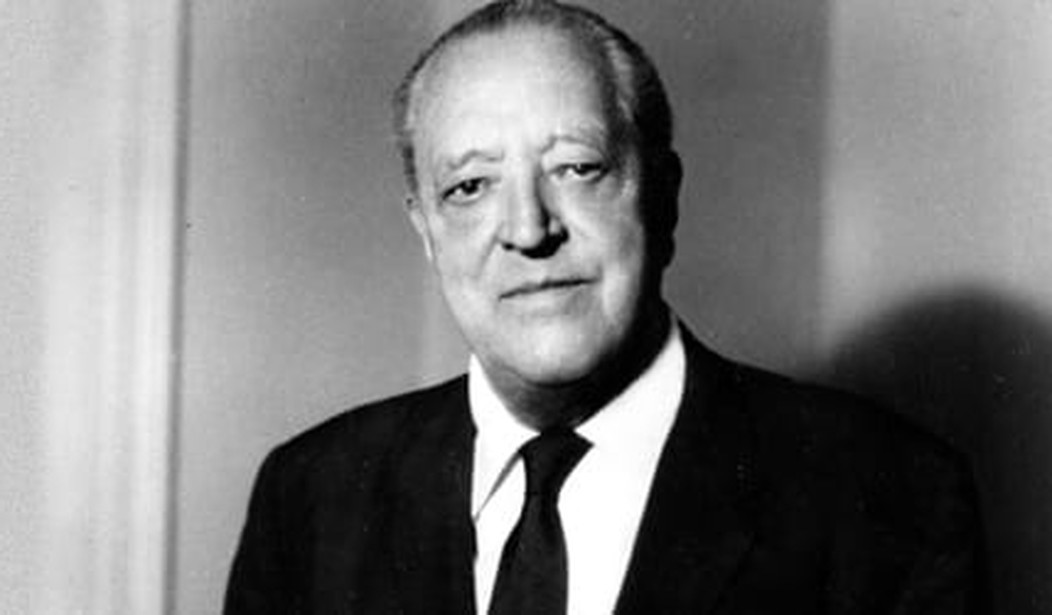
Mies van der Rohe (1886-1969) is the titular subject of the newly published biography by architectural historian Franz Schulze and architect Edward Windhorst (who studied his craft under a protégé of Mies). They’ve collaborated on an extensively — very extensively — revised version of the biography of Mies that Schulze first published in 1986, the centennial of Mies’s birth.

Mies van der Rohe’s 1929 Barcelona Pavilion, May 2000. Photo © Ed Driscoll.
While he was America’s most influential postwar modern architect and teacher, Mies never quite become a household name on the same order as Frank Lloyd Wright. (Despite a prominent Life magazine feature in 1957.) But he’s been the subject of numerous biographies and book-length profiles, beginning with his prominent role in The International Style, the pioneering Museum of Modern Art exhibition by Philip Johnson and Henry Russell Hitchcock, which first put modern architecture on the map in America, back in 1932.
Even as Mies was associated with several prominent buildings deserving of respect after World War II, perhaps his greatest accomplishment was to singlehandedly invent the language of postwar American architecture. We take tall steel and glass office buildings and apartments for granted, but it was Mies who created their look, beginning with 1951’s Farnsworth House (which would also provide the inspiration for Philip Johnson’s own Glass House) and from that same year, the 860-880 Lake Shore Drive apartment complex.

The Adam Building, a 1928 project (not built) by Mies for a department store in downtown Berlin. Scanned from the 1986 edition of Mies van der Rohe: A Critical Biography.
Mies didn’t arrive at this language overnight – he began formulating it as early as his 1921 Friedrichstrasse Office Building project (his charcoal and conte crayon sketches were perhaps the very first modern designs for tall office buildings) — in an era when a bankrupt Germany was still literally crawling out of the rubble of World War I. And his much lesser-known 1928 commercial designs, such as the Adam Building, which was a proposal for a department store for Berlin, and a similar design for a bank/department store in Stuttgart, further point the way to his post-World War II American architecture.

Unbuilt Stuttgart bank and department store project, 1928. Scanned from the 1986 edition of Mies van der Rohe: A Critical Biography.
These buildings also expose one the paradoxes of modern architecture: While the external I-Beam didn’t make its appearance on a Mies-designed building until after World War II, Mies arrived at his basic building forms, and all of his furniture designs, by the end of the 1920s – and yet this “modern” architecture and design is still very much with us today. (At the start of the year, when I prepped for writing a review of the DVD edition of HBO’s Boardwalk Empire series set in Atlantic City in the Roaring Twenties, I watched several hours of the show in a marathon session lasting deep into the night. When I turned the DVD player off, I was thrilled to return to the 21st century – only to stare at all of the Mies-designed furniture in my kitchen and living room and realize in a sense, I was still stuck in 1920s!)
Unfortunately, while illustrations of the Adam Building and Stuttgart Bank/Department Store were included in the original 1986 edition of Schulze’s book, they’re missing from this revised edition. Which is too bad, as they’re not readily found in Google’s image archives. There are several key additions in this new edition, however. Perhaps the most intriguing is the transcript of the court hearing from 1952, when Dr. Edith Farnsworth sued Mies after construction costs for her titular house on the banks of the Fox River in Plano, Illinois, went over budget. As Schulze and Windhorst note, the relationship was cordial (some have argued quite very cordial), until 1951, when Farnsworth soured on the design of the house once it was completed, and the relationship between client and architect irrevocably soured as a result. On the other hand, as Mies told the court in 1952, “I was famous before. She is now famous throughout the world.” But neither parties acquitted themselves all too well during this period, as the transcript found by Schulze and Windhorst highlights.
Another way that this biography differs from Schulze’s 1986 predecessor is an emphasis near the end of the book on the projects built under the name of The Office of Mies van der Rohe, but largely designed by Mies’s associate architects. For the most part, these were competently done, but frequently lacked the sense of Schinkel-inspired proportion that Mies brought to the best of the buildings he personally designed.
But then, as Schulze and Windhorst write, while Mies saw himself as the most systematized and rational of architects, his sense of space, proportion and massing, the keys to his best works, were concepts almost impossible to teach:
Mies was a system builder in an age suspicious of systems, and part of his genius was his skill in reconciling opposing positions. His system was not a set of rules but a method for seeking and finding an architecture in harmony with modern times. It was his will, firm and final, that convinced the world of the 1950s that he was a man of reason. Yet without the simple excellence of his architecture, even his will and the charisma that radiated from it would not have been enough to win the acclaim he garnered. It became conventional wisdom to acknowledge that Mies’s architecture, because it was reasonable and systematic, was therefore the most teachable. The stillborn design in the Miesian manner that transformed the American cityscape in the 1950s and 1960s suggests otherwise.
And then there were the architects who didn’t work in Mies’s office, but borrowed his language extensively, such as Philip Johnson and Gordon Bunshaft of Skidmore, Owings and Merrill. SOM in particular would build far more Miesian buildings than Mies himself — which Mies himself didn’t mind at all, as he told an interviewer in 1960, “Sometimes people say how do you feel if somebody copies you and so on. I say that is not a problem to me. I think that is the reason we are working, that we find something everybody can use. We hope only that he uses it right.” But the public and the American urban landscape didn’t necessarily benefit, as Schulze and Windhorst’s comment on the acres of stillborn Miesian buildings in postwar America highlights.
But that same reductionist impulse wasn’t just confined to modern architecture. It would impact graphic design as well by the mid-1960s, as the classic moment in the 2007 documentary Helvetica illustrates:
Note that for both Mies and designer Michael Bierut, featured in the above clip, this was a benefit of modern design, not a drawback. However, one enormous drawback to Mies’s language – and the language of modernism in general — was its lack of emotionalism. As the recurring leitmotif in Tom Wolfe’s From Bauhaus to Our House went, expressions of grandeur would be responded to with an upturned nose and the droll socialist reply, “how very bourgeois” by most postwar modernist architects.
The way Americans lived made the rest of mankind stare with envy or disgust but always with awe. In short, this has been America’s period of full-blooded, go-to-hell, belly-rubbing wahoo-yahoo youthful rampage— and what architecture has she to show for it? An architecture whose tenets prohibit every manifestation of exuberance, power, empire, grandeur, or even high spirits and playfulness, as the height of bad taste.
We brace for a barbaric yawp over the roofs of the world— and hear a cough at a concert. In short, the reigning architectural style in this, the very Babylon of capitalism, became worker housing. Worker housing, as developed by a handful of architects, inside the compounds, amid the rubble of Europe in the early 1920s, was now pitched up high and wide, in the form of Ivy League art-gallery annexes, museums for art patrons, apartments for the rich, corporate headquarters, city halls, country estates. It was made to serve every purpose, in fact, except housing for workers.
When Mies had the opportunity to first build in America, beginning on his own IIT campus during and after World War II, the results looked rather factory-like to the layman. Wolfe described Mies’s open-planned S.R. Crown Hall, his showplace school of architecture on his IIT campus, as looking like an LA car wash. This is somewhat unfair on one level, as the stylized “Googie” architecture of L.A. in the 1950s and ’60s was an attempt to add additional curb appeal to Miesian architecture. On the other hand, when Wolfe writes, “The compound style, with its nonbourgeois taboos, had so reduced the options of the true believer that every building, the beach house no less than the skyscraper, was bound to have the same general look,” he’s certainly onto one of the key disadvantages of Miesian architecture — and modern architecture in general.
As Schulze and Windhorst note, once Mies had developed his postwar architecture language and details (extensively cataloged and illustrated in the oversized 1974 book Mies van der Rohe at Work, written by Peter Carter, who studied and later worked with Mies), he tended to reuse it ad infinitem. As we previously noted, Schulze and Windhorst describe Mies as a systems builder who frequently questioned new architectural designs. Mies’s famous quip that “architecture is not a cocktail” – not something for which you mix up a fresh batch of ingredients every weekend – seemed a direct rejoinder to Frank Lloyd Wright, whose forms and styles seemed endlessly inventive.

Neue Nationalgalerie, Berlin. Photo by andersphoto / Shutterstock.com.
At one point, Schulze and Windhorst write, “After the completion of the Farnsworth House and its scaling up for [the 860 Lakeshore Drive apartment complex], Mies was essentially finished creating. He had successfully adapted his European vocabulary to the new materials and methods of fabrication available to him in the United States.”
This seems a bit harsh, particularly as it dismisses the care and innovation that Mies put into his landmark Seagram building, and the amount of effort that he put into his less successful, yet still epochal final building, the Neue Nationalgalerie in Berlin. This building had a circuitous birth — it began in 1957 as a showplace office headquarters commissioned by Jose M. Bosch, then the president of the Bacardi Corporation for their offices in Santiago, Cuba (after reading Mies’s Life magazine profile and seeing the photos of the building Mies had designed for the rival Seagram Corporation on Park Ave). Castro’s revolution scotched that building. But Mies, in the last decade of his life, was so enamored of the enormous structure he had designed, an engineering marvel free of internal columns he would dust it off — and scale it up to even larger proportions — when commissioned to design a museum for Schweinfurt, Germany in the early 1960s. The column-free building was a concept that married engineering and spatial deign that obsessed Mies throughout the 1950s, particularly when his gargantuan Chicago Convention Hall project of the early to mid-1950s was never built. While he was working on the Schweinfurt museum, the city of Berlin contacted Mies about creating a museum in the city where he had first made his reputation four decades earlier and he would request (and be granted) permission to conclude the Schweinfurt project, only to scale it up even further for the museum in Berlin.
Mies’s final building would end up being one of his most controversial. Great architects often cap their career with unwieldy museums (see also, the Guggenheim, one of Frank Lloyd Wright’s last buildings). But with the Neue Nationalgalerie, here was a building where the form and the function never quite meshed. While the enormous one-room structure echoes, on a much larger scale, some of the spatial concepts Mies had pioneered four decades earlier in his Weimar-era Barcelona Pavilion, as Schulze and Windhorst note, it functioned poorly in its intended role as a museum. Even Mies admitted it, as the authors note:
The great room is a mostly inflexible, inhospitable arena for the display of any but the largest objects. In the inaugural exhibition, Piet Mondrian’s paintings were hung on large white panels suspended from the ceiling. In ensemble the panels themselves were an impressive study in weightlessness, but the paintings were drowned in the ocean of surrounding space. Mies barely bothered to rationalize his solution. “It is such a large hall,” he declared, “that of course it means great difficulties for the exhibiting of art. I am fully aware of that. But it has such potential that I simply cannot take those difficulties into account.” These words are a measure of the intensity, not to say the willfulness, of Mies’s belief that the structurally objective clear span was the ultimate expression of the epoch.
Incidentally, we’d be remiss without mentioning a few words on Mies’s politics and worldview. While Schulze and Windhorst spend plenty of time with Mies in the hothouse Weimar era of the 1920s, when Mies’ politics shift from a dalliance with Communism (he designed a tribute to murdered Spartacist leaders Rosa Luxemburg and Karl Liebknecht in 1926) to the socialism of the Bauhaus (and Weimar in general) to a dalliance with National Socialism, the authors, not surprisingly, fail to notice that this progression isn’t as dramatic as it first seems, or that Philip Johnson, Mies’s chief early American benefactor would, if anything, become infinitely more enamored with post-Weimar socialist Germany than Mies ever would.
And speaking of the Weimar era, a key revision to this edition of Mies’s biography is the removal of any reference to Oswald Spengler, the Weimar-era German historian who wrote the legendary The Decline of the West in 1918, (and whose name inspired the nom de blog of PJM’s own David Goldman) and followed it was a second volume in 1922. In his 1986 edition, Schulze believed that Spengler’s works formed much of the seminal influence upon Mies’s Weimar-era worldview:
The proximity of several of Mies’s best-known statements to Spenglerian concepts and even locutions is so noteworthy that, together with the evidence of the two well-worn volumes in his library, we are led to believe that the melancholy historian-philosopher was on Mies’s mind [during the early 1920s].
A year after the publication of the second volume of The Decline of the West, Mies wrote: “Architecture is the will of an epoch translated into space”; “Not yesterday, not tomorrow, only today can be given form”; and “Create form out of the nature of our tasks with the methods of our time. This is our task.” As late as 1930 he added: “The new era is a fact; it exists, irrespective of our ‘yes’ or ‘no.’” And in 1964: “My definition of civilization is an order in the material realm; and culture is the order in the spiritual realm-or rather the harmonious expression of order in the spiritual realm…We speak of the Roman Civilization and the Greek Culture; and this is how I see it.”
The reference in this last, late statement to “civilization” and “culture” is traceable certainly to Spengler, though it is more the cold- blooded tone of Mies’s earlier remarks that rings with the sentiments of The Decline of the West, even as it points to his ultimate differences with de Stijl and the constructivists.
In contrast, searching on “Spengler” in the Kindle edition of the 2012 biography of Mies brings up no listing. Indeed, in the new edition, Schulze and Windhorst now claim that historical philosophy played little role in Mies’s designs:
Historians and critics alike sometimes make broad claims about the genesis of works of art. In the case of Mies, scholars with excellent credentials have contended that he designed some of his buildings with the intention of expressing, in built form, a philosophical position, and that his buildings are architectural translations, from word into form, of his thinking, as derived, for example, from that of Romano Guardini.
It is tempting, especially in the case of Mies, who read and quoted philosophy his entire life, to evoke a causal connection between what he read and what he designed. But there is no evidence that the philosophy of Guardini or Rudolf Schwarz or anyone else was the source or the starting point of the design of any of Mies’s works; nor is there reason to believe that Mies designed by anything other than his own formal intentions “to solve architectural problems,” as he always described his work, unless they were derived to some degree from the acknowledged influences of other architects, like Schinkel or Paul or Behrens or Wright. This applies also to Saint Thomas Aquinas and Saint Augustine, two other philosophers frequently cited in discussions of presumed influence on Mies’s architecture.
Joseph Fujikawa, who knew him professionally as well as anyone, offered this view of Mies’s interest in philosophy: “He did quote . . . philosophers and I’m sure, even though he didn’t personally say so, he made a real effort to read as much as he could of their works. My general impression is that he was trying to confirm ideas which he himself had. I think the things he believed in, he found these historical figures who said the same thing. I think it reinforced his own convictions. . . . He read philosophy primarily for that reason.”
Whatever their inspiration, MIes’ architecture and furniture designs continue to further inspire both laymen and architects to this very day, decades after Mies himself passed away. To understand them better — and thus the visual language of the world we inhabit, Mies van der Rohe: A Critical Biography is highly recommended.



Join the Conversation
VIP members get the ability to comment on articles.