





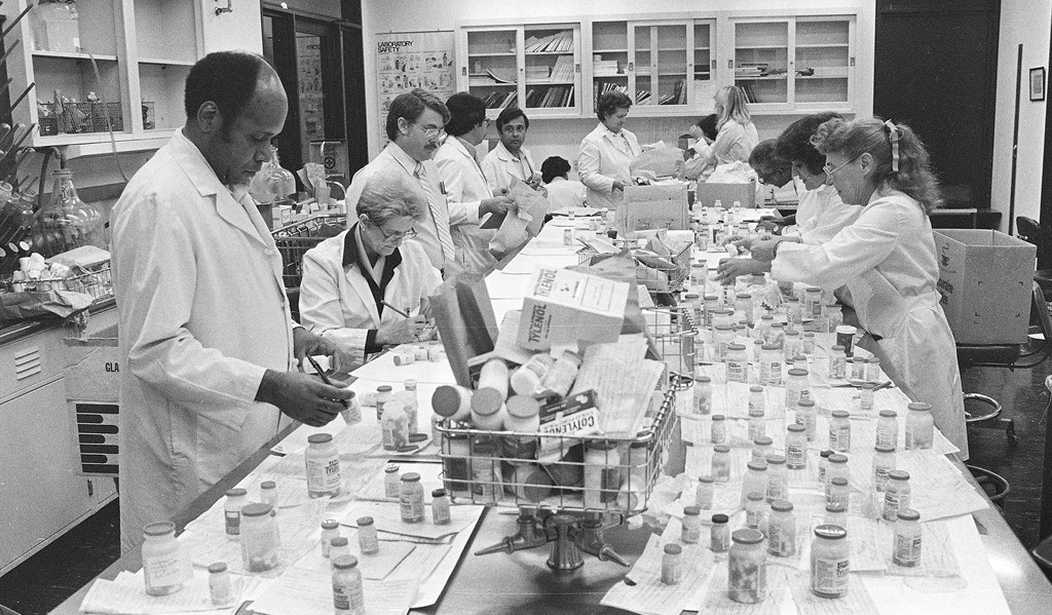
Anyone who’s serious about working in the crisis management field can tell you the whole story of the Chicago Tylenol murders of 1982, and specifically how Johnson & Johnson (J&J), maker of Tylenol, responded. The case study is the grandaddy of modern crisis management and the way it should be done.
Now, we have a new development, which may help shed light on a cold case that, while it remains unsolved, has seen some new developments that may bring us closer to finding out exactly who was behind those murders.
What happened in 1982?
In September 1982, seven people, all of whom lived in nearby Chicago suburbs, died with poison in their systems. The first victim was 12-year-old Mary Kellerman, who felt sick and took one Tylenol capsule shortly before collapsing on the bathroom floor inside her parents’ house. She died not long after that.
The second victim was a 27-year-old postal employee who lived roughly 10 miles away in Arlington Heights. Adam Janus took two capsules before ending up at a local hospital, where he died. When news of his death reached his family, everyone came together at his house to try to come to terms with the death, to support each other and to grieve. Adam’s brother Stanley and his wife Theresa then took Tylenol capsules from the same bottle. Soon, they collapsed on the floor and were later pronounced dead.
In the coming days, three more people in nearby suburbs died after taking Tylenol, including Mary McFarland (31), Paula Prince (35), and Mary “Lynn” Reiner (27).
Helen Jensen, a nurse, visited the Janus' home after the deaths and noticed that six capsules were missing from a Tylenol bottle. She collected the bottle and turned it into investigators. Health officials examined the bottle and its contents, discovering that the capsules in the bottle had been taken apart, and that the Tylenol powder was replaced with potassium cyanide.
That sparked a massive public health response and an unprecedented product recall. It was this public response that provided the product recall playbook we see routinely today.
J&J instituted a nationwide recall of over 31 million bottles already on store shelves. This was the first mass recall in U.S. history. Every bottle of Tylenol Extra Strength, 500 milligrams, was recalled, and samples were sent to forensic labs for study.
As quickly as the killing started it stopped. After completing the recalls and related investigations, health officials confirmed that in addition to the five bottles tied to the seven victims, they later found three other unused Tylenol bottles, which also contained cyanide-laced capsules. All were in the Chicago region, though no additional deaths were reported.
According to the Chicago Tribune, all were recovered locally. Two were sold to customers and were still unopened, while a third was still on a store shelf at Osco Drug in Schaumburg.
One customer returned an unopened bottle to Dominick’s Old Town on Chicago’s North Side. Once it was tested, investigators reported that 11 of the 50 capsules in the bottle were laced with cyanide. The wife of a DuPage County judge returned her unopened bottle of Tylenol, which she bought from Frank’s Finer Foods in Wheaton, to police two weeks after the first deaths. Tests confirmed that some of that bottle’s contents contained the poison.
The recall
Prior to this, no American company had ever conducted a mass, nationwide recall on this scale.
The brand counted more than 100 million users and represented 19% of Johnson & Johnson’s corporate profits at the time. It was the category leader in pain relief, enjoying higher sales than its next four competitors combined – Anacin, Bayer aspirin, Bufferin, and Excedrin.
But that September, the brand and its owner, J&J, were caught flat-footed. Reports at the time were that the company first learned of the crisis when a Chicago news reporter, who had just attended a news conference conducted by the medical examiner, called J&J’s PR department. He told company officials that the medical examiner stated that cyanide-laced Tylenol capsules were killing people.
Very quickly, J&J kicked into action, led by CEO James Burke, who made decisions that prior to this were unheard of. First off, he made himself available to the media and didn’t hide behind “no comment.” The company operated from the belief that open and thorough communication might save lives and would help investigators. The second big thing Burke decided was to pull all of those bottles from the shelves nationwide, even when it appeared that the crisis could be isolated to Chicago. He didn’t take any chances, but more importantly, he sent a message to company shareholders, product users, and consumers nationwide that his company was willing to put consumer safety before profits.
The company used public relations and paid advertising to alert the public to the risks, and to keep the public informed of the latest developments. In those first few days, the company established a toll-free telephone hotline for consumers. It used that number and another toll-free number to collect information from the public, and to inform anyone who might call into it. Pre-recorded messages were kept up to date on a daily basis on the current status of the situation.
In the end, the company and the brand were able to survive and rebound from the crisis. And the company gained new respect in the public and among consumers.
The trail to the killer goes cold
The FBI and other law enforcement agencies and departments – local, state, and federal – devoted tremendous resources to finding the killer to no avail. No one has ever been charged with the murders.
One individual did emerge as a person of interest, and he was long thought to have been the killer, though authorities never had enough evidence to tie him directly to the crimes.
James William Lewis was reported to have sent a threatening letter to J&J in which he requested $1 million to put an end to the Tylenol murders. Needless to say, investigators checked him out every which way, but never had enough on him to prosecute. He ended up being charged and convicted for extortion for sending that letter and making those demands. He served 12 years in prison for that, and he later died in 2023, denying to the end that he had anything to do with the actual murders.
When investigators interrogated him, he threw out a number of theories on how the poisoning could happen. In 1992, he told CNN, “If I were going down the street and your house was on fire, not my problem, but I would stop and try to help.”
In other words, he framed his role in all of this as trying to make the killings stop by offering what he felt were expert insights. I know, weird, right?
Here’s the latest
With no substantive leads, the case faded into history until this week when it appears this case and another from Idaho have intersected. In 2019, Detective Tim Cooper of the Ada County Sheriff’s Office (ACSO) reopened a cold case from 1982 in his own jurisdiction that would lead to possible identification of the Tylenol killer. In Boise, his case was known as “the unknown wanderer.”
In a statement on Sept. 23, the ACSO announced it had identified a man whose body was discovered under a pew inside a Boise Catholic church in December 1982. Investigators at the time determined he died by suicide after ingesting cyanide in Sacred Heart Catholic Church. The man’s name was Dr. Mathew Betkouski.
When discovered, Betkouski had no identification on him. Police found on his person an amount of cash and a typed note signed “Wm. L. Toomey.”
When Cooper reopened that investigation, he cross-referenced that case against more than 17,000 missing persons records. But, according to the ACSO, the break in the case came from an engraved key that was among the unknown man’s belongings.
This, the ACSO office said, took investigators to “a residential street in Jacksonville, Fla.”
“There, detectives identified a property owner who had disappeared in 1982 and was later declared deceased in absentia. Photo comparison and familial DNA confirmed his identity: Dr. Mathew Betkouski,” the ACSO said in its statement. “Investigators found that Betkouski had worked in two drugstores during his undergraduate studies, giving him working knowledge of pharmacy operations. Those who knew him described a history of volatility, including a documented fascination with explosives.”
According to the Associated Press (AP), police found cyanide in Betkouski’s desk, which according to Cooper appeared to be homemade and different from the cyanide used in the Tylenol killings.
While Betkouski lived in five states during his life, he never lived in Illinois. Though police did find photos that prove Betkouski visited the Chicago area a year before those killings. The Chicago Police Department has refused to say whether it considers Betkouski a suspect in the open cold case.
Cooper interviewed people who knew Betkouski throughout his life, the ACSO said. And he reviewed thousands of pages of documents and personal letters. In the course of this, Cooper learned that Betkouski sometimes talked about how to commit the “perfect crime,” specifically describing how cyanide could be used as a way to kill someone without being detected.
Cooper collected and organized all of the data and evidence he found and then reached out to a forensic psychiatrist who had consulted with the FBI on the Tylenol murders. That psychiatrist, Dr. Park Dietz, said that by December 2021, “Tim’s findings convinced me he’d identified a viable suspect for the 1982 Chicago Tylenol murders.”
The Ada County Sheriff’s Office has already shared its findings with the Chicago Police Department, but it is not yet releasing the full body of supporting evidence to the public. Detectives are hoping that news of their most recent progress in the case will help them nail down Betkouski’s movements between Oct. 14 and Dec. 4, 1982.
In the end, police still do not have a definitive suspect in the case, though it appears they are getting closer. They now have much more to work with, which could mean that family members of the victims may one day soon have closure.
As for the legacy of the Tylenol murders case, it is impossible to know how many lives may have been saved by changes which have since been instituted to prevent product tampering as a direct result of those murders.
J&J developed new ways to protect the integrity of its products. The company worked with the U.S. Food and Drug Administration (FDA) to create tamper-proof packaging, which includes the now familiar foil seals and other packaging features that make it easier to detect whether someone might have tampered with a product. The packaging changes are now the industry standard.
Another notable change coming out of the crisis was the invention of “the caplet,” which is a tablet that’s coated with gelatin to make it easy to swallow but more difficult to tamper with.
In 1983, the Congress passed "the Tylenol bill" or the Anti-Tampering Act, which made it a federal crime to tamper with consumer products. Then in 1989, the FDA established federal guidelines on how manufacturers should make their products more tamper-resistant.
In my own work in crisis management, I've learned there's a story behind most of those packaging and labeling innovations, and it's not always a bland business story or a creative branding story. Sometimes, a human toll went into that packaging change. Thanks to that, you really are safer than you would otherwise be.
Reader’s Note: Find out what you’re missing behind the members-only wall. It’s time for you to take advantage of the full catalogue of common-sense thinking that comes with a PJ Media VIP membership. You’ll get access to content you didn’t even know you wanted, and you’ll be hooked. The good news is, PJ Media VIP memberships are on sale! Get 60% off of an annual VIP, VIP Gold, or VIP Platinum membership! Use promo code FIGHT to get 60% off a VIP membership!



Join the Conversation
VIP members get the ability to comment on articles.