
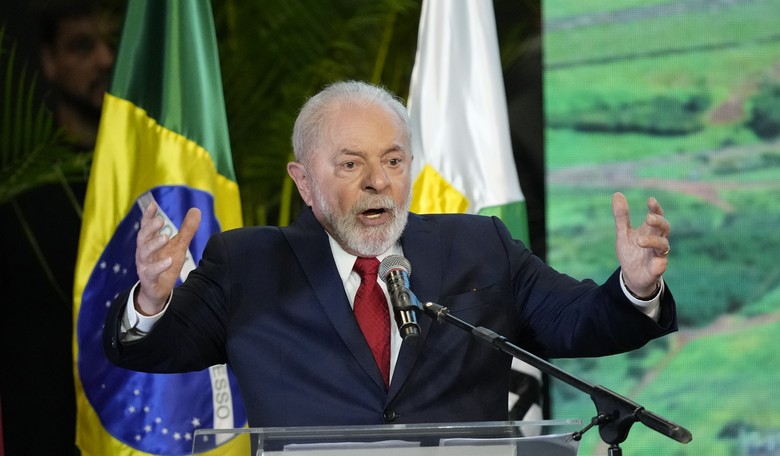
After elections held earlier this month, Brazil looked like it could swing to the right and away from a fourth term for its little communist dictator, Luiz Inácio Lula da Silva. Lula's opponent, Flávio Bolsonaro, son of former president Jair Bolsonaro, achieved far more of the vote than expected. However, neither candidate received enough to avoid a runoff.
But it wasn't just that. What happened down the ballot looked like a good indicator of what was to come. A win for Flávio, a win for the right, and a win for Brazil and the entire Western Hemisphere. I'll admit that I've been analyzing this for a year and felt very confident about it (and I've yet to be wrong about these things; not to toot my own horn), but I also knew it was possible that Lula would cheat. Commies gonna commie, right?
For many of us here in the United States, it reeked of 2020. An incumbent who trailed in the first round staged a late surge to claim victory after a last-minute judicial intervention extended voting hours, transport disruptions appeared in areas favorable to the eventual winner, and the losing candidate immediately refused to concede while alleging the rules had been changed midstream. Several Spanish-speaking media outlets have quoted Donald Trump as saying it was like something out of the "Joe Biden playbook," but I haven't been able to confirm that quote myself, though he wouldn't be wrong. It's also giving me 2024 Nicolás Maduro vibes.
Many are calling the win "historic" because it's been nearly four decades since an incumbent who trailed in the first round made such a comeback. But is it historic? Or did someone have this planned all along?
On October 4, Lula finished second with roughly 45.16% to Bolsonaro’s 47.03%. Three weeks later, the certified totals showed Lula at 51.79%, with about 64.3 million votes, and Bolsonaro at 48.21%.
I'm not going to go through all the math, but it appears that Lula gained 10,376,694 votes and won by 4,430,191.
Lula claims it was all about getting out the vote. Abstention did fall between rounds, and around three million more Brazilians voted in the runoff. There is also the matter that this was a two-man race, and other candidates complicated the numbers during the first round, taking a combined 9.317 million votes.
But there is still something fishy. For example, those extra candidates were generally to the right of Bolsonaro and even endorsed him after they lost. Are we to believe every single one of their voters suddenly thought Lula was a better option?
And then there's the rule change. Just after the polls closed around 5 p.m., Supreme Federal Court Justice Cristiano Zanin extended voting nationwide by two hours. We already know that Brazil's Supreme Federal Court is corrupt, but Zanin specifically was appointed to the court in 2023 by Lula. Oh yeah, and he was Lula's personal defense attorney during el presidente's corruption trial. He cited "transportation" issues and pointed out that some areas had reduced bus services. But the voting stations that were already closed couldn't be reopened, so the extended voting was uneven across cities.
For what it's worth, Bolsonaro had asked for extended voting hours in areas that were impacted by heavy rains, but Lula wanted the nationwide changes. Tribunal Superior Eleitoral (TSE) president Kassio Nunes Marques called the extension "unprecedented" and said it should have been planned in advance.
On election night, Flávio refused to concede, and rightfully so. He accused Lula's side of changing the rules in the middle of the game and said he would seek an annulment of the vote.
On Monday, the younger Bolsonaro was visiting his father, Jair, when, he said, federal police stopped him and asked him to surrender his ordinary and diplomatic passports. He was also told he could not leave the country. He says the order came from none other than Supreme Court Justice Alexandre de Moraes and it was based on "remarks from his younger brother Eduardo Bolsonaro, who said on a podcast last week that Flavio should leave the country if he lost the runoff election to Lula."
Moraes, of course, is the justice who oversaw the investigation and conviction of Jair Bolsonaro on coup-plotting charges after the 2022 election. He was also sanctioned by Marco Rubio in July 2025 for "serious human rights abuse."
According to the State Department, "He has used his position to weaponize courts, authorize arbitrary pre-trial detentions, and suppress freedom of expression." The Trump administration also accused him of "abusing his authority, creating a censorship complex, [and] blatantly targeting political opponents."
There are many things to question here, but if everything is on the up-and-up, why did they go after the supposed loser's passports less than 24 hours after the election? In what other countries is this a normal part of the ordinary democratic process? This is exactly the kind of thing the U.S. has already sanctioned Moraes for.
The left can't win fairly, so it has to cheat. I have a feeling this will only get uglier before it's over, much like what happened in Brazil in 2022. The question is whether having Trump in office vs. Biden will make a difference.