
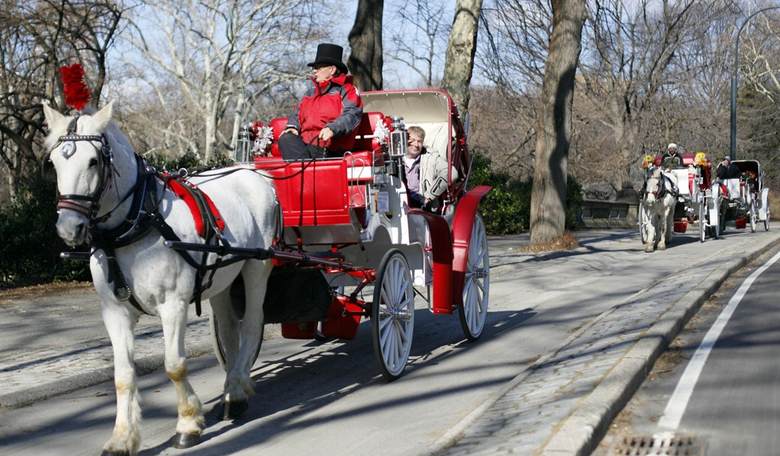
For 168 years, horse-drawn carriages have taken politicians, celebrities, and ordinary people on a slow, leisurely canter around Central Park. It's the most touristy thing you can do when you visit New York City for the first time, and you'll never forget it.
Alas, today is (another) black day in the city's history. The City Council will vote to end the horse-drawn carriage industry for good.
More than 200 carriage drivers will lose their jobs, and dozens of owners will be left with several horses on their hands.
“ If I cannot afford my horses, all six of them, then I have to pick and choose, says Alexus Lawson, who has owned several carriage horses for nine years. "Do I sell some horses back to the Amish because they need plow horses? I can’t get rid of my retired horses. They don’t stand a chance,” she said.
Lawson is referring to the likelihood that middlemen will buy most of her horses. The law says she can't sell the horses for slaughter, but no one checks what the middlemen do with the animals after the owners sell them, and the rules can't be enforced on them, anyway.
“Horses like [this one] stand a better chance, but then I can’t control her future if she’s out of my hands, and that’s heartbreaking for me,” Lawson said.
“I don’t want to have to think about that,” she said. “I raised this horse.”
There are several valid arguments against horse-drawn carriages in Central Park. Activists and animal rights groups argue that Manhattan’s hard asphalt streets and heavy concrete environments are fundamentally unhealthy and punishing for horses. Constant impact on hard surfaces can cause joint, leg, and hoof damage over time.
Also, horses have a very strong flight response. Traffic noises, horns honking, tires squealing, sirens, and flashing lights easily startle the animals, sometimes causing panicked flight. The straw that broke the camel's back and convinced many city council members that it was time to end the carriage rides was a tourist who died when he was thrown from the carriage after the horse was spooked.
“Romanch’s Law” is named for Romanch Mahajan, a tourist from India, who jumped from the carriage after his mother fell out, hit his head, and died. The horse bolted just as the driver was climbing into the carriage.
“ It was a very tragic situation,” Lawson said. “ We’re not trying to gloss over that. I’m not trying to say it didn’t matter; it did.”
Lawson wonders whether the tourist falling out of another conveyance would have provoked the same reaction.
“If he would have jumped out of a pedicab and hit his head and passed away in the same manner, would there be the same uproar that we have for the horse carriages?”
It's a good question. In fact, the tragic death of Mahajan was the perfect vehicle for the animal rights activists to piggyback their agenda on.
The pedicabs are a source of consternation for another carriage driver, Tony, who’s been working in the park for 40 years.
“This was a pleasurable job and they came along then and that was it,” he said as two pedicabs buzzed Harry, the brown standard bred pulling his carriage.
The pedicabs have also taken the spots where the carriages used to line up, he says, and less visibility means fewer customers.
Neither Tony nor Ms. Lawson own their carriages, which operate on a medallion system. The system has been used to regulate the city’s horse-drawn cabs, as the carriages are still legally known since before the dawn of the car age and the city’s signature yellow taxis.
The city has promised to find jobs for the more than 200 drivers and owners who will be left in the cold by the new law. The MTA, the city's mass transit agency, will offer many of the drivers jobs. For some, it's not an option.
“We’re here for the horses,” said Joseph, a driver of three years. He met his wife, a fellow carriage driver, on the job, and says they will leave New York if the law passes.
Critics also argue that slow-moving carriages create bottlenecks and exacerbate traffic congestion on perimeter roads around Central Park (such as Central Park South) and nearby avenues, slowing down emergency vehicles and general traffic.
Supporters of the industry, including carriage drivers and union representatives, defend the practice as a cherished, historic New York City tradition immortalized in classic films like 1948’s Judy Garland's Easter Parade to 2003’s Elf. They argue that the horses are well cared for, that regulations such as temperature limits and mandatory vacation time (three months) protect the animals' health, and that a ban unfairly destroys the livelihoods of working-class operators.
In every case where something like horse-drawn carriages is banned, very little thought is given to what is being lost. Not just jobs and livelihoods, although that's important. Central Park carriage rides are part of New York City's DNA. Ending them without so much as a "by your leave" to tradition and history is just another example of how left-wing activists are destroying everything good and important about urban life without a second thought.
Exclusively for our VIPs: Cats and Their Human Companions Appear to Share a Fascinating Hormonal Connection