
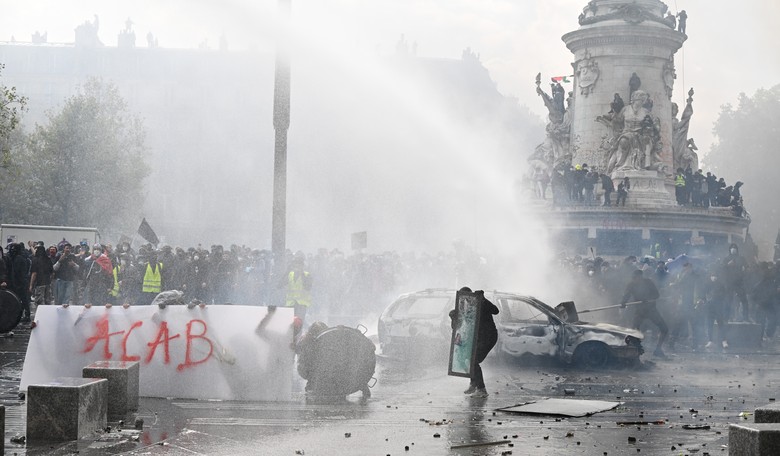
France is in deep trouble. The riots and protests point to a crisis far deeper than school funding or the cost of living.
It's also far more complex than Muslims running wild in the streets. France and its historic belief in centrist politics are fraying at the edges. In recent years, French politics has become closely associated with a form of "radical centrist" governance under President Emmanuel Macron, whose party, Renaissance, champions a pro-European, social-liberal "progressivism" that pulls figures from both the traditional center-right and center-left.
While centrist coalitions and technocratic leaders often capture the presidency and steer the government, the French electorate remains deeply ideologically diverse, prone to strong anti-establishment sentiment, and sharply polarized between the political extremes.
Macron's weakness and his party's exhaustion, plus some unforced errors, such as calling for snap elections in June 2024 when his support was at a low point, have combined to create a perfect storm of discontent that is still rising.
“We are experiencing a profound crisis of trust and authority, which poses a threat to democracy,” said National Rally leader Marine Le Pen, who leads opinion polls for the April presidential election.
The radical left in France is culpable, but they're only taking advantage of a situation created by Macron's weakness and young people's dissatisfaction. That's what makes what's happening in France likely to repeat in the U.S. and elsewhere in industrial democracies.
The generational chickens are coming home to roost, and we're not prepared for the upheaval.
In essence, more and more resources are going to the generation already retired or soon to be. This leaves less and less for younger citizens, and they're just waking up to the fact that the whole Ponzi scheme will go bust before they're old enough to collect what they're paying into the system now.
Walter Russell Mead, writing in the Wall Street Journal, notes that France isn't the first country to fall victim to the generational war. "In 2024 youthful protesters drove Bangladeshi Prime Minister Sheikh Hasina from power and challenged Serbia’s political establishment," Mead writes. "The following year, generational unrest shook and sometimes toppled governments from Nepal and Madagascar to Morocco and Peru."
In addition to France, India is seeing its own generational war with the "Cockroach" movement roiling the streets of major cities.
Youth movements can be consequential. In 1968 youth revolts in both Western Europe and the U.S. took place whose consequences (and elderly survivors) still shape Western politics. The large post-World-War II generations of the West were born into unprecedented affluence and met new realities, including oral contraception, that gave them wildly different experiences and expectations from those of their war- and depression-scarred parents and grandparents. As these large generational cohorts reached voting age and began working, they reshaped their societies in their own image—not always, it must be said, for the better.
Globally, the generation gap has grown into a chasm. From the advent of social media to the rise of artificial intelligence, young people face conditions their elders struggle to understand. At the same time, baby boomers like your Global View columnist and our elders are living longer, more active lives. Warren Buffett might have stepped down at 96, but octogenarians and septuagenarians like Larry Ellison, Stephen Schwarzman and Michael Bloomberg are still at their desks. In politics, Donald Trump (80), Elizabeth Warren (77) and Bernie Sanders (85) continue to rule the roost.
Governments are running out of other people's money to spend and, like a game of musical chairs, the youngsters are left with nowhere to sit.
"According to France’s National Institute of Statistics and Economic Studies, the poverty rate for children (22.4%) is more than double that of retirees (10.4%)," reports the Journal. "France’s Pensions Advisory Council reports that 24.3% of public spending in 2025 went to pensions, while the Finance Ministry puts the share of the Education Ministry’s proposed 2027 budget going to pension payments at 32%."
Prime Minister Sébastien Lecornu presented a budget that cut about $50 billion from a $1.7 trillion budget, and labor unions are up in arms. Too much is cut from the wrong programs. The Education budget was raised about 5%, but it wasn't enough, say the students. What can the government do when one-third of the education budget goes into retired teachers' and education employees' pockets?
Mead believes the crisis is oversimplified.
This mix of economic grievances that tend to unite young people in France and ethnic and religious tensions and alienation that affect some young people more than others helps explain the complex nature of France’s youth rebellion. Some protesters want to lobby city hall. Some want to burn it to the ground. Some don’t care much about city hall but enjoy looting stores and rioting in the streets.
This is bad news, but France’s problems aren’t only generational. Where young and old agree in France, they are generally both wrong. The best way to open opportunities for youth would be to slash taxes and dismantle restrictions on new housing, infrastructure, business, employment and almost everything else strangling the French economy with red tape.
It's a nearly incoherent cry from France's youth for the same future their parents and grandparents enjoyed. They don't understand how hard it was to create that kind of life because they didn't have to struggle for it. Their parents and grandparents fought a World War, a Cold War, experienced social upheaval and domestic crises, and came through the other side battle-scarred and exhausted. Now, this generation wants the good life handed to them?
Once American kids wake up to what the $2 trillion deficits and $40 trillion national debt actually mean for their middle and old age, I don't think they're going to sit still and behave.
I know I wouldn't.
Exclusively for our VIPs: Americans Aren't Very Good at Playing the Long Game. China Is.