
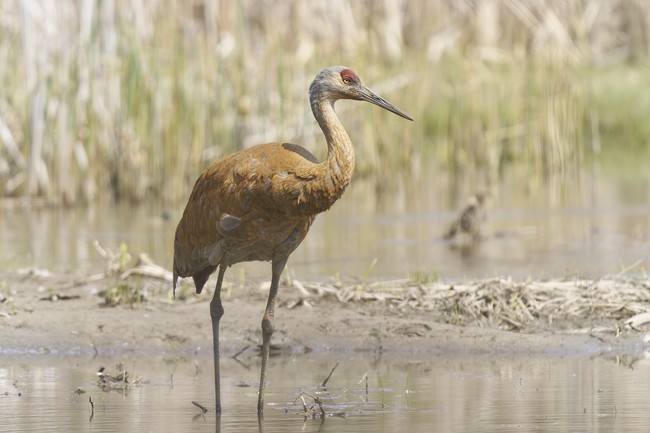
When a sandhill crane walks a newly planted Wisconsin cornfield, it isn’t admiring the rows. It follows them, digging up germinating kernels one after another and turning a farmer’s seed bill into lunch.
Around 200 Wisconsin farmers report crane conflicts have reached a reported loss of nearly $2 million.
From Wisconsin Public Radio:
People weighed in on the bill Wednesday during a hearing held by the state Senate sporting heritage committee. The proposal is the third attempt since 2012 to hunt the birds, sometimes dubbed the “ribeye of the sky” by hunters. The Joint Legislative Council introduced the bill earlier this year after a committee studied ways to manage cranes and related crop damage.
Under the bill, Wisconsin hunters would have the opportunity to hunt sandhill cranes, pending federal approval. The measure would also create a new program to reimburse corn growers for up to 50 percent of the cost of a treatment used to repel birds that eat freshly planted corn.
The damage can hit an individual farm hard. Omro farmer Rick Gehrke told a legislative study committee that when cranes force a field to be replanted, a farmer’s cost jumps from about $150 per acre to more than $300 after labor, fuel, seed, and the consequences of planting late. Farmers aren’t complaining because they dislike wildlife; they’re watching an increasingly successful wildlife population eat into already thin margins.
Wisconsin should be proud of the bird’s comeback. The Eastern population of sandhill cranes was nearly wiped out more than a century ago, and federal wildlife managers now describe it as a population that rebounded from near extirpation.
Recommended: From Bernie to Bumper Stickers, Wisconsin Shows Where the 2026 Midterms Stand
Saving a species is a conservation success; refusing to manage a recovered population forever is entirely something else.
Farmers are living with the cost of Wisconsin’s hesitation. Cranes do much of their damage in spring, pulling newly planted corn from the ground, and Wisconsin Farmers Union says potatoes, peas, and other crops can take losses, too. Seed treatments such as Avipel can help, but somebody still has to pay for them.
Wisconsin policy makes the situation worse. Farmers generally can’t receive payments for sandhill crane crop losses through the state’s wildlife damage program unless the Department of Natural Resources authorizes a hunt. Wisconsin has no crane hunting season, so farmers can be stuck paying for damage caused by a bird the state has chosen not to manage through hunting.
Farm organizations aren’t pretending to solve every problem with a shotgun. Wisconsin Farm Bureau delegates adopted a 2026 policy calling for stronger crane management, including a spring season on farm fields, while also backing crop-damage relief and using repellents. Wisconsin Farmers Union pushed lawmakers to restore Avipel assistance and improve damage payments when legislators considered a hunting bill.
Federal migratory-bird rules complicate the spring-season idea because a Wisconsin recreational season would fall later in the year. DeForest farmer Dave Mickelson made the practical point when lawmakers stripped farmer assistance from one version of the bill: don’t sell a fall hunt as the cure for damage occurring months earlier.
From Wisconsin Public Radio:
The proposal would increase fees to hunters to pay for additional wildlife damage claims. But an amendment proposed by the committee’s chair, Sen. Rob Stafsholt, R-New Richmond, would scale back those fees and also remove funding to reimburse farmers for the cost of Avipel, a seed treatment to deter the birds.
DeForest farmer Dave Mickelson, who served on the study committee, opposes the bill for removing aid for farmers like him.
“If having only a hunting season is the intent, then it should be presented as such. But crop damage should not be used as a justification for a hunting season,” Mickelson said.
Wisconsin can authorize hunting without pretending hunting alone fixes everything.
Hunting sandhill cranes is hardly some radical wildlife experiment. Federal managers classify them as game birds, and 17 states offer crane hunting. Minnesota hunters harvested an estimated 1,059 cranes during the 2025-26 season.
Alabama, Kentucky, and Tennessee harvested another 1,277 birds from the Eastern Population.
Sandhill cranes also have one of the best nicknames created by sportsmen: the “ribeye of the sky.” Wisconsin, meanwhile, protects a bird abundant enough to damage crops while farmers watch neighboring states manage the same resource through regulated hunting.
Wisconsin lawmakers came closer than ever this year. Assembly Bill 117 passed the assembly in February but died when the Senate ended its season without taking it up. Another serious attempt now waits for 2027, which means farmers get another planting season of damage while Madison gets another year to talk about what everybody already knows is happening.
A fall hunt won’t stop every crane from pulling corn in May. Wisconsin should pair a carefully regulated hunting season with practical compensation, crop-protection assistance, and strong hunter education to protect endangered whooping cranes.
Conservation policy should work for the people living with its consequences, not merely look good in a brochure.
Wisconsin saved the sandhill crane. Now Wisconsin needs to manage the success it created instead of sending farmers the invoice.
A farmer shouldn’t have to subsidize state wildlife policy one row of corn at a time.