
Hello, all, and welcome to Wednesday, Oct. 7, 2026 — Guess what day it is, and what is this camel doing in my office? Sadly, it's also the third anniversary of the Hamas attack on Israel, so I offer a moment of remembrance before the calendar gets totally silly. Balance, ya know.
My calendar says it's Chocolate Covered Pretzel Day, Trigeminal Neuralgia Awareness Day, Inner Beauty Day, Frappe Day, LED Light Day, Propane Day, Walk and Roll to School Day, Coffee With a Cop Day, Pumpkin Seed Day, Random Acts of Poetry Day, and World Financial Planning Day. So have coffee with a cop, ask your financial planner whether you can afford the propane, and eat chocolate-covered pretzels while writing a random poem about pumpkin seeds by LED light.
Today in History:
1765: The Stamp Act Congress convenes in New York to draw up colonial grievances against England.
1777: The second Battle of Saratoga begins in New York; British Gen. John Burgoyne surrenders 10 days later.
1849: Edgar Allan Poe dies in Baltimore at 40.
1868: Cornell University opens in Ithaca, N.Y., with 412 students, the biggest initial enrollment of any university in the nation to that date. Ironic, given their current circumstances.
1913: Henry Ford's moving assembly line begins operating at the Highland Park, Mich., plant.
1916: This one's a bit weird: Georgia Tech beats Cumberland University 222-0, the most lopsided score in college football history.
1949: The Soviet-backed German Democratic Republic, or East Germany, is formed.
1959: The Soviet probe Luna 3 transmits the first photographs of the far side of the Moon.
1960: John F. Kennedy and Richard Nixon hold the second of their televised debates.
1985: Palestinian gunmen hijack the Italian cruise ship Achille Lauro in the Mediterranean and murder an elderly Jewish tourist, Leon Klinghoffer.
1996: Fox News Channel begins broadcasting. Happy Anniversary to them.
2001: The United States and Britain begin airstrikes against al-Qaida and Taliban targets, launching the war in Afghanistan.
2003: Arnold Schwarzenegger becomes governor of California after a recall election removes Gov. Gray Davis.
2023: Hamas-led militants attack Israel at daybreak, killing nearly 1,200 people and taking more than 250 hostages.
Birthdays Today include: Caesar Rodney, signer of the Declaration of Independence. (His ride into Philly to break the deadlock is a famous one. Among other things, he was suffering from facial cancer at the signing, which killed him some eight years later.); Niels Bohr, physicist; Desmond Tutu, archbishop and Nobel Peace Prize laureate; Oliver North, Marine lieutenant colonel; John Mellencamp, singer-songwriter ("Jack & Diane", "Small Town"); Yo-Yo Ma, cellist; and Toni Braxton, singer ("Un-Break My Heart").
If today's your birthday, too, you're sharing it with a signer of the Declaration, a Nobel-winning physicist, and a cellist who plays better than either of us. Happy Birthday!
* * *
Much has been made by some in this election cycle of fuel prices. A lot of finger-pointing is going on without a good deal of attention being paid to the attendant facts of the case.
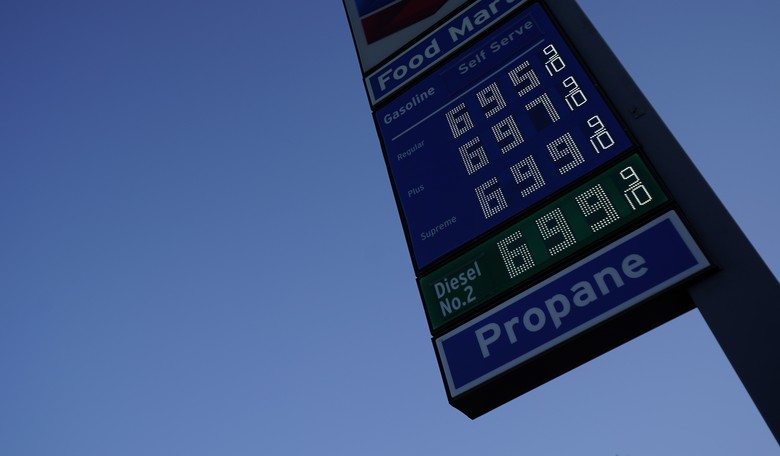
OK, fine. Let's talk about fuel prices, specifically in the People's Republic of California. Seems a reasonable test case. Have another look at the photo at the top of this page before we dive in. Let that rest in your mind for a cycle or two.
There was a time when California was an oil state in more than name. It pumped enormous quantities of crude, refined it at home, employed Californians doing both, and supplied its own gasoline and diesel. That California is disappearing, and not because the oil ran out. It has been sacrificed in the name of global warming. No, Global cooling. Err… Climate Change. Yeah, that's it. That'll work. No matter which way it goes, we're covered, right?
Anywho, production has fallen hard of late. Back in 1985, California pumped roughly 1.1 million barrels a day. By 2025, U.S. Energy Information Administration (EIA) data put it at about 288,000, and this year it's running near 245,000. Refining has shrunk even faster, from 38 operating refineries in 1982 to 12 operable this January, according to the EIA. Then two more went. Phillips 66 shut its Wilmington refinery in the Los Angeles area last October. Valero stopped making fuel at Benicia near San Francisco and fully idled it in April, citing the state's regulatory climate and high costs. Together, Argus reports, they cost California 17% of its refining capacity. All of it regulated out of existence, and all the jobs with it.
Look, gang, a refinery isn't just a building with some pipes in it. It's jobs, tax revenue, and the ability to turn crude into the fuel people put in their cars. California has been steadily and voluntarily surrendering that ability.
So where does their crude come from, after all that green legislation? In 2025, only 22.9% came from California and 16% from Alaska. The other 61.1% came from foreign countries. Of the foreign share, Brazil supplied 17.99%, Iraq 17.53%, Guyana 13.70%, Canada 12.22%, Ecuador 11.94%, and Saudi Arabia 7.85%. California sits on oil, has oil wells and refineries, and burns enormous quantities of gasoline and diesel. Yet more than six of every 10 barrels going into its refineries arrived from abroad.
The Irony here only gets stronger, because California also imports finished fuel. No pipelines bring gasoline in from the Gulf Coast or other major refining centers, so it arrives by ship. The Energy Commission puts 2025 gasoline imports at about 167,000 barrels a day, roughly 19% of supply, and two-thirds come from India, South Korea, and Taiwan. Valero has even started bringing gasoline in from its refinery in Pembroke, Wales. Yikes!
The state imports crude from halfway around the world, refines some of it at home, and when that falls short, imports gasoline from across the Ocean.
It's an extraordinary system, and by extraordinary I mean extraordinarily expensive. Every added leg adds shipping, handling, insurance, storage, and exposure to disruptions. When trouble hits in the Middle East, in a shipping lane, or at a refinery, Californians live at the end of a supply chain, without the cushion most Americans have. And the thing is, that’s by design.
While Sacramento has talked about energy independence for decades, what it actually delivered isn’t even close. It has delivered energy dependence with a green label on it. It never eliminated the need for liquid fuels because trucks, tractors, aircraft, ships, and ambulances still run on them. It just made the supply chain longer and more fragile.
(Aside: Yes, it’s been pushing Electric vehicles, but it doesn’t have the infrastructure to power them, and the state already imports a good chunk of its electricity. That figure swings up and down based on hydro systems and the availability of water to turn them. That too is in trouble of late. Something of a pattern here, but that’s a topic for another day.)
Oil companies don't pay those costs out of some magical offshore account. Californians do. Transportation, refining, compliance, scarcity, taxes, and fees all end up in the price, and the guy at the pump pays the bill. The Energy Commission itself lists the state's isolated fuel market, special gasoline blend, environmental program costs, and taxes among the reasons prices run high. California averaged $6.09 a gallon in mid-September, against $4.44 nationally.
This stuff is all basic economics. If you make it harder to produce, harder to refine, harder to ship, and harder to build replacement infrastructure, you don't get to act shocked when the price rises. That's not an unintended consequence; that's economics. California's Democrat party would rather pay foreigners for petroleum the state once produced and processed at home than make it attractive to do more of that here.
Call it environmental policy, energy transition, or climate leadership. When the trucker, the farmer, the commuter, and the family read the number on the pump, they know what to call it: expensive.
They’ve not arrived at this juncture in one move; they’ve done this with hundreds of small steps, all of them trying to be “green.” That mindset is strangling the economy there. What happens as a result is what happens every time the big government Democrat Party runs things: dependence and economic disaster.
Recommended: Weapons of Mass Distraction: The Mid-Term Panic Machine Revs Up Right on Schedule
Now, you may ask, what has California to do with the rest of us? Everything, actually, because what rules get set in California don't tend to stay there. More often than not, the idiotic standards set by California become the standard for the remainder of the country eventually. Take vehicle standards as a starter. Under Section 177 of the Clean Air Act, 17 states and D.C. adopted California's emissions rules, roughly 40% of the U.S. new-car market. New York is among them. I know, I live there, but not for long. Washington's cap-and-invest program is in linkage talks with the California-Quebec market, and New York has drafted its own outline. Of course, the other blue states are the first to follow California down the road to their own destruction. Back in 2022, some 17 state attorneys general complained to EPA that California had too much power, and Missouri's AG called the rules oppressive. Even the blue states are starting to recognize the dangers of all this: Maryland, Massachusetts, Oregon, and Vermont delayed adopting the truck rules.
Oh, and just one more point: You don’t get to blame others for the prices Californians are paying, regardless of how desperate you are to keep people from voting Democrats out of office.
Thus endeth the lesson.
= = =
Thought for the Day: Evil, like what we saw in Israel from Hamas three years ago, counts on the world forgetting, like New York forgot about 9/11. The least we can do is disappoint it this time.
VIP members: What are you paying for fuel where you are? What are you doing about it?
Take care of yourselves today, people. Let's see you here tomorrow.