
The moment Flávio Bolsonaro got more votes than Luiz Inácio Lula da Silva in Brazil on Sunday and voting down the ballot favored the right, I knew it would happen.
Very excited for Brazil. Venezuela must be next. @MariaCorinaYA is the missing piece of the whole continental puzzle now. But the "USAID caused Latin America to reject socialism" talking point that isn't true is popping up, and I already have a headache, so I'm signing off for the night. Buenas noches, friends.
— SarahDownSouth (@SarahDownSouth) October 5, 2026
The conservative "It's funny how ever since we shuttered USAID, Latin America has been electing right-wing leaders" line was repeated across social media as some sort of factual talking point. I even saw people whom I respect and admire posting it and agreeing. It's a theory. It's a meme. The problem is that it leaves out a lot of important nuance that makes it not quite the flex many think it is.
It's the equivalent of me saying I stopped eating sugar this year, and my neighbor lost 70 pounds. The only way my diet maybe impacted my neighbor's weight loss was that I stopped sending him cookies on Christmas. That's not how he lost 70 pounds. He actually lost the weight through eating better and exercising.
The political change in Latin America is real. I've been covering it and predicting it for two years here at PJ Media. Ecuador, Bolivia, Chile, Honduras, Costa Rica, Peru, and Colombia have all elected conservative, U.S./Donald Trump-aligned leaders since USAID shut down in 2025.
The fact that USAID did political work is real. The Trump administration has opened our eyes to just how bad it was over the last year and a half. We know that "political competition and consensus building" was part of its portfolio.
But when you dive a little deeper and look at the facts, you realize that while both things are true, they aren't necessarily related.
The Timing
First, the timeline doesn't match up. It's the easiest fact to prove.
This swing to the right was happening before Trump was re-elected and took office in January 2025. Costa Rica, for example, already had a right-leaning president in Rodrigo Chaves, who was elected in 2022. When the country went to the polls in February 2026, it elected his hand-picked choice to succeed him, Laura Fernández. Chaves was an anti-establishment populist who was focused on security and often clashed with other branches of government and the media (sound familiar?). He was working with Nayib Bukele of El Salvador to curb crime in Costa Rica, including building a mega-prison, and he was moving his country's diplomatic and economic ties away from China and toward the United States.
Then there's Ecuador, a country that has become one of the United States' greatest regional security partners in recent months. Some people like to include it on the list — Daniel Noboa was elected to a full term in a runoff in April 2025. But Noboa was an incumbent. He'd been the country's president since 2023 when it held snap elections to replace the impeached president Guillermo Lasso.
Bukele has governed El Salvador since 2019. Javier Milei was elected in Argentina in 2023. Luis Abinader was elected in the Dominican Republic in 2024.
Marco Rubio announced that 83% of USAID programs were cancelled on March 10, 2025.
Then there's Bolivia, a country that saw one of the biggest political turns when it elected Rodrigo Paz, who assumed office in November 2025. After two decades of Movement for Socialism (MAS) rule, it finally had a center-right leader.
People love to equate this one with USAID. The problem? In 2013, the country's corrupt socialist president Evo Morales stopped the flow of all USAID money into Bolivia, accusing the agency of conspiring against his government and the Bolivian people.
Latin America's move to the right was already well underway before Trump and Rubio dismantled USAID.
How Much USAID Actually Went to Latin America
When you understand how much USAID money actually went to Latin America, the theory becomes even more difficult to prove.
Let's look at 2023. When you take some of the major regions of the world — Europe and Eurasia, Sub-Saharan Africa, the Middle East and North Africa, and Latin America and the Caribbean — the money flowing into the Western Hemisphere is chump change compared to what was going to the other regions.
Europe and Eurasia received $17.2 billion (much of it going to Ukraine). Sub-Saharan Africa received $12.1 billion. The Middle East and North Africa received $3.9 billion. Only $1.8 billion went to Latin America and the Caribbean.
Of that $1.8 billion that went to the Western Hemisphere, most of it ended up in one of three places. First is Colombia, where it was used in relation to the FARC peace accord, counternarcotics operations, and the Venezuelan migrant crisis — people trying to flee Nicolás Maduro. The next is Haiti, where it was used to promote stability and humanitarian need. The third was the Northern Central America corridor, where it was used to address root causes of mass migration.
These numbers are far from impressive. Taking that money away may have pissed off some NGOs, but it didn't win or lose elections.
The Money That Actually Shaped Latin America's Left
USAID may not have shaped elections, but there was some financial backing that did. It didn't come from Washington, D.C., however. It came from Caracas.
In 2005, Hugo Chávez launched Petrocaribe, a regional oil procurement agreement that allowed some Caribbean and Central American governments to buy Venezuelan oil cheaply with credit that could be paid over 25 years with something like 1% interest. Some even repaid the debt with goods and services.
At its peak, it was supplying these countries with up to 200,000 barrels of oil a day at those terms. Cuba also had its own deal with Venezuela, receiving 100,000 barrels a day at the peak, largely in exchange for doctors through its forced labor program and security and intelligence training. Many of these countries would take the cheap oil and resell it to other nations, pocketing huge profits.
Chávez's goal was to expand his geopolitical influence and support left-wing, anti-imperialist allies in the region. He also funded ideological allies, political campaigns, and friendly media outlets across Latin America and the Caribbean through PDVSA (Venezuela's state-owned oil company) contracts. Profits were, of course, supposed to go to the Venezuelan people, not to illegally fund other governments and help sway elections.
By the mid-2010s, the Venezuelan regime had gutted PDVSA. Prices collapsed. Output plummeted. In 2019, U.S. sanctions stopped the repayment of all of those loans. At that point, Maduro and his narco-thugs were relying mostly on drug trafficking and illegal mining to fund the Venezuelan state and line their own pockets, but the free money to fund the leftists in the region was no longer available.
With no more Venezuelan cartel money to bankroll their campaigns, socialists are being ousted by voters across Latin America.
— Marshall S. Billingslea (@M_S_Billingslea) October 5, 2026
As I reported last year, Hugo Carvajal, who ran Venezuelan military intelligence, told United States authorities that this ran for at least 15 years and reached the Kirchners in Argentina, Lula in Brazil, Morales in Bolivia, Fernando Lugo in Paraguay, Ollanta Humala in Peru, Manuel Zelaya in Honduras, Gustavo Petro in Colombia, and the far-left Podemos party in Spain. Other U.S. and former Venezuelan officials have supported some of this.
This is also one important reason why people want Trump and Rubio to remove "interim president" Delcy Rodríguez from Caracas as soon as possible. You can't legitimize the country with the same regime still in charge. Eventually, Trump will not be president. U.S. foreign policy will change. Delcy waits him out, has oil flowing again, and suddenly, that money goes right back to the leftists.
As one of my favorite experts on the matter, Emmanuel Rincón, put it, "Our genuine concern is that the Chavista dictatorship will stabilize with access to money and funding, and that Venezuelans’ resources will once again be used to finance the far left on the continent."
Many conservatives in the United States are claiming that the right wing is gaining ground in Latin America due to a lack of USAID funding; the reality points more toward this. Chavismo bankrupted the Venezuelan oil industry and had to turn to drug trafficking and illegal mining to somewhat sustain the operations of the Venezuelan state, but the “free money” to finance the far-left on the continent has run out. Our genuine concern is that the Chavista dictatorship will stabilize with access to money and funding, and that Venezuelans’ resources will once again be used to finance the far left on the continent. Elections in Venezuela are essential to prioritize the interests of the U.S. and the region.
— Emmanuel Rincón (@EmmaRincon) October 5, 2026
The Reasons Why Latin America Is Shifting to the Right
One reason why this whole "no more USAID changed Latin America" banter gets under my skin — aside from the fact that it's incorrect — is that it takes away the agency of the people in these countries. They have legitimate reasons for voting the way they do. I'm pretty sure I've gone over this approximately 8,394 times in the last year, but let's do it again, shall we?
The reasons include:
1. Crime and Security: As I said in February, "Cartels, narco-terrorism, gang violence, extortion — people are tired of feeling unsafe in their own communities, and it's extending beyond the normal hotspots into mostly peaceful cities and countries as they become part of transit routes for cartel and drug smuggling activity."
2. Mass Migration Backlash: This isn't just a United States problem. Since 2014, between 8 and 9 million Venezuelans have left their home country. While it has been one of the fastest-growing sources of migration into the United States recently, many of them didn't quite make it this far north. They ended up in Ecuador, Colombia, Chile, Peru, etc., where they are eating up resources.
Additionally, open-border policies in various countries provided access to more than just Venezuelans seeking a better life. They allowed Maduro to weaponize Tren de Aragua and send it into foreign communities. They allowed cartels, Chinese spies, or members of Middle Eastern terrorist groups like Hamas or Hezbollah to move about the Western Hemisphere as they please. This is actually a big reason why José Antonio Kast won the presidency in Chile. He campaigned hard on stopping migration.
3. Economic Frustration: I'm just going to quote myself from earlier this year here: "Between 2014 and 2023, Latin America had some of the worst economies in the world, marking a second 'lost decade' for the region. Average annual growth was just below 0.9%, even lower than the 1.3% of the first 'lost decade' back in the 1980s. Many countries faced persistent inflation.
Fortunately, they eventually realized that this is what leftist, big-government policies get you: heavy spending, regulation, state control, etc. Businesses move to or invest in other countries. People end up trapped in poverty. There aren't enough jobs to go around. Promised prosperity never comes... unless you're one of the ones at the top."
4. Socialism Fatigue: I don't have much to say about this one. It happens, and I think the reasons why are obvious to this audience. Fortunately, most of these countries caught it while they could still vote themselves out of it.
5. Cultural Pushback: Again, something I wrote back in February: "Latin Americans tend to be socially conservative and family-oriented. They favor traditional values. Many are Catholics, though there's a growing evangelical presence in the region — it's up to something like 25% from 5% in the 1970s — and those voices are getting louder and more political. They oppose abortion. They don't want gender ideology in their schools, and they favor parental vs. government control over their children. They're tired of policies that appease the LGBT+ crowd..."
When I wrote "The Real Reasons Why Latin America Is Moving to the Right" that I'm quoting from back in February, I received so many emails from people who live in the region who told me, yes, this is 100% correct. This is why we're voting the way we are.
The Leaders Who Led the Way
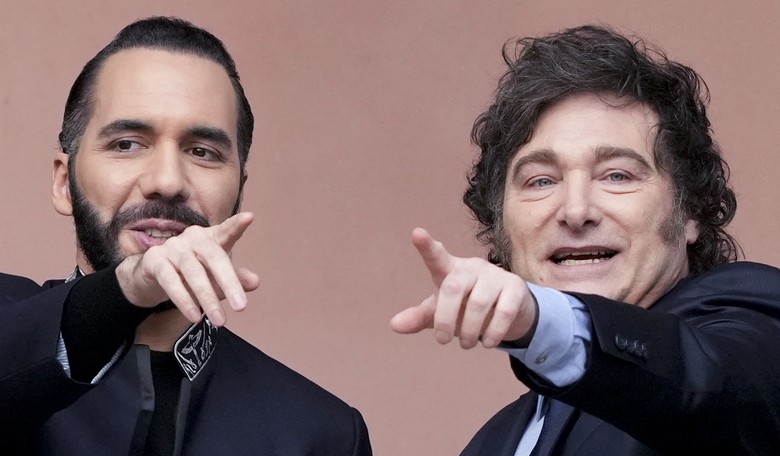
With all of that in mind, I want to point out the leaders in the region who helped others see what they can have. You can look to the picture at the top of this article to get an idea of who they are.
The first and, perhaps, the most important is Bukele of El Salvador. We all know what he has done for his country — turned it from the so-called "murder capital of the world" to one of the safest nations in the Western Hemisphere. He got rid of the gangs and organized crime, locked up the thugs, and started building programs that would help support a free, safe, and prosperous nation long into the future. I'm oversimplifying, but it's been magnificent to watch.
Crime and security have driven people to the polls in all of these countries. They've seen what Bukele can do for El Salvador, and they want leaders who can do the same for them. I talk to Central and South American voters almost daily and have for the last three years, both in a personal and professional capacity. Every single one — and that is not an exaggeration — knows Bukele and mostly praises him because organized crime has become such a big problem. Someone even emailed me back during the Peruvian elections and said they saw more Bukele posters than posters for their own candidates.
Every one of these "right-wing" presidents that has won over the last two years has promised to be a hardliner on crime. Many have consulted with Bukele. They're building their own mega-prisons. They're partnering with the United States to fight the cartels.
Economically, Milei has led the way in Argentina. These new leaders also praise him, promising to follow his lead, slashing regulations, cutting spending, and implementing free-market and pro-business principles. Many also promise to move away from China and toward the U.S. when it comes to trade and investment.
What Trump and Rubio Really Did
If you look back at the five main reasons why these countries have voted the way they have in recent years, you might see something familiar: crime, border issues, economics, fear of socialism, and weariness of wokeness.
These are the same reasons why we elected Donald Trump in 2024. He didn't start the movement — he was a product of it. The majority of the civilized people across the entire North and South American continents, the U.S. included, all reached the same conclusion: leftist policies were ruining their lives.
I'm not discounting Trump and Rubio here. Quite the opposite. While they may not have started this journey, they jumped in in January 2025 and strengthened the hell out of it.
They've done that by endorsing candidates, getting rid of Maduro, making the region a priority, investing economically, forming the Shield of the Americas and the Americas Counter Cartel Coalition (A3C), courting relationships that will help keep China out of the region, designating various gangs and cartels as terrorist groups, ramping up pressure on Cuba and Nicaragua, making hemispheric threats the main component of their National Security Policy, etc.
It sounds cliché at this point, but Latin America is our backyard. We are all largely aligned culturally. When we all stand together, we are all better for it, and Trump and Rubio have recognized and implemented that after far too many in the past ignored it.
USAID was a small, politically tilted program in a region whose elections have been decided by crime, prices, and the ghost of Venezuelan oil diplomacy. Ending it was the right thing to do. Claiming it produced the rightward swing sounds good, but it's simply not accurate, and recognizing the real reasons for the change is the only way to nurture them into a long-term, sustainable movement.