
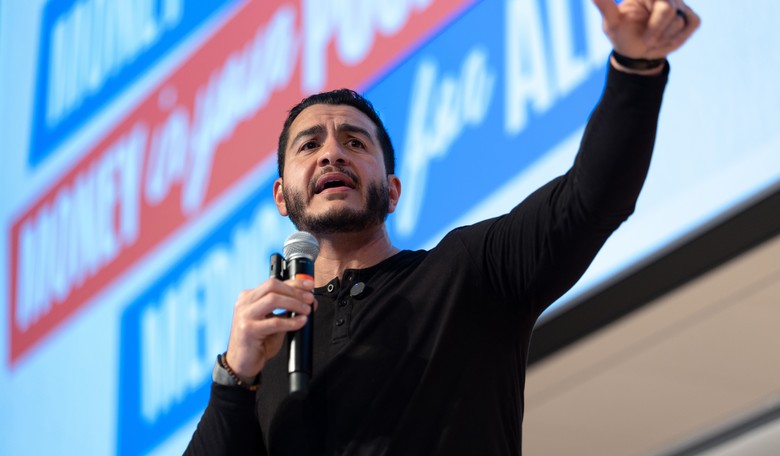
A new report by the Middle East Forum (MEF) details how several tax-exempt organizations in Michigan, including mosques, routinely and blatantly violate federal tax law by openly campaigning for the Democratic candidate for Senate in Michigan, Abdul El-Sayed.
The report, “Weaponized Charity: Islamist Nonprofit Electioneering in America,” by Islamist Watch research associate Mahyar Entezari, reveals a shocking use of taxpayer funds in support of a Muslim Democratic Senate candidate.
The law in question prevents designated nonprofits, known as 501(c)(3) organizations, from "endorsing candidates, soliciting campaign contributions, distributing campaign literature, hosting candidates with no evident equal opportunity for opponents, and publishing editorialized voting records timed to elections," according to MEF.
Abdul El-Sayed won the Michigan Democratic Senate primary by 13,000 votes, a margin of less than one percent. In the lead-up to election day, various nonprofit Muslim groups, including mosques and religiously affiliated organizations, solicited donations, distributed campaign literature, and openly endorsed El-Sayed from the pulpit. Two mosques hosted the candidate during services.
"At the Islamic House of Wisdom in Dearborn Heights, Imam Mohammad Ali Elahi, an Iranian-trained cleric who once directed the Political-Ideological Bureau of the Islamic Republic of Iran Navy, welcomed El-Sayed to the pulpit and told congregants, 'I’m going to vote for this man,' adding, 'voting is as wajib [religiously required] as prayer … everybody vote and let us vote for Brother Abdul El-Sayed,'" according to MEF.
The day before the August 4 primary, Imam Husham Al-Husainy of the Karbalaa Islamic Educational Center in Dearborn said that an El-Sayed victory would be a “victory to God.”
Recommended: Netanyahu at the UN: Israel Will 'Win Because We Have No Other Choice'
IRS guidance on permissible activities by 501(c)(3) organizations also bans the use of "code words" in furtherance of a candidacy. MEF documented several incidents where El-Sayed's name wasn't mentioned, but the imam spoke of a “religious duty” to vote, with one warning — “The Zionists are pouring over 60 million dollars so they can hijack your voice” — and urging listeners not to “allow the Zionist candidate to win.”
Over Labor Day weekend, ISNA gave El-Sayed the convention stage in Detroit while his campaign ran a full exhibitor booth in the hall, complete with “Donate Today” QR codes, “Muslims for Abdul” banners, and flyers laid across seats. ISNA’s convention program described El-Sayed in wording identical to the candidate biography published by a PAC that raises money for his campaign, with no statement of neutrality. After the speech, ISNA’s chief executive told the audience that Muslims “know exactly what decision they should take,” having moments earlier stated that ISNA endorses no party or candidate and that El-Sayed’s Republican opponent, Mike Rogers, had not replied to invitations to attend. The report notes that the IRS treats context as part of the message: the remark came immediately after El-Sayed’s campaign speech, while volunteers were parading his campaign posters across the hall. El-Sayed’s campaign had said before the convention that he “is not affiliated with and does not endorse any other participant of the conference.” The IRS states that “no political fundraising should be allowed” at a candidate event.
A careful reader of history might ask, "What about black churches in the 1960s?" or Jesse Jackson's campaigns for president in the 1980s. The IRS rarely enforced the ban on political activity in the 1960s, seeing the political downside in attacking places of worship for any reason.
There was actually quite a bit of pushback from Republicans during Jesse Jackson's two runs for the presidency in 1984 and 1988. Numerous black churches across the country served as the original operational hubs for his bid. Pastors regularly passed collection plates during Sunday services specifically designated for the "Jesse Jackson for President" campaign, allowed campaign staff to distribute election materials in church foyers, and openly urged congregations to vote for him from the pulpit.
Conservative legal watchdogs and political opponents filed formal complaints with the Internal Revenue Service, alleging that churches participating in Jackson's campaign were illegally using tax-exempt sanctuary resources for partisan fundraising.
In response to legal scrutiny, the Jackson campaign and allied ministers attempted to modify their methods. Rather than collecting money directly through church accounts, pastors increasingly asked congregants to write personal checks directly to the official campaign committee or designated PACs, or held fundraising events on non-church property. This fig leaf was good enough for the left, but would not pass muster today.
The kind of blatant violations by mosques and Muslim organizations in advocating for and donating to El-Sayed are as if the IRS rules don't even exist. The IRS is gun-shy about removing the tax-exempt status of mosques and groups like the Islamic Society of North America (ISNA). The outcry would be loud, long, and severe. It would give the Left another issue to run against Republicans. That's the political reality confronting the IRS and those who want the law enforced.
Nevertheless, MEF is urging the IRS to "apply the excise tax and revocation remedies that the law provides, and to review the tax-deductible status of any organization on the Auto-Revocation List that still solicits tax-deductible gifts," according to the report.
MEF is also asking the Federal Election Commission (FEC) "to investigate whether any tax-exempt corporation named in the report provided anything of value to a federal campaign, including pulpit time or official communication channels, that would constitute a prohibited corporate contribution."
The Forum is also asking the secretaries of state where the violations occurred, as well as election officials in several counties, to investigate.