
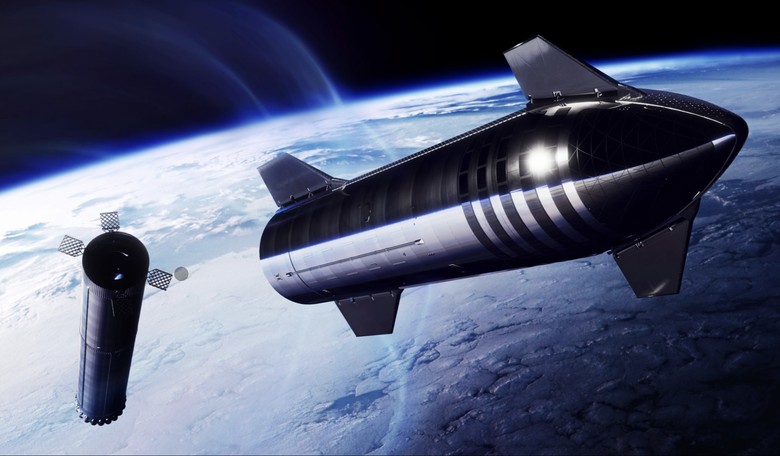
"We are go for orbit," and with that, the Starship mission that a moment before appeared to be a big disappointment turned into something entirely else.
What the "else" is — and one big reason why the entire control room burst into cheers — I'll get to in a moment. But first, the drama.
It felt like a long time getting to Flight 14 this morning, just a little over two months since Flight 13. FAA regulatory approval only came through on Sunday. For a company that prides itself on testing, iterating, and testing again with all due haste, it must have felt like years.
There's a lot riding on today's flight. While the company did not attempt to catch the Starship's booster stage in Mechazilla's tender embrace, the mission profile was to simulate a catch by making a soft water landing in the Gulf of America.
The upper stage — usually called Ship — was not only supposed to make its first orbital flight, but was also, for the first time, supposed to deploy fully operational Starlink V3 orbital internet satellites before completing six orbits and itself making a controlled splashdown near Chile. Those satellites are also a big deal, and I'll come back to them momentarily.
But first we have to look at how everything almost went very wrong just a few minutes after Flight 14's 8:46 a.m. Eastern liftoff.
And Another Thing: It feels wrong that every time I type "Gulf of America," I want to type "Gulf of America, F*** Yeah." I'm kidding, of course. It feels awesome.
The Super Heavy booster lost two of its 33 Raptor engines on ascent. Individually, those Raptors aren't that powerful. But strap nearly three dozen of them together in a single booster, and you get a launch platform with 2.4 times the thrust of the Saturn V rocket of Apollo moon landing fame.
Liftoff of Starship! pic.twitter.com/40D8bXSkr2
— SpaceX (@SpaceX) September 28, 2026
You're allowed to say "Wow." Assuming you haven't lost the power of speech, of course. Those launches never fail to take my breath away.
But part of reusability is that with 33 engines — arranged in sets for launch (all 33), boostback burn (13 then 5), and landing (3) — a Starship launch can afford to lose a couple of engines and still make the launch and the landing. And yes, it was two of the boostback engines that went out during ascent.
Nevertheless, the full stack got to where it needed to go for the Ship to "hot stage" away from the Super Heavy booster. After separation, the Ship's six engines would keep it flying to its initial suborbital trajectory, while ground control kept its fingers crossed for a successful boostback burn and landing with two missing engines.
They must've crossed those fingers really tight, because the booster made a perfectly controlled splashdown at 8:53 a.m.
Super Heavy has splashed down in the Gulf of America! pic.twitter.com/pEIjC2Aae1
— SpaceX (@SpaceX) September 28, 2026
Gorgeous, isn't it?
At 8:54 a.m., one of the Ship's three vacuum engines failed, and a solemn decision had to be made: Continue on, using a longer burn with fewer engines to reach orbit — and deploy those Starlink satellites — or continue on the suborbital trajectory and make one more got-dam splashdown in the Indian Ocean.
The initial call at about 9 a.m. was no-go for orbit. The Ship and its 26 next-gen Starlink satellites would go nowhere they hadn't been before. I was watching the SpaceX live feed and could feel the entire company deflate. Hell, I deflated.
But as more data came in from the Ship, flight controllers determined that there was enough redundancy remaining in the functional engines to make a successful boostback burn and return the Ship safely. That was the big deal all along: Not whether SpaceX could get the Ship to orbit, but getting it back.
At 9:10, flight control personnel were finally polled: Go or no-go?
"We are go for orbit."
Go for orbit! Starship will soon perform a burn with a single Raptor engine to enter an ~275 km orbit of Earth pic.twitter.com/HQxgQYc4eZ
— SpaceX (@SpaceX) September 28, 2026
At 9:11 a.m., a SpaceX Starship upper stage made its first-ever orbital burn. And after that, everything seemed to move like clockwork.
Once in orbit — above the coast of Namibia, if I was reading the live feed globe correctly — the Ship opened its Pez dispenser door and began deploying the first-ever operational Starlink V3 satellites. All 26 are now using their own motors to assume their orbits among the 11,000 or so V1 and V2 satellites currently in operation. Those first V3's will enter service in a few weeks.
Given the launch issues, SpaceX decided to de-orbit the Ship earlier than planned, and that also went well.
Splashdown confirmed. Congratulations to the entire SpaceX team on the first orbital flight of Starship! pic.twitter.com/urjmiwnvNl
— SpaceX (@SpaceX) September 28, 2026
This is where everything starts to come together, and I can get to those "momentarily" I teased you with.
It's almost impossible to believe what a huge upgrade Starship is to Falcon 9, and V3 Starlink is to V2.
"Each one of these V3 Starlink satellites being deployed right now increases the bandwidth capacity of the ENTIRE Starlink constellation by roughly 0.11%," Sawyer Merritt explained this morning. And one of the replies noted that "This one launch is over 2.8% of all bandwidth."
One launch. To increase Starlink capacity that much with V2 and Falcon 9, you'd need no fewer than 10 launches. But today's launch barely even tested Starship's capabilities. A fully loaded Starship will put 60 V3 satellites into orbit — eventually, at a fraction of the cost-per-kilogram of Falcon 9. And Starlink is already price-competitive with terrestrial high-speed internet services.
From my Starlink TAM model, each V3 satellite deployed at the current scale of the constellation brings in ~$100–150M of revenue over a 5 year life.
— Christopher Kalitin (@CKalitin) September 28, 2026
Flight 14, with 26 V3 sats will generate $2.6B - $3.9B in revenue.
Starship will be insanely profitable. https://t.co/ADEDTjc4Xd pic.twitter.com/p8IIicEeU2
Now, do you begin to understand the economics of Elon Musk's "crazy" idea to put data centers in orbit?
The point isn't whether this engine or that one lost ignition. The point is that Starship today became a revenue-generating machine. First with Starlink, then with Starmind.
The company's fate is tied to Starship. A control room always erupts into cheers when the mission performs nominally, and today, Starship proved that it can generate revenue.
SpaceX shares are down nearly 1% on today's news.
People see, but they do not understand.
Recommended: That's Right: We're Shooting Down Enemy Drones With Fricken Laser Beams