
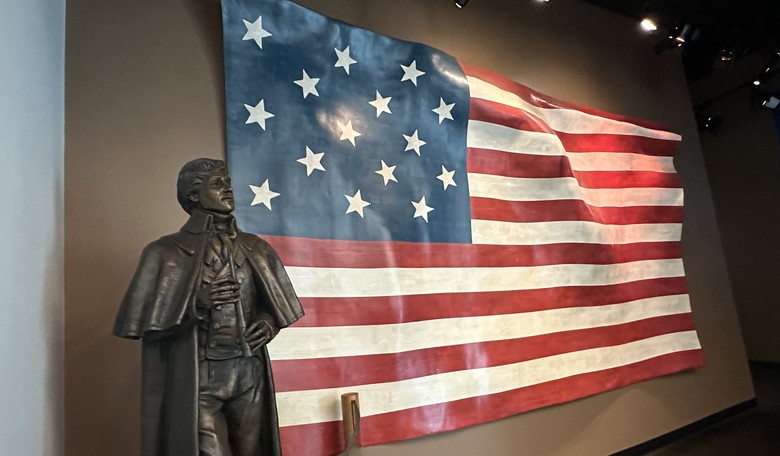
On Sept. 20, 1814, the Baltimore Patriot first published a poem that would eventually become the national anthem of the United States.
We sing it as "The Star-Spangled Banner." But when Francis Scott Key offered it for newspaper publication, it was a poem he titled "The Defence of Fort McHenry," as the Council on Foreign Relations states . The poem later became a song set to the tune of a popular English song, and when a printer decided to change the title to "The Star-Spangled Banner," its popularity increased. The U.S. government first began requiring its performance at certain official occasions in 1916, but it did not become the national anthem until 1931, finally securing the title that had been unofficially applied to other famed tunes, including "Yankee Doodle," "America the Beautiful," and "George Washington's March."
Key's poem has a wonderful story behind it. In September 1814, a group of U.S. sailors and soldiers — with a few civilian sailors mixed in — prepared to defend Fort McHenry and the city of Baltimore from the British. Only a few decades after America won its independence, it was again fighting the empire from which it had broken. The British sacked Washington, D.C., in 1814, a devastating blow to American morale. And Baltimore, being not too far away from the national capital, was terrified it would suffer the same fate.
Yet Maj. George Armistead declared, "Not a man shrunk from the conflict," according to the Fort McHenry National Monument. The men at Fort McHenry awaited the British ships, determined to protect the city or die defending it.
For Our VIPs: George Washington’s Hopes for We the People in His Farewell Address
Francis Scott Key, an American lawyer, had boarded a British ship to negotiate the release of his friend William Beanes. The British were, in fact, willing to release Beanes, but not until after their bombardment of Fort McHenry, as they were wary of the Americans being able to carry back information on British movements to their countrymen in Baltimore. Hence, Key and his friends found themselves watching the hellish bombardment of the fort from the British ship. Key described it “as though mother earth had opened and was vomiting shot and shell in a sheet of fire and brimstone.”
For over 24 hours, the British fired some 1,500 rockets and bombs at Fort McHenry. But somehow, the next morning, only four Americans were dead, and as Key strained his eyes through the fog and early light, the American flag was still flying over the battered fort. Overjoyed, Key wrote the poem that became our national anthem.
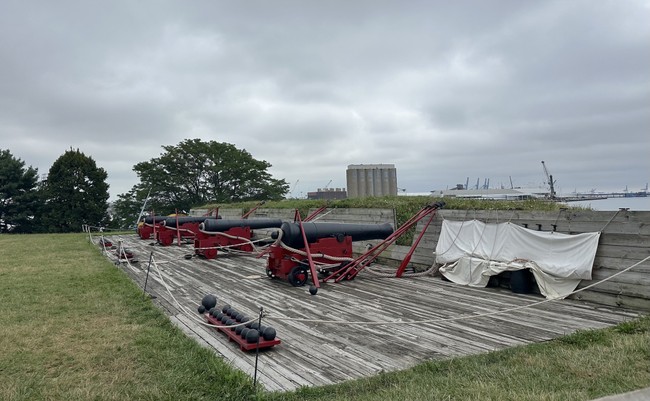
I had the privilege of visiting Fort McHenry earlier this year, just after America's 250th birthday. Above is a picture I took of one reconstructed battery pointed out at the bay where the British ships sailed in to bombard the fort. Just as on that historic day back in 1814, the star-spangled banner was flying over the fort. A little girl ran excitedly along the battlements, singing the national anthem. Veterans and schoolchildren admired the cannons and the flagpoles. The gift shop offered special 250th anniversary flags. Patriotism was in the air and on the faces around me. If only every American could find such inspiration in our national anthem.
I have included Bing Crosby, the 20th-century star nicknamed the "Voice of America," reading Key's full poem and also singing part of it. Below, you can also read the first and last verses of the poem. This year especially, it behooves us to recall the "freemen" heroes of our past who, as Key put it, with God's help "preserved us a nation." And long may that star-spangled banner yet wave o'er the land of the free and the home of the brave.
O! say can you see, by the dawn’s early light,
What so proudly we hail’d at the twilight’s last gleaming,
Whose broad stripes and bright stars through the perilous fight,
O’er the ramparts we watch’d, were so gallantly streaming?
And the rockets’ red glare, the bombs bursting in air,
Gave proof through the night that our flag was still there—
O! say, does that star-spangled banner yet wave
O’er the land of the free, and the home of the brave?…
O! thus be it ever when freemen shall stand
Between their lov’d home, and the war’s desolation,
Blest with vict’ry and peace, may the heav’n-rescued land
Praise the power that hath made and preserv’d us a nation!
Then conquer we must, when our cause it is just,
And this be our motto—“In God is our trust!”
And the star-spangled banner in triumph shall wave
O’er the land of the free, and the home of the brave.