
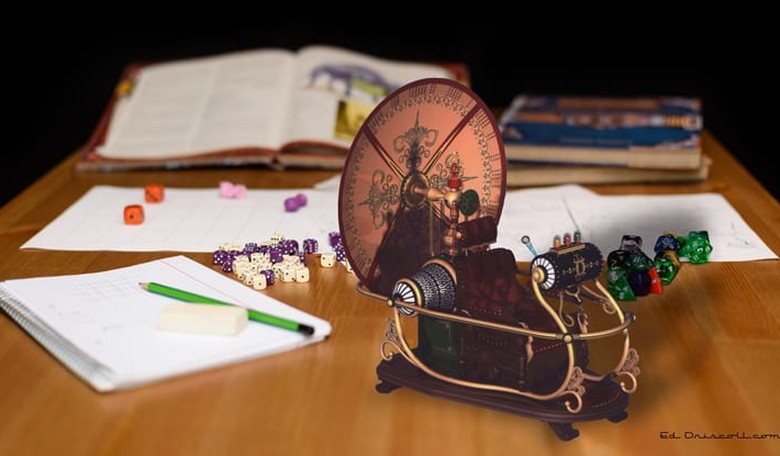
So your gamemaster (GM) has sent you and your party back in time (or to a low-technology parallel dimension) in your roleplaying game (RPG); and, for one reason or another, it’s become pretty clear that you’re going to be able to mess with the ‘true’ timeline however you like. Your party has probably already decided to ‘invent’ gunpowder, distilling, and antiseptics, mostly because everybody usually does in these circumstances and a player can reasonably claim that his player-character (PC) might have that information carried around in his head, thanks to him having the relevant skill. Which is perfectly fine, but what disruptive technologies can the rest of the party produce?
Well, let’s take a look. Note that this list is hardly exhaustive, and probably cannot be exhaustive. Innovation happens in every field of human knowledge. What these are are mostly innovations that don’t require much in the way of specialized equipment; merely having the required skill should be sufficient. Also note that the assumption in this case is for the standard late Medieval European period, partially because many fantasy worlds in literature are associated to that technological setting anyway.
- Accountant. Accountants can teach double-entry bookkeeping at any point prior to about 1250 (in Europe), but first they’ll need to introduce the concept of zero. An Accountant can also have an interesting career sniffing out corruption in an existing bureaucracy. Or just getting more money out of it for the local authorities.
- Artist. The first known examples of perspective drawing in Europe occurred in the 15th Century, and almost immediately caught on. Oil painting more or less became common in Europe about a century later. An Artist who specializes in either painting or sculpture can plausibly claim that he’s learned how to draw the basic human form accurately: this will prove of interest to both contemporary artists and physicians.
- Carpenter. Balloon framing and platform framing are extremely new innovations in building houses, but the first in particular requires nothing more, technologically speaking, than a plentiful supply of soft woods and iron nails. Sawmills are present in Europe in the 13th Century. See the Craftsman for nails.
- Craftsman. Most competent modern metalworkers should be able to find ways to improve medieval wire-drawing techniques, particularly since wire-drawing is an excellent way to get the iron nails that the Carpenter needs. Also: modern-style wheelbarrows appeared relatively late in Europe, and in limited areas. And, of course the average, say, plumber should know how to put together a toilet system that will function and not smell. At least, it won’t smell for the person using it.
- Engineer. When the Engineer is done setting up the mass production of black powder and alcohol, he’s more than welcome to institute the use of interchangeable parts and reintroducing cement.
- Historian. This is the go-to skill set for any sort of historical “well, I learned in grad school about where and when the treasure ship sank,” of course. The Historian can also be a treasure-trove of any sort of not-really-trivia about when Group A learned or invented Technique B. Lastly: in any kind of time-travel scenario the Historian should always come up with a good reason why he’s heard of Random Real-Life Historical Character #5. Particularly if the party is known to be time travelers. Everybody loves hearing that they ended up in the history books.
More examples on the next page.
- Lawyer. Assuming that the Lawyer in the party hasn’t been tagged by the GM to be the party’s latent wizard, and assuming that the Lawyer hasn’t instead been dragooned into getting a crash course in the local legal system, he can always teach people how to read. If there’s no phonetic alphabet, then that will be the first thing that the Lawyer will teach.
- Librarian. The Librarian can operate roughly similarly to the Historian, or he can concentrate on finding contemporary versions of the techniques or innovations that the party wishes to introduce. Being able to claim that a supposedly new way of doing things was actually done In Times Long Past can be remarkably useful at times.
- Policeman. Fingerprinting and forensic techniques are all very well, but community policing didn’t really exist before the 19th Century in Europe, and the basic concepts will be effective in any stable society prior to that. Keeping track of evidence, usefully interviewing witnesses, getting a confession out of somebody without beating him… this is a valuable skill set to people in power.
- Social Worker. What can a Social Worker do, one might ask? …Well, in any culture where there are serious race, gender, religion, or culture-based social restrictions a Social Worker’s player will generally be able to make the argument that he’d be good acquiring friends and contacts among the various underclasses. If the party is looking for truly motivated assistants and workers for their various industrial projects, this is an excellent way to get some.
- Teacher. If your party time or dimension travels, and if this skill exists in any form in your game world, learn it as soon as you can.
One last point: there’s a passage in Eric Flint’s 1632 alternate history series where he noted that time travelers can have a major advantage. Which is to say, they know what techniques or methodologies work. And they’re going to be visibly confident that those methodologies work, too. This instinctive confidence can be a real help for players who are trying to convince their GM to let the party get away with an innovation that’s particularly envelope-pushing…