
In the Trump administration’s pursuit of government efficiency, one egregious source of waste has gone overlooked: the Bureau of Land Management’s (BLM) Wild Horse and Burro Program, which regularly operates under a self-inflicted 900% markup.
Proven, dart-delivered fertility vaccines can humanely manage wild horse populations on-range for just $1,500 per mare. Yet in typical bureaucratic fashion, BLM uses a reactive, ‘roundup-and-repeat’ cycle to remove animals instead, driving lifetime holding costs to an unsustainable $15,000 per horse. Responsible fiscal governance demands urgent reform.
Annual expenditures for BLM’s Wild Horse and Burro Program have escalated to roughly $153 million, while removal numbers have grown from 8,000 in 2025 to roughly 14,000 in 2026 across more than 40 roundups. Around 66% of the Program’s budget goes to maintaining nearly 65,000 captured equines in government feedlots, while less than 4% goes to fertility control, defying Congressional recommendations.
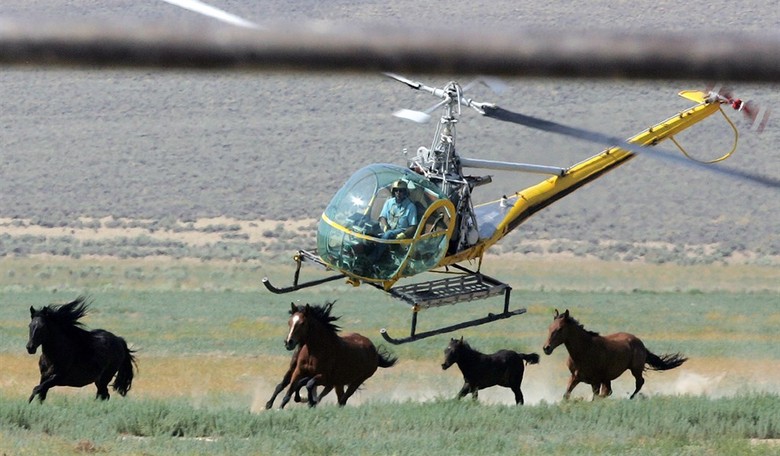
BLM’s recent roundup in Nevada’s Callaghan Complex illustrates this entrenched cycle.
Low-flying helicopters gathered over 2,000 wild horses from 1.1 million acres in July, causing eleven deaths, including several foals. Surviving horses face indefinite holding, adoption, or sale channels that carry risk of slaughter. Without on-range fertility management, herd populations will quickly recover, triggering another gather in just a few short years.
The Callaghan roundup alone cost taxpayers $765,000, paid to a private contractor BLM has relied on since 1975. The federal government maintains over $100 million in open contracts with this single company – a relationship that incentivizes roundups by design.
If the fiscal and moral advantages of fertility control are so glaring, why does BLM continue relying on roundups? The crisis originates from systemic administrative failure.
Though BLM is legally mandated to protect America’s wild horses, it is also tasked with managing livestock grazing permits on public lands. The agency treats these as competing interests — an approach that fails taxpayers, ranchers, and horses alike.
On BLM-managed lands, wild horses are vastly outnumbered by livestock. In the Callaghan Complex, for example, BLM caps horse herds at a few hundred animals while leasing the same land to be grazed by 10,000 privately-owned cattle and sheep. When range degradation occurs, wild horses are targeted first, even though, according to BLM’s own documentation, livestock cause substantially more damage.
By neglecting on-range fertility management, BLM allows wild horse populations to surge past the population targets it has set, which inevitably leads to costly and disruptive emergency roundups as the agency scrambles to restore the status quo and protect the interests of permit-holders.
From a fiscal standpoint, BLM's approach is failing. Though livestock grazing permits generate nearly $13 million in revenue, the overall grazing program operates at a net loss to taxpayers of nearly $100 million. And by expending tens of millions more on wild horse roundups, the agency is throwing more money at a crisis of its own making, while forcing taxpayers to fund inefficiency on both ends.
BLM faces a choice: continue rounding up wild horses and pouring millions into lifetime holding costs, or address the underlying problem. Broadly implementing dart-delivered vaccines would reduce reproduction on-range, while minimizing disruption on public lands and providing the breathing room needed to responsibly adopt out animals currently in holding.
The agency recently signaled it knows a shift is overdue. After spending just $6 million on fertility control in FY2024, BLM announced in September that it would allocate $30 million to the practice. But to break the cycle permanently, reforms must mandate comprehensive fertility management alongside every future gather and establish a clear timeline to phase out roundups altogether.
The Wild Horse and Burro Program is a prime target for the Trump administration’s government efficiency efforts. Replacing bloated, contractor-driven roundups with modern, science-backed management will save taxpayers millions while ensuring wild herds are treated humanely.
These reforms would represent a rare win-win for fiscal hawks and animal welfare advocates alike – an opportunity we literally cannot afford to miss.
Related: Nine Wolves, Six Conflicts, and a Difficult Wisconsin Decision