
Hello and welcome to Monday, Oct. 26, 2026. Monday again, so pour the coffee strong.
My calendar says it’s Pumpkin Day, Mule Day, Chicken Fried Steak Day, Mincemeat Day, Day of the Deployed, and Financial Crime Fighter Day. So thank a service member overseas, salute the fraud investigators chasing down MaineCare billing (I did mention that already this week), and celebrate with chicken fried steak and pumpkin pie. Hold the pumpkin spice coffee, if you will, please. (Ewww!) I'd pass on the mincemeat too, unless you’re a sporting type.
Today in History:
1774: The First Continental Congress adjourns in Philadelphia after sending its grievances to King George III.
1825: The Erie Canal opens, linking the Hudson River to Lake Erie and turning western New York into the nation’s front door. Mule teams towed the boats, so Mule Day has a hometown hero.
1861: The Pony Express makes its final run, two days after the transcontinental telegraph put it out of business.
1863: Founders of the Football Association meet in London and write the first standardized rules of what we call soccer.
1881: The Earp brothers and Doc Holliday shoot it out with the Clantons and McLaurys at the O.K. Corral in Tombstone, Arizona Territory.
1955: The Village Voice publishes its first issue in New York.
1958: Pan Am flies the first commercial transatlantic jet flight, a Boeing 707 from New York to Paris.
1977: Doctors record the world’s last naturally occurring case of smallpox in Somalia. (No, I'm not touching that one. I'll leave that to you).
1984: Doctors transplant a baboon heart into “Baby Fae,” a newborn in California.
1994: Israel and Jordan sign a peace treaty ending 46 years of war.
2001: President George W. Bush signs the Patriot Act into law.
Birthdays Today include: Domenico Scarlatti, composer (keyboard sonatas); Mahalia Jackson, gospel singer (“Move On Up a Little Higher”); Mohammad Reza Pahlavi, the most recent shah of Iran; Bob Hoskins, actor (Who Framed Roger Rabbit, The Long Good Friday); Jaclyn Smith, actress (Charlie’s Angels); Pat Sajak, game show host (Wheel of Fortune); Rita Wilson, actress and producer (Sleepless in Seattle, My Big Fat Greek Wedding); Dylan McDermott, actor (The Practice, Steel Magnolias); Cary Elwes, actor (The Princess Bride, Robin Hood: Men in Tights); Natalie Merchant, singer (10,000 Maniacs, “Carnival”); Keith Urban, country singer (“Somebody Like You,” “Blue Ain’t Your Color”); Seth MacFarlane, animator and actor (Family Guy, Ted); Jon Heder, actor (Napoleon Dynamite).
If today’s your birthday too, Happy Day to you.
* * *
The IPCC, the U.N.’s premier climate bureaucracy, recently convened in Ethiopia alongside delegates from 195 member nations. Ostensibly, they gathered to prep for a "major U.N. climate milestone" in 2028 by hashing out their seventh assessment report.
Instead, they packed their bags and fled Addis Ababa broke, empty-handed, and unable even to agree on a simple publication date. Turns out the same institution that constantly insists "the science is settled" can’t even settle on a calendar invite. And I wish I could laugh over it, but when I think of all the money wasted on these clowns, along with the broken economies in their wake, I simply can't.
The IPCC's 65th session ran from Oct. 12 to 16 and wrapped up in its default state: complete deadlock. According to Carbon Brief, this marks the sixth consecutive meeting since 2024 where governments failed to agree on when to actually release their homework.
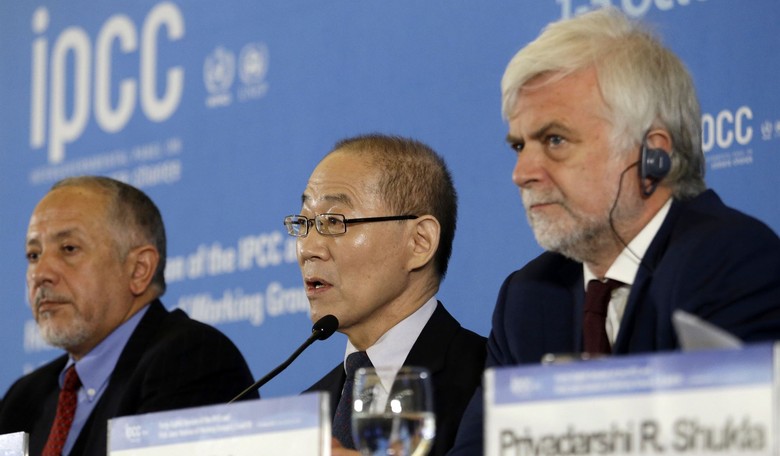
This was supposed to be the final deadline. The second "global stocktake" under the Paris Agreement wraps up at the COP33 summit in late 2028, and IPCC chair Jim Skea openly warned that hitting the mark required a decision before year’s end. (He's the one with the earpiece in the photo above.) Instead, delegates bloated the timeline options to seven, whittled them back down to four, and then predictably rejected every single one of the remaining options.
Skea finally threw in the towel and suspended the session at 8:29 p.m. on Friday — well after several delegations had already abandoned ship to catch flights home. He dubbed the collapse a "profound disappointment" and noted he’d use stronger words if he had them. Yeah, never underestimate the strongly worded memo.
Allow me to offer a few words, Jim: expensive, useless, and entirely predictable.
And no, I'd not leave you hanging with a short column. This story gets better.
The panel didn't just fail to schedule its own future; it failed to pass a budget and is officially flat broke. Who is paying, I wonder, for all that jet fuel schlepping this circus around?
The IPCC's own secretariat warned of a "serious funding crisis." Voluntary contributions in 2025 tanked by 5.3 million Swiss francs compared to 2023, even as operating costs ballooned. As of July, a pathetic total of 16 countries and organizations had chipped in for 2026, totaling a grand 2.8 million francs. At this burn rate, the panel's own budget docs admit its trust fund runs dry by the end of 2028 — right before it can finish the very reports it’s spent years squabbling over.
And here’s the kicker that should bring a smile to every taxpayer’s face: the United States, historically the IPCC's undisputed sugar daddy, hasn't sent a single dime since 2024. President Trump pulled the U.S. out of the IPCC and the broader U.N. climate apparatus earlier this year. Turns out when Uncle Sam stops footing the bill, the "global consensus" gets real quiet real fast about what it can actually afford. We should have pulled out of that mess years ago.
You might assume the holdouts torpedoing the process are a cabal of right-wing climate skeptics. That would be a "no."
The loudest voices demanding the reports be kicked past 2028 are India, Saudi Arabia, Russia, and Kenya, while China glibly insists the reports don't even need to align with the global stocktake. When Skea begged delegates on the final evening to just approve the 2026 and 2027 budgets so lights could stay on, Saudi Arabia, India, and Russia shut it down. Saudi Arabia openly accused the secretariat of "blatant bias," while Western diplomats grumbled that two nations threatened to blow up the entire budget unless they got their way.
Consider the cast: the world's top oil exporter, the world's most populous nation (and third-largest emitter), and Vladimir Putin's Russia. Toss in China — the reigning king of global emissions — who isn't in any rush either. These are the exact players Western governments keep gaslighting us into accepting as "essential partners in saving the planet." They aren't partners. They’re playing the room, dragging the clock, and winning. Not that they don't have a reality-based case, as you'll see.
If you want to know what the IPCC actually is, ignore the scientists and follow the food fights. The panel hasn't even managed to approve official summaries for its last four meetings. At this summit, Belgium and Germany spent precious hours crying over the passive voice in draft summaries, claiming it made every opinion look "equally supported." Saudi Arabia, meanwhile, spiked a proposal to release full meeting transcripts, while nervous delegates worried that publicly naming the two or three obstructing countries might "invite unwelcome attention."
This is an organization that sells itself as the pure, unvarnished gold standard of objective science, yet spends its days squabbling over grammar, hiding receipts, and protecting the non-science. That’s not a scientific body — that’s a political circus. And it always has been.
The IPCC's sacred "Summaries for Policymakers" aren't handed down from on high by impartial researchers; they are haggled over line-by-line by government politicians. The "consensus" you’re commanded never to question is negotiated like any other standard U.N. communiqué. Addis Ababa simply lets the public see how the sausage gets made. Which, in turn, is why this piece is likely the first you've heard of it.
Back in the real world, economic growth requires energy — real, dense energy, not power that vanishes when the sun sets or when the breeze dies down. You cannot build or sustain civilization without fossil fuels. And the irony of 195 delegations burning thousands of gallons of jet fuel to fly off to exotic destinations just to bicker over banning jet fuel remains as rich as ever.
If you want a crash course in why the world can’t decouple economic survival from fossil fuels, skip the jet-setting climate summits and look at Iran. One rogue regime, one narrow shipping lane, and a couple of months of chaos taught the planet more about energy reality than 30 years of COP conferences combined. Indeed, about the only people who haven't learned that lesson are the members of the very same IPCC.
When Iran squeezed the Strait of Hormuz — the vital artery carrying roughly a fifth of global oil and LNG — it didn't just send gas prices soaring. Iranian drones struck Qatar’s LNG infrastructure, forcing QatarEnergy to shutter the world’s largest urea plant. Layer that onto a war in Ukraine that had already gutted European energy security, and you get what any trucker, farmer, or factory worker could have told you: skyrocketing costs and immediate shortages.
Then came the punchline the climate crowd systematically ignores. Urea — the nitrogen fertilizer keeping the planet's agriculture alive — uses natural gas as a core feedstock. No gas, no fertilizer. Bangladesh was forced to shut four of its five fertilizer plants. India, the world’s top urea importer, choked off production at three plants. Pakistan’s producers went dark shortly after. These nations had to ration scarce gas, and agriculture lost the coin toss.
Without fertilizer, crop yields crater, and food prices explode. The World Bank projects urea prices will surge nearly 60% this year. For hundreds of millions across South Asia, that isn’t a minor annoyance at the pump — it’s the brutal difference between eating and starving.
So the next time some activist clad in a $400 designer parka preaches that we must "keep it in the ground," ask them a simple question: Which part of Bangladesh’s dinner table do you plan on keeping in the ground first? And while we're at it, how long do American consumers get hit with the exact same grocery bill shock?
Here's the truth, gang: Fossil fuels don’t just move our cars; they grow the food on our plates. Iran proved it in a matter of weeks. We didn’t need a bloated U.N. committee to explain it to us—especially one that couldn't agree on the truth if their budget depended on it. Which, by the way, is why I say President Trump was exactly right in cutting off the money.
Thought of the day: If a liberal from 1966 showed up today, he'd be considered a fascist. If a liberal from today showed up in 1966, he'd be considered a lunatic and on his way to the nearest facility.
VIP members: Time to hit the comments section. You guys are making me proud. The message is clear: Your voice matters.
Have as good a Monday as you can manage, gang. Let's meet here tomorrow, OK?