
Hey! Welcome. It’s Friday, Oct. 23, 2026. Chemists, pie lovers, and horror fans finally get the same holiday.
My calendar says it’s Mole Day, Boston Cream Pie Day, TV Talk Show Host Day, and Horror Movie Day. So slice a Boston cream pie, cue up a slasher flick, and raise a glass to Avogadro at 6:02, preferably during somebody’s monologue.
Today in History:
1707: The first Parliament of Great Britain convenes in London.
1864: Union troops rout Confederate forces at the Battle of Westport, sealing federal control of Missouri.
1915: Some 25,000 women march up Fifth Avenue in New York demanding the right to vote.
1941: Disney’s Dumbo premieres in New York.
1942: Gen. Bernard Montgomery’s Eighth Army opens the Second Battle of El Alamein.
1944: The Battle of Leyte Gulf begins, the largest naval battle of World War II.
1946: The United Nations General Assembly convenes in New York for the first time, at Flushing Meadows.
1956: Students in Budapest march against Soviet rule, igniting the Hungarian Revolution.
1958: Belgian cartoonist Peyo introduces the Smurfs in the comics magazine Spirou.
1973: President Richard Nixon agrees to turn over the White House tapes after the Saturday Night Massacre backfires.
1983: A suicide truck bomber strikes the Marine barracks in Beirut, killing 241 service members.
1987: The Senate rejects Robert Bork’s Supreme Court nomination, 58–42.
2001: Apple unveils the iPod, promising “1,000 songs in your pocket.”
Birthdays Today include: Gertrude Ederle, swimmer (first woman to swim the English Channel); Johnny Carson, talk show host (The Tonight Show Starring Johnny Carson); Jim Bunning, Hall of Fame pitcher and senator; Pelé, soccer player (Santos, Brazil); Michael Crichton, novelist (Jurassic Park, The Andromeda Strain); Ang Lee, director (Brokeback Mountain, Life of Pi); Dwight Yoakam, singer (“Guitars, Cadillacs,” “Fast as You”); Sam Raimi, director (The Evil Dead, Spider-Man); “Weird Al” Yankovic, musician (“Eat It,” “Amish Paradise”); Doug Flutie, quarterback (Boston College, Buffalo Bills); Ryan Reynolds, actor (Deadpool, The Proposal); Emilia Clarke, actress (Game of Thrones, Me Before You).
If today’s your birthday, too, Carson and Raimi make for one strange guest list.
I should make note of the passing of country star John Anderson back on the October 21. I had occasion to meet with him some years ago, when I was working at a country station. He was promoting his latest single "Swingin'" at the time. That's a tune I spun more than a few times. Twenty top ten hits and five number ones. Blake Shelton, Reba, and Luke Combs have posted tributes. I can hardly do less.
* * *
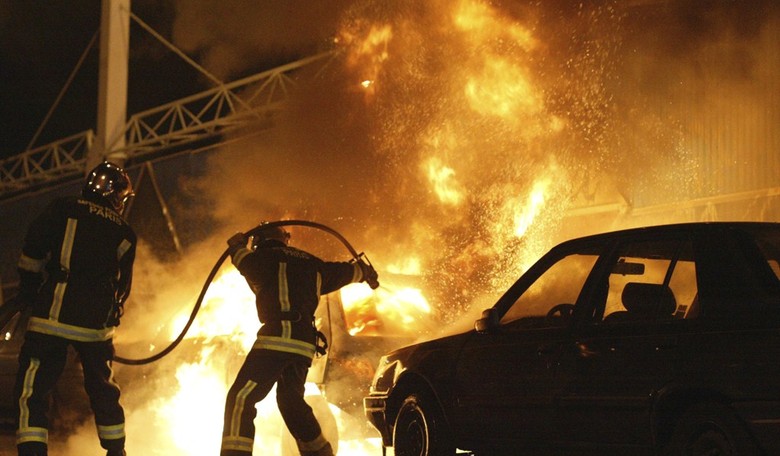
Like most of you, I've spent recent days watching Europe burn — to the accompaniment, as always, of the official soundtrack: "Diversity is our strength." Apparently, the strength in question involves setting fire to your own neighborhood while your supposed betters lecture you about "tolerance."
Paris, as I wrote yesterday, leads the program. According to the press, this month's French riots began as protests over school conditions and the economy. The demonstrations started in September, swelled into nationwide marches over living costs, fuel prices, and education funding, and turned violent on October 17. Roughly 550,000 people marched that day. Police arrested 1,200, and a police officer and a protester died. Paris and Lyon now live under nightly curfews.
Fine. Nobody's claiming the cost of living is imaginary, or that governments don't routinely botch the economy. But the official story skips one rather important question: What turns an economic grievance into a riot — and who, exactly, is doing the rioting?
President Donald Trump says the unrest is about "immigration, not schools." Vice President JD Vance argues that Western liberals imported the Third World into France and ignored the question of assimilation. Marine Le Pen blames delinquents from the banlieues, the suburbs where much of France's immigrant population lives.
French President Emmanuel Macron, naturally, dismissed the foreign commentary as "stupid comments." His officials haven't named immigration as a factor at all, preferring to point at a left-wing political party.
Ha! Well, that settles it, doesn't it? The people who designed and implemented the policies have reviewed the policies and found the policies blameless. What a remarkable coincidence.
To be fair, nobody has proven what caused any particular riot, and that takes evidence rather than political guesswork. Evidence that French policy neatly avoids. Economic misery can light the match. But somebody ought to ask why the house holds so much gasoline — and Trump and Vance are asking the question European governments have spent years dodging.
How is that evidence avoided? The French republican tradition insists on one national identity, so the government largely refuses to sort its citizens by ethnicity, and INSEE, the French statistical agency, operates under real legal restrictions on the subject. A French citizen is French. No hyphens, no ethnic boxes. No worries about who you import and no worries, either, about those who decide they don't want to be French at all, but foreign invaders.
As ideals go, it's worthwhile, if you ignore reality. Declaring everyone part of the same national community doesn't make them participate in it. You can decree national unity. You can't manufacture social cohesion by pretending the question doesn't exist. And refusing to count makes the hard questions harder, not easier.
Happily, France's own numbers say plenty without anyone guessing at ethnicity. According to INSEE, 32.8% of immigrants in metropolitan France lived below the poverty line in 2024, against 11% of people with no immigrant background. Among immigrants born in Africa, the figure hit 39.7%. Unemployment tells the same story: roughly 12% among immigrants in 2025, against about 7% for everyone else.
None of that proves immigrants cause riots, or explains why any individual is poor. It does prove France has a massive integration gap. So what does Paris plan to do about it? Tear down the barriers to work, enforce the law evenly, and insist newcomers take on the civic duties of the country they chose? Or keep insisting everything's fine until the next neighborhood goes up in smoke? The smoke rising over Paris would seem to answer that question.
Assimilation isn't a dirty word. It's how a country stays a country, instead of becoming a collection of mutually suspicious populations sharing the same GPS coordinates. And the job belongs to both the newcomers and the governments that let them in. An immigration policy that stops at the border isn't managing immigration. It's outsourcing the consequences to the next generation of taxpayers.
Unlike Paris, Rome actually counted noses. Riots on October 17 and 18 injured nearly 200 police officers across northern Italy. Prime Minister Giorgia Meloni says about half of the 330 people police detained or arrested had foreign origins — either born abroad or born in Italy to immigrant families. In Milan, 220 of the 271 people police brought in were minors. The youngest was 11.
Eleven. At that age, a boy should worry about homework, soccer, and bedtime, not about getting hauled in after a street brawl with riot police. Eh, oh well. It's a better fate than some in, say, Afghanistan have faced. (Boom!)
Meloni's government answered with up to five years in prison and €20,000 fines for violent rioting, financial liability for parents, and 500 more troops for Milan. Debate the details if you like. But at least Rome grasps that public order isn't a philosophy seminar — and that when 11-year-olds join the mob, the problem reaches past policing into families, schools, and a society's willingness to enforce basic standards.
None of this makes every immigrant a problem. That claim would be absurd. Millions of immigrants work, raise families, obey the law, and came precisely because they wanted what the West offers. They have more reason than anyone to want governments to separate the newcomers who play by the rules from the ones who don't. A government that refuses to draw that line isn't compassionate. It's negligent.
Notice the pattern. Unrest has also hit Spain, Portugal, Greece, Albania, and Belgium, and every time, officials blame living costs, unemployment, extremists, or inequality. Immigration never makes the list. But there again, why would they admit their own responsibility for the problem?
Some of those explanations hold up as far as they go. The trick lies in pretending they rule out the immigration question. They don't. Rapid population growth worsens housing shortages when construction can't keep pace. Miscalculated arrivals strain public services. Unemployment stalls integration. And culture clashes get ugly when people arrive from societies with sharply different ideas about law, religion, and personal freedom.
None of that is inevitable. All of it deserves an honest look. Even the labor data says so: in 2024, people born outside the EU had a 65.3% employment rate, compared with 71.4% for the native-born, according to Eurostat figures. Integration and assimilation don't happen on autopilot.
So why does Europe treat the question itself as an offense? Why must every discussion open with a ritual declaration that immigration has nothing to do with anything — before anyone has examined the facts? Shouting "racist" at whoever asks isn't an argument. It's an attempt to make the argument disappear.
For years, Europe's establishment has treated mass immigration as a moral achievement in and of itself. Question the scale, the pace, the selection, or the odds of assimilation, and the establishment casts you as a moral defective. The slogan does the work evidence and policy should do. Diversity becomes the goal, integration becomes optional, and enforcement becomes impolite.
But a country isn't a spreadsheet of demographic categories. It's a social contract. Citizens pay taxes, obey laws, and expect the government to protect their neighborhoods and apply the rules to everyone. When that breaks down, the costs don't land evenly. Politicians have security details. Ordinary people have to walk through the neighborhoods their leaders swear are perfectly safe.
The money works the same way. Immigration can fill labor shortages and prop up aging populations, and pretending every immigrant drains the treasury is dishonest. But so too is pretending immigration costs nothing. The grown-up approach measures both, sets realistic limits, and demands integration that works. Europe's leaders chose a different plan: import the population, ignore the problems, and blame the voters when they complain. Not unlike the American left. It's as if they all drank from the same drugged party bowl.
Voters notice the gap between what their leaders promise and what they live. That gap breeds political movements. Sometimes it breeds something worse: Britain's 2024 riots after the Southport stabbings, Northern Ireland's arson spree this past June, and Spain's anti-migrant violence in Torre-Pacheco last year all show what happens when people decide nobody in charge is listening. None of that is excusable. All of it was predictable.
Europeans and Americans alike are asking whether their governments remember whose interests they serve, whether national identity means anything beyond a passport, and whether a country can expect newcomers to adapt to it rather than the reverse. Macron calling those questions "stupid" won't make them go away, nor will American pols screaming "racism" and "fascism."
Now, how many of you, I wonder, see our own country being lured into the same trap that Europe is in?
= = =
Thought for the Day: A slogan is what a government recites once it stops counting in the eyes of the citizens.
VIP members: Your comments please. Don't hold back. Your voice matters.
Take care, gang. I'll be here tomorrow, and I hope you will be as well. See you then.