
The problem with the discursive fields of commentary, expository scholarship, the misnamed “social sciences,” theology and the humanities in general (with the exception of music, which is built on mathematical ratios) is the inevitability of bias, prior convictions, and partisan viewpoints that can never be ruled out. Of course, this is true of the scientific community as well, but there is a difference. There are strongly held personal convictions, ruthless competition for Nobel Prizes, and considerable bickering in science, but eventually incontestable fact, if not absolute truth, will emerge. Two plus two will always equal 4, but the poet e. e. cummings can plausibly title a volume is 5.
Foundational truths are another matter. Science can rise no further into indisputable and primordial questions of origin and meaning than religious, philosophical, and poetic thought. This does not imply that the quest for truth has recused itself from the court of radical inquiry. The discursive writers’ guild is also, like the scientific community, searching for truth. But in the human sphere of culture, politics, society and history, the quest for truth is nearly always shadowed by degrees of contestable evidence and by the intrusion of personal values and beliefs whose moral component is never fully assured. Squabbles and rows are part of the game.
The distinction between the two spheres of investigation, science and the humanities, is commonly construed as the difference between objective methodology and subjective parallax. True, serious philosophy is mitochondrial and good poetry will usually deal with issues of considerable gravity. But neither is now taken as a valuable contribution to modern thought. In Twilight of the Idols, Friedrich Nietzsche viewed philosophy as a sure sign of cultural decline. And when W.H. Auden in his elegy for William Butler Yeats wrote “Poetry makes nothing happen,” he did not mean that poetry creates the hyperactive quantum vacuum, obviously, but the fact that poetry is no longer a going concern in the modern world. It’s a truth, and a grave one. But what I’m getting at is that felt truth, even if valid, is not the same as analytic or deductive truth. This is the gravamen of C.P. Snow’s The Two Cultures—and yet, the gulf is not as wide as he imagined.
As I have been at pains to indicate, the religious posture or demeanor, when it is genuine, is a cry for the absolute, for the origin and meaning of the vast drama in which we are both actor and spectator. This is also true of science, which is equally animated by a spirit for understanding what we happen to be involved in as we thread our way, as observers and participants, in this incredible theater of the universe.
Not everyone is in agreement. In The Meaning of it All, Richard Feynman famously said that “The stage is too big for the drama.” Many cosmologists I am familiar with do not seem to give Feynman much assent on this matter. Mind is an essential component of the miracle we are part of, ingeminated in the universe. Even if ultimate truth continues asymptotically to recede, even if science is never settled, which is as it should be, the quest for reliable knowledge is authentic, impartial, scrupulous, never-ending, and honorable, producing disparate but incontrovertible results in various fields of inquiry that can test true or false, as evidenced by practical applications. The stage incorporates the play.
We may not get to the Playwright, but we do learn about some of His tricks and techniques. That’s why the Infinity Principle works in calculus. That’s why your GPS works. That’s why almost every appliance you take for granted works. Such facts, or designated truths, account for the basic morality of scientific inquiry, its adherence so far as possible to truth, its “ethical importance” wedded to veracity, as Erwin Schrödinger writes in My View of the World, and which he regards as no less compelling than its “logical force.”
Related: Calculus: A Light Refresher
It’s a vexed issue, but we can say this. The great distinction of science is that it is impossible to lie and get away with it indefinitely. Science is the study of nature and nature does not lie. One may misconstrue, misinterpret, or outright lie about nature—physical nature (Lysenkoism), human nature (Communism, et al.)—but nature’s truth will eventually and always come home to roost. True science is nature’s famulus and mirror: it does not lie. It may not cover the entire field of potential knowledge, but this is a constraint imposed by reality, not a lie by omission.
We are speaking of real science as opposed to politicized science. Science is as close as we can get to truth, which exerts its own species of intellectual and spiritual gravity. That is why, perhaps, science honorably pursued may be as close as we can get to God, or at least toward understanding the works of the universe, if not of God Himself. But there are times when poetry can get there, too.
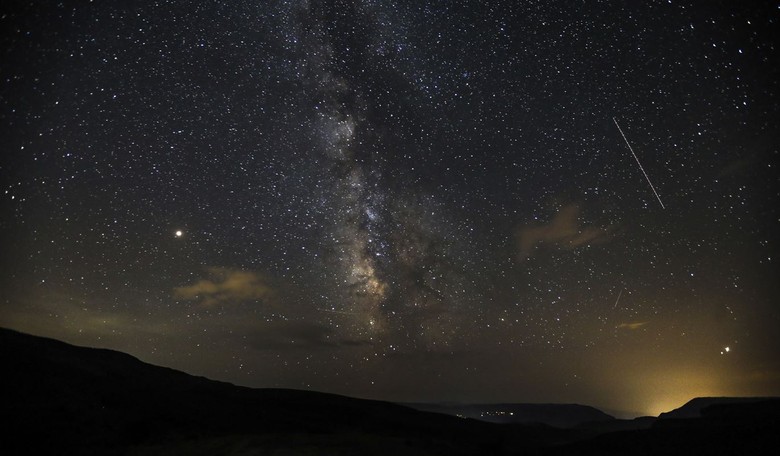
A beautiful poem by Greek Philosopher Parmenides of Elea , titled "Peri physeōs" ("On Nature") circa 475 BC, is a hymn to the Creation and the joy of knowing its works and composition. It sums up the thought perfectly. (I translate freely fragments 10/11 and preserve galaxías kýklos, Milky Circle, or Milky Way, for its lovely sonority.)
And you shall know the whole of the sky, and all the
figures therein,
and the splendid works of the burning sun’s pure
torch, and how they came to be.
And you shall learn as well of the wandering deeds of
the orbiting moon,
and of her glory. You shall know, too, the heavens
that encircle us with light,
how they came to be, and how Truth took them and
bound them to keep the rightful limits of the stars,
how the earth, and the sun, and the moon,
and the heaven that is a gift to all, and the kýklos galaxías, and
Olympos that is the home of Truth,
and the celestial might of the stars,
how all these came to be.
Εἴσῃ δ' αἰθερίαν τε φύσιν τά τ' ἐν αἰθέρι πάντα
σήματα καὶ καθαρᾶς εὐαγέος ἠελίοιο
λαμπάδος ἔργ' ἀίδηλα καὶ ὁππόθεν ἐξεγένοντο,
ἔργα τε κύκλωπος πεύσῃ περίφοιτα σελήνης
καὶ φύσιν, εἰδήσεις δὲ καὶ οὐρανὸν ἀμφὶς ἔχοντα
ἔνθεν ἔφυ τε καὶ ὥς μιν ἄγους΄ ἐπέδησεν Ἀνάγκη
πείρατ' ἔχειν ἄστρων.
πῶς γαῖα καὶ ἥλιος ἠδὲ σελήνη
αἰθήρ τε ξυνὸς γάλα τ' οὐράνιον καὶ ὄλυμπος
ἔσχατος ἠδ' ἄστρων θερμὸν μένος ὡρμήθησαν
γίγνεσθαι.