
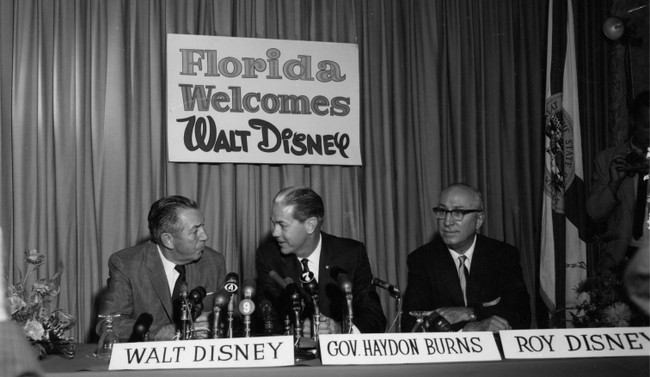
Sixty years ago this week, Walt Disney made his final appearance on film in a short that explained to Florida’s movers and shakers what his company’s acquisition of land would bring to the central part of the state. “The EPCOT Film,” which the company showed to Sunshine State businesspeople and politicians in 1967, laid out a bold, optimistically futuristic vision, and while what we know today as Epcot isn’t quite the same as what Walt had in mind, it’s still inspiring six decades later.
The EPCOT concept, as well as my memories of early EPCOT Center, still excites me. I listen to the soundtrack from those golden days every week while I'm working.
Sadly, Walt went to the hospital a few weeks after filming this short, and he died of lung cancer on Dec. 15, 1966. In honor of his last filmed appearance on Oct. 27, 1966, here’s a slightly updated version of a piece I wrote here at PJ Media way back in 2013.
Many visions of the future — from 1984 to Silent Spring to Blade Runner to After Earth — lead us to believe a bleak, gray-skied world awaits. The prevailing theme of dystopian futurists is that we and the generations to follow are going to destroy our society or our planet because of our greed. Most futurists view the world through a cynical, grim prism, and optimistic futurists come few and far between. One of them left his mark on the world in a most indelible way — Walt Disney.
When many people think of Disney, they feel nostalgia, fantasy, and escapism, but in reality, Walt possessed a strong vision for making the future better than the present. He believed that technology and free enterprise held the key to a positive future.
Walt’s futuristic dreams began to manifest themselves in the science-fiction-crazy 1950s. On the Disneyland television series, he devoted entire episodes to the conquest of space, landing on the moon, going beyond the moon, and using satellites to improve life on Earth. He and director Ward Kimball worked with leading lights of the scientific community such as Wernher von Braun and Willy Ley to create diagrams and dramatizations of potential space travel that even predate NASA — and what ended up on the screen resembled actual space travel in surprising ways!
When Walt opened Disneyland in 1955, the Tomorrowland area of the park took place in 1986! For Disney and the Imagineers, the future was wide open and buzzed with kinetic energy. New and innovative transportation systems made their debut there. The Disneyland Monorail was unlike anything guests had seen. The WEDWay People Mover, which we now call the Tomorrowland Transit Authority, employed linear induction technology to move guests around quietly and using only electricity. Both transportation systems leave a unique impression on guests even today.
When the organizers of the 1964-65 New York World’s Fair approached Disney about developing exhibits, Walt saw the fair as an opportunity to show how thrilling the future could be. One exhibit in particular, General Electric’s Carousel of Progress, took a look at the technological innovations of the past and dared to glance at what technology could do for the future. Richard and Robert Sherman provided the soundtrack for the attraction with their giddily optimistic tune “There’s A Great Big Beautiful Tomorrow.” The attraction moved to Walt Disney World in the 1970s and underwent a few changes. The Carousel of Progress still spins today at the Magic Kingdom, although it’s currently closed because it’s getting a long-overdue makeover for 2027.
Read the Whole Series: Disney and the 1964-65 New York World’s Fair, Part 6: 'A Living Blueprint Of The Future'
As the sprawl of metropolitan Los Angeles closed in on Disneyland’s landlocked space, Walt sought to take his grand futuristic visions to the next level. He wanted to solve the problem of tacky urban blight, and he sought “the blessing of size” to allow those dreams to become a reality. The company stealthily bought up 33 square miles of land in central Florida for his most ambitious idea yet, and it encompassed more than just a theme park:
I don’t believe there is a challenge anywhere in the world that’s more important to people everywhere than finding solutions to the problems of our cities.
But where do we begin? How do we start answering this great challenge? Well, we’re convinced we must start with the public need. And the need is not just for curing the old ills of old cities. We think the need is for starting from scratch on virgin land and building a special kind of new community.
Of course, the Florida Project would include a theme park, modeled after Disneyland but having its own distinct character and flavor. But the jewel in the crown of the Florida Project was a model city Walt called EPCOT — Experimental Prototype Community of Tomorrow. This community would include a climate-controlled, vibrant downtown area under a glass dome and a pedestrian-friendly suburban space with monorails and People Movers to shuttle residents back and forth throughout the city and to the theme park. Disney would invite the best and brightest of American industry to build plants there and test their products among residents.
In October 1966, Walt himself outlined the concept in his last appearance on film, “The EPCOT Film.”
Yes, the EPCOT idea sounds too good to be true, and, sadly, it died with Walt in December 1966. After Walt Disney passed away, the Imagineers didn’t really know how far to go with his vision of a planned community. Walt’s brother Roy tabled the idea altogether, and the company focused on the theme park, which became Walt Disney World’s Magic Kingdom.
The Magic Kingdom itself boasted some futuristic innovations: a pneumatic trash collection system, a series of underground tunnels for cast member use, new ride and parade control programs, and a filtration project that used water hyacinths to clean wastewater. One of the hotels, the Contemporary Resort, embodied sleek, futuristic design. Disney even put the monorail system and the People Movers to use in Florida.
Flashback: The Evolution of EPCOT Through The Eyes of Preview Films
Eleven years after the Magic Kingdom’s debut, EPCOT finally opened on Oct. 1, 1982, albeit in a much different format. The Imagineers under the leadership of Disney CEO Card Walker chose to keep the spirit of EPCOT alive within the structure of a second theme park in Florida.
One half of the park celebrated the cultures of the world, with native college students working in painstaking replicas of their country’s most beautiful areas, while the other half looked to the future, identifying problems in our world and devising innovative solutions. The company made certain to the public that EPCOT Center (as it was known in its early days) was a theme park unlike any other.
EPCOT Center’s attractions continued to display Walt’s vision of a thrilling future through human cooperation, industry, and capitalism (most of the attractions had corporate sponsors). Spaceship Earth celebrated how communication can bring people together. Universe of Energy explored alternatives to fossil fuels. Horizons looked at exciting possibilities for the 21st century. World of Motion examined transportation. Journey into Imagination took a glance at creativity. The Land analyzed man’s relationship to the land around him and demonstrated new farming techniques. The Living Seas contained, at the time of its opening, the world’s largest aquarium. Communicore, later Innoventions, highlighted new technologies and ideas that are just around the corner. Though the park sometimes took its subject matter too seriously in the early days, the Imagineers have added humor and whimsy to many of the attractions over the years.
Flashback: Horizons: Walt Disney's Lost Futuristic Legacy
So where does Walt Disney’s brand of optimistic futurism stand today? You can still see it best in the parks. The Carousel of Progress still runs in Florida’s Tomorrowland, and, though it’s a bit dated, the attraction still has its followers. Spaceship Earth, The Land, and The Living Seas have undergone changes that reflect changing times and new Disney characters. Universe of Energy now inexplicably houses a Guardians of the Galaxy-themed attraction that, as far as I know, has nothing to do with the challenges of the energy sector, while Journey into Imagination desperately needs updating. Mission: SPACE and Test Track have replaced Horizons and World of Motion, respectively.
The town of Celebration, Fla., just south of the parks and resorts, represents the closest thing to Walt’s urban vision, yet it is still a more traditional town. Though the Imagineers have tempered some of the more naive aspects of Walt’s vision, they have remained quite true to his idea of futurism.
Walt Disney’s friend Ray Bradbury — no stranger to futurism himself – once spoke about Disney’s legacy of optimistic futurism:
Everyone in the world will come to these gates. Why? Because they want to look at the world of the future. They want to see how to make better human beings. That’s what the whole thing is about. The cynics are already here and they’re terrifying one another. What Disney is doing is showing the world that there are alternative ways to do things that can make us all happy. If we can borrow some of the concepts of Disneyland and Disney World and Epcot, then indeed the world can be a better place.
Bradbury got it right. Cynics will always find something negative to look to about the future. The world around us can make us jaded about what may be in store for us. But when I walk through the gates of Walt Disney World — especially Epcot — I sense a palpable excitement about what can be in the future. Give me the optimistic futurism of Walt Disney over cynicism and grimness any day.