
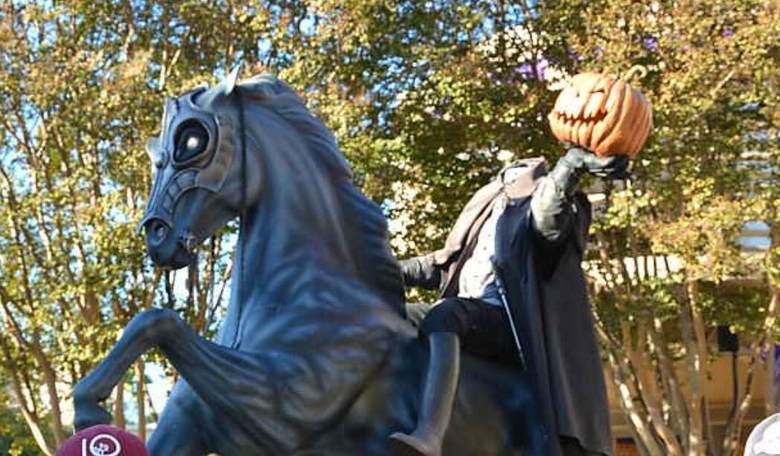
Saturday is All Hallows’ Eve, and perhaps the 250th anniversary of the Headless Horseman galloping into legend. Did you know that one of the most famous Halloween spooks has a connection to the American Revolution in 1776?
Washington Irving’s “The Legend of Sleepy Hollow” blends history and myth so masterfully that the Headless Horseman remains one of the most iconic ghouls of Americans’ celebrations for the ghostly eve (Hallowe’en) before All Saints Day. Partly that’s because Walt Disney adapted the ghost tale for film, earning the Headless Horseman his place in the Disney classics canon. But before the Galloping Hessian of the Hollow appeared in candy commercials, Hollywood movies, or theme park parades, he cantered through the faded tombstones of the Old Dutch Cemetery in Tarrytown, N.Y. And the origin of his haunting is supposed to be a grisly event at the Oct. 28, 1776, Battle of White Plains.
If you’ve never read Irving’s original legend, it’s perfect Halloween reading, and an entertaining mix of satire, history, and horror. We do not know for certain if the legend of the Horseman dates all the way back to 1776, if it was a story that Irving — who lived near Tarrytown — heard and adapted to his own purposes, or if he invented it entirely after doing some local research into history and fantasy. The old Dutch settlers of that part of New York were supposed to be rather superstitious and delighted in ghost tales, especially if they could connect them to specific executions or battles. But we do have a pretty good idea of who the real-life inspiration for the Horseman is, as the New-York Historical Society noted.
For Our VIPs: A Halloween Tribute to Patrick Stewart: ‘The Canterville Ghost’
First, here is Irving’s description of the Horseman, as old Dutch housewives provided in their story to their new Yankee schoolmaster Ichabod Crane:
"It is said by some to be the ghost of a Hessian trooper, whose head had been carried away by a cannon-ball, in some nameless battle during the [R]evolutionary war; and who is ever and anon seen by the country folk, hurrying along in the gloom of night, as if on the wings of the wind…he sometimes passes along the Hollow, like a midnight blast."
Now contrast that to a passage in Maj. Gen. William Heath‘s memoir: “A shot from the American cannon at this place [White Plains] took off the head of a Hessian artillery man.”
The Battle of White Plains, as I mentioned above, occurred only a few days before Halloween during that crucial year of the American Revolution exactly two and a half centuries ago. Unfortunately, the Americans, although inflicting higher casualties on their Hessian and British enemies, were outnumbered and under-supplied, and had to retreat. It was a discouraging defeat for the Americans, but they would make a spectacular comeback at Trenton in December.
Read More: America 250, White Plains: Patriots of 1776 Survived Many Setbacks to Save the Cause
The schoolmaster Crane supposedly came to Tarrytown already obsessed with ghost stories and found another consuming passion in the wealthy, beautiful Katrina Van Tassel. His courtship arousing the ire of local suitor Brom Bones, the latter decided to get his revenge upon Crane by terrifying him at a Van Tassel party with a graphic description of his encounter with the Galloping Hessian of the Hollow. According to Irving, Crane was on his way home from the party when, to his horror, he perceived an apparently headless horseman pursuing him. Crane managed to get his old horse to do a breakneck dash across the church bridge, only to be knocked down by the horseman’s severed head, hurtling after him. Bones wed Katrina, and the people of Tarrytown never afterwards saw Crane, which the old Dutch wives insisted on attributing to the Headless Horseman.
In the 1940s, Walt Disney decided this was a wonderful story to put in an animated film, “The Adventures of Ichabod and Mr. Toad.” With Bing Crosby, the most popular star of that era, providing the narration and singing, the retold ghost story became a classic of film as it had been of literature. And now, every year, Disney Parks call upon the Headless Horseman to ride out of the realm of historical fantasy to alarm and delight new generations of Americans.To this day, you can still visit the New York cemetery the horseman once haunted, and even see the colonial tombstone of Catriena Van Tassel, inspiration for the Katrina of Irving’s legend. The wooden bridge is long gone, but a marker tells you where Ichabod Crane raced for his life from the Hessian of the Hollow, very close to where Irving himself has his final resting place. Tarrytown still has a quaint atmosphere and on gloomy days or during the month of October, just as Irving said, it even now seems under the “sway of some witching power.” And it always will, so long as the Galloping Hessian of the Hollow pursues his ghostly course through the American imagination.